
Inquiry · Inquiry in organisations
Psychological Safety and the Freedom to Ask Questions
People ask fewer questions when asking feels risky. This article explains psychological safety, what research shows about its effects on learning and performance, why employees stay silent, and what leaders can do to make it safe to ask, challenge and admit what they do not know.
A question can be a risky act. Asking one may reveal that you do not know something you are expected to know. Challenging a decision may be taken as disloyalty. Pointing out a problem may make you responsible for it. In many workplaces, people weigh these risks quickly and silently, and often decide that saying nothing is the safer course. The result is that organisations lose access to the knowledge and doubts of their own people. Research on psychological safety explains when people feel free to ask questions and speak up, what difference it makes and how it can be built.
What psychological safety is
The idea was first discussed by Edgar Schein and Warren Bennis (1965), who argued that people need to feel secure before they can accept the uncertainty and anxiety involved in learning and change. William Kahn (1990) later described psychological safety as one of the conditions under which people engage fully at work: a sense of being able to show oneself without fear of negative consequences to self-image, status or career.
Amy Edmondson (1999) defined team psychological safety as a shared belief that the team is safe for interpersonal risk-taking. It is a property of the group, not just of individuals, and it describes a climate of mutual respect and trust in which people are comfortable being themselves. Edmondson stressed that psychological safety is not the same as being nice or lowering standards. It means that people can raise difficult issues without fear of humiliation or punishment, which often makes conversations more candid, not less.
What the evidence shows
Edmondson (1999) studied 51 teams in a manufacturing company and found that teams with higher psychological safety engaged in more learning behaviour: asking questions, seeking feedback, experimenting, reflecting on results and discussing errors. Learning behaviour, in turn, was associated with better team performance.
An earlier study had produced a surprising result. In research on hospital nursing units, Edmondson found that the better-led teams appeared to make more medication errors. On closer investigation, the difference was in reporting, not in errors: in teams where people felt safe, errors were reported and discussed; elsewhere, they were hidden (Edmondson, 2018). The measure of error was really a measure of how freely people could speak.
The research has since grown substantially. Frazier et al. (2017) conducted a meta-analysis of 136 studies and found that psychological safety was positively related to information sharing, learning behaviour, task performance, employee engagement and satisfaction. Newman et al. (2017) reviewed the literature and identified leadership behaviour, supportive relationships and team characteristics as its most consistent antecedents. A large internal study at Google, reported by Charles Duhigg (2016), found that psychological safety was the most important of the factors distinguishing its more effective teams.
Edmondson et al. (2001) studied how surgical teams learned to use a new technique for cardiac surgery. Teams that adopted it successfully were those in which the surgeon explicitly invited input from nurses and other team members and made it clear that their observations were needed. In teams where traditional hierarchies were maintained, junior members were reluctant to speak, and the new routine was adopted more slowly or abandoned.
Why people stay silent
Psychological safety matters because the default in many organisations is silence. Milliken et al. (2003) interviewed employees about issues they had not raised with their managers. Most could recall such issues, ranging from concerns about colleagues' performance to disagreements with company policy and suggestions for improvement. The most common reasons for silence were fear of being seen negatively, as a troublemaker or complainer, and a belief that speaking up would make no difference.
James Detert and Amy Edmondson (2011) found that employees hold implicit voice theories: taken-for-granted beliefs about when speaking up is risky. Examples include "do not challenge the boss in public", "do not speak up without solid data" and "do not embarrass the boss by pointing out problems in their area". These beliefs led people to stay silent even in organisations where managers said they welcomed input. Elizabeth Morrison (2014) reviewed research on employee voice and silence and concluded that people weigh both the likely effectiveness and the likely risks of speaking up, and stay silent when either looks unfavourable.
Asking for help or information carries its own risks. Fiona Lee (1997) found that people were less likely to seek help when doing so might make them appear incompetent, particularly in settings where status and power mattered. Yet the perceived risk is often exaggerated. Brooks et al. (2015) found that people who asked for advice were seen as more competent, not less, as long as the task was difficult and the advice was sought from the person judging them. Huang et al. (2017) found that people who asked more questions in conversation, particularly follow-up questions, were better liked by their partners. These findings suggest that many people avoid questions out of a fear that is not justified by how others actually respond.
Hierarchy and status
Silence is most pronounced across differences in status. Nembhard and Edmondson (2006) studied neonatal intensive care units and found that psychological safety was lower among professions of lower status, such as nurses and respiratory therapists, than among doctors. However, when leaders were inclusive, inviting and appreciating others' contributions, the gap narrowed. Detert and Burris (2007) found that employees were more likely to speak up when their managers were open to their input and when they believed their ideas would be acted on, more so than in response to general leadership styles.
Aviation offers a well-known example of changing these dynamics. Analyses of accidents in the 1970s found that junior crew members sometimes noticed errors but did not challenge the captain effectively. Airlines responded with crew resource management training, which taught crew members to raise concerns assertively and captains to invite and respond to them. Helmreich et al. (1999) described how this training evolved and became standard throughout commercial aviation. Wider cultural factors also play a role. Geert Hofstede (2001) described differences between national cultures in power distance, the extent to which less powerful members accept that power is distributed unequally, which may affect how readily people question those above them.
Safety and standards
A common concern is that psychological safety will lower performance by making people too comfortable. Edmondson (2018) argued that psychological safety and high standards are separate dimensions, and that both are needed. Figure 1 shows the combinations.
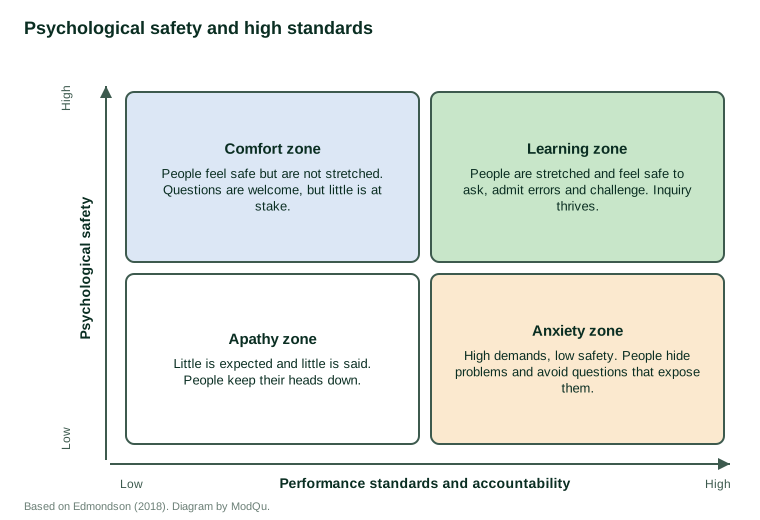
When safety is high but standards are low, people are comfortable but not challenged. When standards are high but safety is low, people are anxious and hide problems. Inquiry and learning flourish when both are high. There is some evidence that psychological safety can have costs when standards are absent. Deng et al. (2019) found that a strong climate of psychological safety could, in some conditions, be associated with reduced effort, as well as with more voice and learning. The lesson is not that safety is harmful, but that it must be combined with clear expectations.
Measuring psychological safety
Because psychological safety is a shared belief, it can be measured by asking team members about their experience. Edmondson (1999) developed a short questionnaire with seven statements, such as "If you make a mistake on this team, it is often held against you", "Members of this team are able to bring up problems and tough issues" and "It is safe to take a risk on this team". Respondents rate their agreement, and the answers are averaged across the team. Newman et al. (2017) found that this scale, or adaptations of it, has been used in most published studies.
Measurement has practical value. Because psychological safety varies between teams within the same organisation, an organisation-wide average can hide teams in which people feel unable to speak. Measuring at team level, and repeating the measurement over time, shows where attention is needed and whether changes in leadership behaviour are making a difference. The results should be handled with care: a survey about whether it is safe to speak up will itself be answered honestly only if people trust that their responses will not be used against them.
Building psychological safety
Edmondson (2018) described three sets of actions leaders can take.
Setting the stage. Leaders can frame work as a learning problem rather than an execution problem, stating explicitly that the situation is uncertain and that everyone's input is needed. They can explain why voices matter, so that speaking up is understood as a contribution rather than a complaint.
Inviting participation. Leaders can model humility by acknowledging what they do not know, and ask genuine questions. Edgar Schein (2013) called this humble inquiry: asking questions to which you do not already know the answer, with real interest in the response. Leaders can also create structures for input, such as asking each person in a meeting for their view, or setting aside time to discuss risks and doubts.
Responding productively. The way leaders respond when people speak up determines whether they will speak again. Expressing appreciation, treating bad news as useful information and responding to failure with support and inquiry, rather than blame, all reinforce safety. Edmondson and Lei (2014) noted that psychological safety can be destroyed quickly by a single dismissive or punitive response, and rebuilt only slowly.
Psychological safety in research teams
Research teams have particular reasons to care about psychological safety. Analysts may notice errors in data, weaknesses in methods or results that contradict what senior colleagues expect. Each of these requires someone to say something uncomfortable. In a team where it is unsafe to question a senior analyst's approach, flawed analyses may go forward unchallenged.
A hypothetical example illustrates the point. A junior analyst on a market research team notices that a key survey question was worded in a way that may have led respondents towards a particular answer. The project is near completion, and the finding has already been presented informally to the client. In a team with low psychological safety, she might decide that raising the concern now would be embarrassing for her manager and pointless, and say nothing. In a team where her manager has made clear that catching problems is valued, she raises it at once. The team runs a short follow-up with neutral wording, finds that the effect is smaller than reported and corrects the result before the final report. The cost of the correction is small; the cost of the error, had it reached the client's decisions, could have been large.
Practical steps
- Say explicitly that questions and concerns are wanted, and explain why.
- Ask before telling. Leaders who speak last hear more.
- Thank people who raise problems, even when the problem turns out to be minor.
- Separate learning reviews from performance evaluations, so that discussing errors does not feel like a disciplinary process.
- Watch for status gaps. Make a point of inviting input from junior or quieter members.
- Keep standards high. Safety is not an alternative to accountability, but the condition that allows people to meet high standards honestly.
Conclusion
The freedom to ask questions is not a personal trait that some employees happen to have. It is largely a product of the environment created by leaders and colleagues. Research on psychological safety shows that when people believe it is safe to speak, they ask more questions, report more errors, share more information and learn faster, and their teams perform better. When they do not, silence hides the problems an organisation most needs to know about. Building psychological safety is therefore one of the most direct ways to strengthen an organisation's capacity for inquiry.
References
Brooks, A. W., Gino, F., & Schweitzer, M. E. (2015). Smart people ask for (my) advice: Seeking advice boosts perceptions of competence. Management Science, 61(6), 1421–1435. https://doi.org/10.1287/mnsc.2014.2054
Deng, H., Leung, K., Lam, C. K., & Huang, X. (2019). Slacking off in comfort: A dual-pathway model for psychological safety climate. Journal of Management, 45(3), 1114–1144. https://doi.org/10.1177/0149206317693083
Detert, J. R., & Burris, E. R. (2007). Leadership behavior and employee voice: Is the door really open? Academy of Management Journal, 50(4), 869–884. https://doi.org/10.5465/amj.2007.26279183
Detert, J. R., & Edmondson, A. C. (2011). Implicit voice theories: Taken-for-granted rules of self-censorship at work. Academy of Management Journal, 54(3), 461–488. https://doi.org/10.5465/amj.2011.61967925
Duhigg, C. (2016, February 25). What Google learned from its quest to build the perfect team. The New York Times Magazine.
Edmondson, A. (1999). Psychological safety and learning behavior in work teams. Administrative Science Quarterly, 44(2), 350–383. https://doi.org/10.2307/2666999
Edmondson, A. C. (2018). The fearless organization: Creating psychological safety in the workplace for learning, innovation, and growth. Wiley.
Edmondson, A. C., Bohmer, R. M., & Pisano, G. P. (2001). Disrupted routines: Team learning and new technology implementation in hospitals. Administrative Science Quarterly, 46(4), 685–716. https://doi.org/10.2307/3094828
Edmondson, A. C., & Lei, Z. (2014). Psychological safety: The history, renaissance, and future of an interpersonal construct. Annual Review of Organizational Psychology and Organizational Behavior, 1, 23–43. https://doi.org/10.1146/annurev-orgpsych-031413-091305
Frazier, M. L., Fainshmidt, S., Klinger, R. L., Pezeshkan, A., & Vracheva, V. (2017). Psychological safety: A meta-analytic review and extension. Personnel Psychology, 70(1), 113–165. https://doi.org/10.1111/peps.12183
Helmreich, R. L., Merritt, A. C., & Wilhelm, J. A. (1999). The evolution of crew resource management training in commercial aviation. The International Journal of Aviation Psychology, 9(1), 19–32. https://doi.org/10.1207/s15327108ijap0901_2
Hofstede, G. (2001). Culture's consequences: Comparing values, behaviors, institutions, and organizations across nations (2nd ed.). Sage.
Huang, K., Yeomans, M., Brooks, A. W., Minson, J., & Gino, F. (2017). It doesn't hurt to ask: Question-asking increases liking. Journal of Personality and Social Psychology, 113(3), 430–452. https://doi.org/10.1037/pspi0000097
Kahn, W. A. (1990). Psychological conditions of personal engagement and disengagement at work. Academy of Management Journal, 33(4), 692–724. https://doi.org/10.5465/256287
Lee, F. (1997). When the going gets tough, do the tough ask for help? Help seeking and power motivation in organizations. Organizational Behavior and Human Decision Processes, 72(3), 336–363. https://doi.org/10.1006/obhd.1997.2746
Milliken, F. J., Morrison, E. W., & Hewlin, P. F. (2003). An exploratory study of employee silence: Issues that employees don't communicate upward and why. Journal of Management Studies, 40(6), 1453–1476. https://doi.org/10.1111/1467-6486.00387
Morrison, E. W. (2014). Employee voice and silence. Annual Review of Organizational Psychology and Organizational Behavior, 1, 173–197. https://doi.org/10.1146/annurev-orgpsych-031413-091328
Nembhard, I. M., & Edmondson, A. C. (2006). Making it safe: The effects of leader inclusiveness and professional status on psychological safety and improvement efforts in health care teams. Journal of Organizational Behavior, 27(7), 941–966. https://doi.org/10.1002/job.413
Newman, A., Donohue, R., & Eva, N. (2017). Psychological safety: A systematic review of the literature. Human Resource Management Review, 27(3), 521–535. https://doi.org/10.1016/j.hrmr.2017.01.001
Schein, E. H. (2013). Humble inquiry: The gentle art of asking instead of telling. Berrett-Koehler.
Schein, E. H., & Bennis, W. G. (1965). Personal and organizational change through group methods: The laboratory approach. Wiley.