
Inquiry · Inquiry in organisations
Appreciative Inquiry: Asking What Works
Appreciative inquiry studies what works in an organisation, rather than what is broken, and uses those findings to design change. This article explains its principles and the 4-D cycle, what the evidence shows about when it succeeds, and the criticisms it has attracted.
Most organisational inquiry starts with a problem. Something is going wrong, and the task is to diagnose it and fix it. Appreciative inquiry reverses the starting point. It asks what is working well, when the organisation has been at its best and what made those moments possible, and it uses the answers to design the future. Developed in the 1980s, it has become one of the most widely used approaches to organisational change. This article explains its ideas, describes its standard process and reviews what the evidence says about its strengths and limits.
Origins and principles
Appreciative inquiry began with the doctoral research of David Cooperrider at Case Western Reserve University. While studying a hospital, Cooperrider and his supervisor Suresh Srivastva noticed that the staff became far more engaged when asked about the organisation's successes than when asked about its problems. Cooperrider and Srivastva (1987) argued that the problem-solving approach to organisational research tends to reproduce the problems it studies, because it focuses attention on deficits. They proposed instead an inquiry that would search for the best in an organisation and use it to generate new possibilities.
The approach drew on the work of Kenneth Gergen (1978), who argued that social science should aim to be generative: to challenge assumptions and open up new possibilities for action, not only to describe what already exists. It also has roots in the action research tradition of Kurt Lewin (1946), in which inquiry and change proceed together, with the people affected taking part in both.
Cooperrider and Whitney (2005) set out five principles that underlie the approach:
- The constructionist principle. Organisations are shaped by the conversations and shared meanings of the people in them.
- The principle of simultaneity. Inquiry is itself an intervention. The questions asked begin to change the organisation at the moment they are asked.
- The poetic principle. An organisation's story can be read and told in many ways, and the choice of what to study shapes what is found.
- The anticipatory principle. Images of the future guide present action. A positive image of the future tends to draw an organisation towards it.
- The positive principle. Change is sustained by positive emotion, hope and a sense of shared purpose.
The anticipatory principle echoes research on expectancy effects. Rosenthal and Jacobson (1968) reported that teachers' expectations of their pupils influenced the pupils' progress, and Dov Eden (1990) found similar effects of managers' expectations on employee performance. The positive principle draws on research such as Barbara Fredrickson's (2001) broaden-and-build theory, which holds that positive emotions broaden people's range of thought and action and help them build lasting resources.
The 4-D cycle
Appreciative inquiry is usually organised around a cycle of four phases, shown in Figure 1. The process begins by choosing an affirmative topic: a positively framed statement of what the organisation wants more of. Instead of studying "why customers complain", for example, a team might study "exceptional customer experiences".
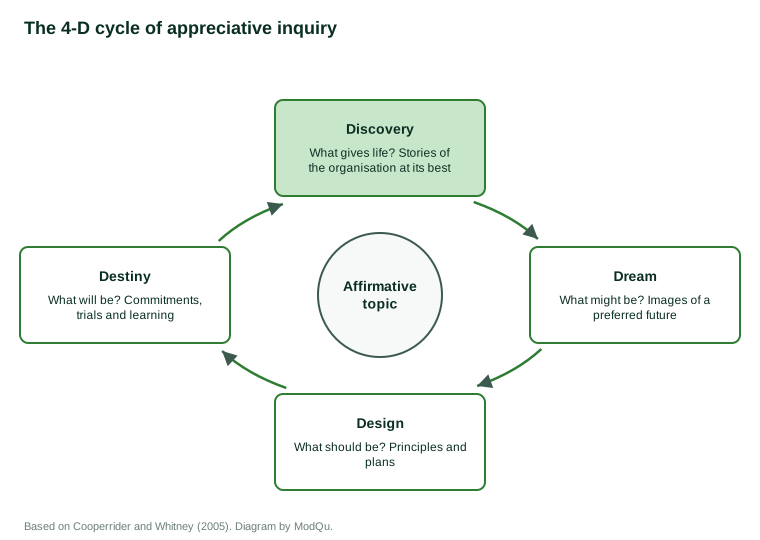
Discovery. Participants interview one another, often in pairs, using questions designed to bring out stories of the organisation at its best. A typical question asks the person to describe a time when they felt most engaged or proud of their work, and what made it possible. The stories are shared, and common themes are identified.
Dream. Participants use the themes to imagine what the organisation could become if those best moments were the norm. The dream phase often takes place in large group sessions involving many parts of the organisation.
Design. Participants write statements describing the organisation they want, sometimes called provocative propositions, and decide what structures, processes and relationships would make them real.
Destiny. Also called delivery, this phase turns the designs into action. Participants commit to initiatives, try them out and continue to learn, often returning to the cycle as new questions arise. Whitney and Trosten-Bloom (2010) describe many examples of this process in businesses, public bodies and communities.
What the evidence shows
Appreciative inquiry has been the subject of many case reports, but rigorous evaluations are fewer. Gervase Bushe and Aniq Kassam (2005) analysed 20 published cases and found that only seven produced transformational change, by which they meant a qualitative shift in the organisation's identity or way of operating. The transformational cases had two features in common. They focused on changing how people thought, generating new ideas and knowledge, rather than simply on changing what people did. And they used an improvisational approach to the destiny phase, encouraging people to act on new ideas themselves, rather than relying on centrally planned implementation.
Studies in health care suggest similar conclusions. Trajkovski et al. (2013) reviewed the use of appreciative inquiry to improve health services and found it could increase staff engagement and support practical improvements, while noting that the quality of evaluation in many studies was limited. Jan Reed (2007) argued that appreciative inquiry can be a legitimate research method as well as a change technique, provided its procedures for gathering and interpreting stories are made explicit.
A related approach, positive deviance, studies individuals or groups who achieve unusually good results with the same resources as others, and spreads their practices. Pascale et al. (2010) describe applications ranging from child nutrition to hospital infection control. Like appreciative inquiry, it treats existing successes as the best source of solutions.
Criticisms
Appreciative inquiry has attracted several criticisms. The most common is that its focus on the positive can suppress legitimate concerns. Fitzgerald et al. (2010) argued that negative experiences and emotions, which they called the "shadow", inevitably arise in appreciative inquiry, and that suppressing them can undermine trust. Grant and Humphries (2006) suggested combining appreciative inquiry with critical approaches that examine power and conflict, so that the search for strengths does not obscure injustice.
A second criticism concerns evidence. Bushe (2011) noted that much of the literature consists of enthusiastic case reports by practitioners, and that claims for the method often go beyond what has been demonstrated. A third concerns a well-established psychological finding: Baumeister et al. (2001) reviewed extensive evidence that negative events and information typically have a stronger effect on people than positive ones. An inquiry that ignores problems may miss information that matters a great deal.
Defenders respond that appreciative inquiry does not ignore problems but reframes them. A complaint can be turned into a question about what the organisation wants instead. The practical lesson is that the reframing should be genuine, and that participants should be free to raise difficulties.
Using appreciative inquiry well
Appreciative inquiry is best suited to situations in which an organisation needs new ideas and broad commitment, rather than a precise diagnosis of a specific fault. A technical failure in a production line calls for root cause analysis, not stories of past success. A hypothetical example illustrates a good fit. A regional retail chain wants to improve staff retention. Instead of surveying departing staff about why they left, it interviews long-serving staff about times they felt most valued at work. Themes emerge around flexible scheduling, recognition from managers and opportunities to learn new skills. Teams then design and test changes based on these themes. The inquiry produces both a set of practical ideas and a group of staff committed to them.
Practical guidance follows from the evidence: choose the affirmative topic carefully, involve a wide range of people, allow concerns to be voiced, make the process of gathering and interpreting stories transparent and support people to act on new ideas rather than waiting for a central plan.
Conclusion
Appreciative inquiry rests on a simple observation: the questions an organisation asks shape what it finds and what it becomes. By studying moments of success, it draws on knowledge and energy that problem-focused inquiry can overlook. The evidence suggests it works best when it generates genuinely new ideas, invites broad participation and lets people act on what they discover. It works less well when it is used to avoid difficult conversations or presented as a substitute for diagnosis. Used alongside other methods, it is a valuable way of asking what an organisation should build on, not only what it should fix.
References
Baumeister, R. F., Bratslavsky, E., Finkenauer, C., & Vohs, K. D. (2001). Bad is stronger than good. Review of General Psychology, 5(4), 323–370. https://doi.org/10.1037/1089-2680.5.4.323
Bushe, G. R. (2011). Appreciative inquiry: Theory and critique. In D. M. Boje, B. Burnes, & J. Hassard (Eds.), The Routledge companion to organizational change (pp. 87–103). Routledge.
Bushe, G. R., & Kassam, A. F. (2005). When is appreciative inquiry transformational? A meta-case analysis. The Journal of Applied Behavioral Science, 41(2), 161–181. https://doi.org/10.1177/0021886304270337
Cooperrider, D. L., & Srivastva, S. (1987). Appreciative inquiry in organizational life. In R. W. Woodman & W. A. Pasmore (Eds.), Research in organizational change and development (Vol. 1, pp. 129–169). JAI Press.
Cooperrider, D. L., & Whitney, D. (2005). Appreciative inquiry: A positive revolution in change. Berrett-Koehler.
Eden, D. (1990). Pygmalion in management: Productivity as a self-fulfilling prophecy. Lexington Books.
Fitzgerald, S. P., Oliver, C., & Hoxsey, J. C. (2010). Appreciative inquiry as a shadow process. Journal of Management Inquiry, 19(3), 220–233. https://doi.org/10.1177/1056492609349349
Fredrickson, B. L. (2001). The role of positive emotions in positive psychology: The broaden-and-build theory of positive emotions. American Psychologist, 56(3), 218–226. https://doi.org/10.1037/0003-066X.56.3.218
Gergen, K. J. (1978). Toward generative theory. Journal of Personality and Social Psychology, 36(11), 1344–1360. https://doi.org/10.1037/0022-3514.36.11.1344
Grant, S., & Humphries, M. (2006). Critical evaluation of appreciative inquiry: Bridging an apparent paradox. Action Research, 4(4), 401–418. https://doi.org/10.1177/1476750306070103
Lewin, K. (1946). Action research and minority problems. Journal of Social Issues, 2(4), 34–46. https://doi.org/10.1111/j.1540-4560.1946.tb02295.x
Pascale, R., Sternin, J., & Sternin, M. (2010). The power of positive deviance: How unlikely innovators solve the world's toughest problems. Harvard Business Press.
Reed, J. (2007). Appreciative inquiry: Research for change. Sage.
Rosenthal, R., & Jacobson, L. (1968). Pygmalion in the classroom: Teacher expectation and pupils' intellectual development. Holt, Rinehart and Winston.
Trajkovski, S., Schmied, V., Vickers, M., & Jackson, D. (2013). Using appreciative inquiry to transform health care. Contemporary Nurse, 45(1), 95–100. https://doi.org/10.5172/conu.2013.45.1.95
Whitney, D., & Trosten-Bloom, A. (2010). The power of appreciative inquiry: A practical guide to positive change (2nd ed.). Berrett-Koehler.