
Inquiry · Ethics and limits
Limits of Inquiry: What Cannot Be Known
Some questions cannot be answered, however good the method. This article outlines the main kinds of limit on inquiry, from logic and physics to chaos, induction and the privacy of experience, and explains why knowing these limits makes inquiry more honest and more useful.
Inquiry is often presented as a process that, given enough time and effort, can answer any question. The history of science and philosophy suggests otherwise. Some limits are temporary, awaiting better instruments or more data. Others are permanent features of logic, nature or human life. Knowing the difference helps inquirers decide which questions are worth pursuing, how much confidence to place in answers, and when to stop seeking certainty and act on the best available judgment.
Kinds of limit
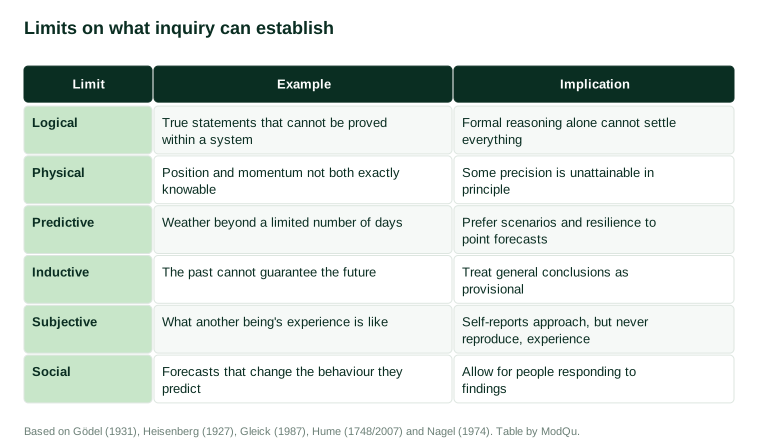
Figure 1 summarises six kinds of limit on what can be known.
Limits of logic
In 1931, Kurt Gödel proved that any consistent formal system powerful enough to describe ordinary arithmetic contains true statements that cannot be proved within the system (Gödel, 1931). Alan Turing (1937) showed that no general procedure can decide, for every computer program, whether it will eventually stop. These results set permanent limits on what can be established by formal reasoning alone.
Limits of nature
Werner Heisenberg (1927) showed that certain pairs of physical quantities, such as the position and momentum of a particle, cannot both be known with unlimited precision. This is not a shortcoming of instruments but a feature of the physical world as described by quantum mechanics.
Limits of prediction
Even where the laws of a system are known exactly, its future may be unpredictable in practice. In the 1960s, the meteorologist Edward Lorenz found that tiny differences in the starting values of a weather model led to completely different forecasts after a short time. James Gleick (1987) described how this sensitivity to initial conditions, popularly called the butterfly effect, became a central idea of chaos theory. Because the initial state of the atmosphere can never be measured perfectly, detailed weather forecasts lose their reliability beyond a limited number of days.
Social and economic systems add a further difficulty: people respond to predictions about them. Philip Tetlock (2005) tracked thousands of forecasts made by experts on political and economic events over many years and found that their accuracy was often little better than simple rules of thumb, especially for longer time horizons. Frank Knight (1921) distinguished risk, where the probabilities of outcomes can be estimated, from uncertainty, where they cannot. Many of the most important business and policy questions fall into the second category. A forecast of next quarter's sales may be a matter of risk, estimable from past patterns; a forecast of how a new technology will reshape an industry over a decade is a matter of uncertainty, where past patterns may be a poor guide and the range of possible outcomes cannot be fully listed in advance.
Limits of induction
David Hume (2007), writing in 1748, observed that no number of past observations can logically guarantee that the future will resemble the past. That the sun has risen every day does not prove it will rise tomorrow. Science manages this problem rather than solving it, by treating general claims as provisional and seeking evidence that could overturn them. But every conclusion drawn from experience remains, in principle, open to revision.
Limits of experience
Some knowledge may be accessible only from the inside. The philosopher Thomas Nagel (1974) asked what it is like to be a bat, a creature that perceives the world through echolocation. He argued that even complete knowledge of a bat's physiology would not tell us what its experience is like from its own point of view. A milder version of the same problem arises whenever we try to understand another person's experience: surveys and interviews can approach it, but never reproduce it fully.
Living with limits
Recognising these limits is not a counsel of despair. It leads to better inquiry in several ways:
- Ask answerable questions. Distinguish questions that evidence can settle from those it cannot, and frame inquiries accordingly.
- State uncertainty honestly. Report ranges and probabilities rather than single figures, and say what is unknown.
- Prefer resilience to prediction. Where the future cannot be forecast reliably, choose courses of action that perform reasonably across many possible futures.
- Keep conclusions open. Treat findings as the best current answer, to be revised when new evidence arrives.
Consider a hypothetical example. A company asks its research team to predict demand for a new product five years from now. The team can measure current interest, compare similar products and model plausible scenarios, but it cannot know which competitors will emerge or how tastes will change. Rather than offering a single figure, it presents a range of scenarios and recommends a plan that can be scaled up or down as evidence arrives. The limits of prediction shape the advice, and the advice is more useful because of it.
References
Gleick, J. (1987). Chaos: Making a new science. Viking.
Gödel, K. (1931). Über formal unentscheidbare Sätze der Principia Mathematica und verwandter Systeme I. Monatshefte für Mathematik und Physik, 38, 173–198. https://doi.org/10.1007/BF01700692
Heisenberg, W. (1927). Über den anschaulichen Inhalt der quantentheoretischen Kinematik und Mechanik. Zeitschrift für Physik, 43(3–4), 172–198. https://doi.org/10.1007/BF01397280
Hume, D. (2007). An enquiry concerning human understanding (P. Millican, Ed.). Oxford University Press. (Original work published 1748)
Knight, F. H. (1921). Risk, uncertainty and profit. Houghton Mifflin.
Nagel, T. (1974). What is it like to be a bat? The Philosophical Review, 83(4), 435–450. https://doi.org/10.2307/2183914
Tetlock, P. E. (2005). Expert political judgment: How good is it? How can we know? Princeton University Press.
Turing, A. M. (1937). On computable numbers, with an application to the Entscheidungsproblem. Proceedings of the London Mathematical Society, s2-42(1), 230–265. https://doi.org/10.1112/plms/s2-42.1.230