
Inquiry · Logic and reasoning
Inquiry Under Ambiguity: Working Before the Problem Is Fully Defined
Many inquiries begin before anyone can say exactly what the problem is. This article explains the difference between risk, uncertainty and ambiguity, what research on ill-structured problems and sensemaking shows, and practical ways to make progress while the question is still taking shape.
Textbook accounts of research usually begin with a clear question. In practice, many inquiries begin with something vaguer: a sense that something is wrong, a figure that does not look right, a market that is changing in ways nobody can yet describe. A manager says "our customers seem less loyal", and it is not obvious whether the problem lies with the product, the price, the service, the competition or the way loyalty is being measured. Waiting until the problem is fully defined is often not an option, because the definition will only emerge from the work. This article examines how inquiry can proceed under ambiguity: what makes ambiguous problems different, what research on ill-structured problems and organisational sensemaking has found, and what practical methods help.
Three kinds of not knowing
It helps to separate ambiguity from two related conditions. The economist Frank Knight (1921) distinguished risk, where the possible outcomes and their probabilities are known, from uncertainty, where the probabilities cannot be calculated. A lottery involves risk; the success of a new kind of product involves uncertainty. Daniel Ellsberg (1961) showed that people treat these situations differently: they tend to prefer bets with known probabilities over bets with unknown ones, even when there is no reason to expect the unknown odds to be worse. He called the unknown-probability situation ambiguity, a term that has since been used in several senses.
Organisational researchers drew a further distinction. Richard Daft and Robert Lengel (1986) separated uncertainty, an absence of information that more data can reduce, from equivocality, the existence of multiple and conflicting interpretations of a situation. More data does not resolve equivocality, because the problem is not missing facts but disagreement or confusion about what the facts mean and which questions to ask. This is the sense of ambiguity that matters most for inquiry. Figure 1 summarises the three conditions.
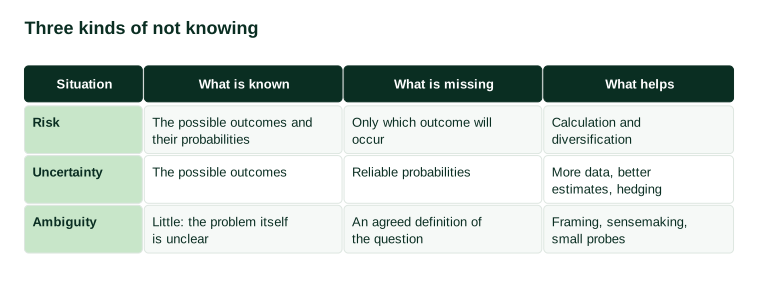
The distinction has practical consequences. Under risk, the right response is calculation. Under uncertainty, the right response is to gather information and estimate better. Under ambiguity, gathering more information without first clarifying the question can make things worse, producing large volumes of data that answer nobody's question in particular.
Ill-structured and wicked problems
Herbert Simon (1973) distinguished well-structured problems, in which the goal, the available moves and the test of a solution are all clearly specified, from ill-structured problems, in which some or all of these are unclear. Chess is well structured: the rules, the goal and the meaning of success are fixed. Designing a house, writing a strategy or diagnosing a fall in customer loyalty are ill structured. Simon observed that people solve ill-structured problems by imposing structure on them step by step, working on a well-structured sub-problem, using what they learn to define the next one, and gradually turning a vague task into a sequence of manageable ones.
Horst Rittel and Melvin Webber (1973) went further, describing wicked problems in social planning. A wicked problem has no definitive formulation; every attempt to state it already assumes a view of its solution. It has no stopping rule, so there is no point at which it is clearly solved. Its solutions are not true or false but better or worse, and every attempt to solve it changes the problem. Not every ambiguous business problem is wicked in this full sense, but many share some of these features, and recognising them prevents the mistake of treating a problem of framing as a problem of calculation.
John Dewey (1938) placed the formulation of the problem at the heart of inquiry. Inquiry, he argued, begins with an "indeterminate situation", one in which something is unsettled, and the first and most important task is to turn that situation into a problem. He warned that a problem wrongly stated sends all subsequent inquiry in the wrong direction, so that it may produce well-supported answers to the wrong question.
Problem finding
Research on creativity supports Dewey's emphasis. Jacob Getzels and Mihaly Csikszentmihalyi (1976) studied art students as they arranged objects and produced drawings. Students who spent more time exploring the objects, and who were more willing to change their idea of what they were drawing as they went, produced work that expert judges rated as more original. Several years later, they were also more successful as artists. Getzels and Csikszentmihalyi called this capacity problem finding: the ability to discover and formulate a problem, not just solve one that has been given.
Studies of designers show a similar pattern. Kees Dorst and Nigel Cross (2001) found that creative design does not proceed by first fixing the problem and then generating solutions. Instead, the problem and the solution develop together. A partial solution reveals something about the problem, which leads to a revised formulation, which suggests a new solution. They described this as the co-evolution of problem and solution. Donald Schön (1983) described the same process in professional practice as a "reflective conversation with the situation": the practitioner frames the problem, acts, notices how the situation responds and reframes accordingly.
Sensemaking
The organisational theorist Karl Weick (1995) studied how people in organisations make sense of confusing situations. Sensemaking, in his account, is the process by which people turn ongoing, ambiguous experience into a situation that can be understood in words and acted upon. Weick emphasised several features. It is retrospective: people make sense of what has already happened. It is social: interpretations are built in conversation. And it is driven by plausibility rather than accuracy, because in a confusing situation people need an account good enough to act on, which can then be revised.
Weick et al. (2005) argued that action is part of sensemaking, not something that follows it. People often discover what a situation is by acting in it and seeing what happens. A team that waits for a complete understanding before acting may never act; a team that acts on a plausible account, while watching carefully for signs that the account is wrong, learns faster. The key is to treat the current interpretation as provisional and to keep testing it.
How ambiguity affects decisions
Research on organisational decisions shows that ambiguity is the normal condition, not the exception. Mintzberg et al. (1976) traced 25 strategic decisions in organisations and found that they rarely followed a neat sequence from problem definition to solution. Instead, decision makers cycled back and forth: a diagnosis would be interrupted by new information, a proposed solution would reveal that the problem had been misunderstood, and the process would return to an earlier stage. Charles Lindblom (1959) argued that in complex policy areas, decision makers sensibly proceed by "muddling through", making small, incremental changes and adjusting in the light of results, rather than attempting a comprehensive analysis that is beyond their capacity.
Paul Nutt (1999) studied hundreds of organisational decisions and found that about half failed. A common feature of the failures was that decision makers adopted the first definition of the problem that was offered, often in the form of a ready-made solution, and then sought evidence to support it. Decisions in which managers explored the problem and considered several alternatives before committing were much more likely to succeed. In other words, settling the definition of the problem too early is a common and costly error.
Tolerance of ambiguity
People differ in how comfortably they work without a clear definition. Stanley Budner (1962) described intolerance of ambiguity as a tendency to perceive ambiguous situations as threatening. Furnham and Marks (2013) reviewed research on the trait and found it related to a range of outcomes, including how people respond to change and how they make decisions. Arie Kruglanski and Donna Webster (1996) studied the related need for cognitive closure, the desire for a firm answer and an aversion to ambiguity. People high in this need tend to "seize" on early information and then "freeze" on the resulting judgement, becoming less open to new evidence. Time pressure, fatigue and noise increase the need for closure in most people.
This research has a clear implication for inquiry. The pressure to define a problem quickly, and to stop questioning that definition, is partly psychological. It feels better to have a clear question, even a wrong one. Teams working on ambiguous problems need ways to resist premature closure without becoming paralysed.
Methods for working under ambiguity
Several approaches allow inquiry to make progress before the problem is fully defined. They share a common structure, shown in Figure 2: act on a working definition, probe cheaply, make sense of the results, reframe and repeat.
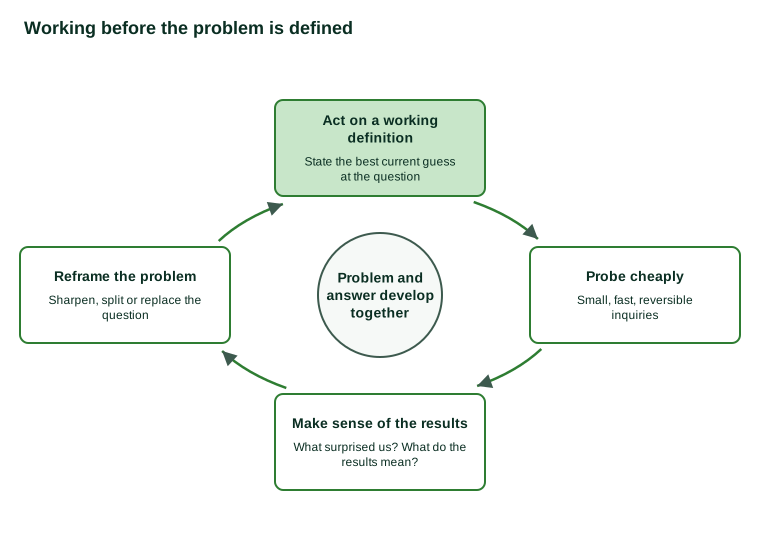
State a working definition and label it as such. A provisional statement of the problem gives the team something to test. Writing it down, with the date and the assumptions it rests on, makes it easier to revise and harder to forget that it was provisional.
Use exploratory research. Robert Stebbins (2001) describes exploratory research as research whose purpose is to discover rather than to confirm: to find out what the important questions and categories are in an area that is not yet understood. Qualitative interviews, observation and open-ended questions are well suited to this stage. Grounded theory, developed by Glaser and Strauss (1967), offers a systematic way of building concepts from qualitative data without fixing them in advance.
Explore the data before testing it. John Tukey (1977) argued that statistical work should begin with exploratory data analysis: looking at data in many ways to see what patterns and anomalies it contains, before committing to formal tests. Tukey (1980) insisted that exploratory and confirmatory analysis are both needed, and that they should be kept distinct. Patterns found by exploring should be treated as hypotheses to be confirmed on new data.
Make small, reversible probes. Snowden and Boone (2007) argued that in complex situations, where cause and effect can only be understood in retrospect, leaders should "probe, sense and respond": run small, safe experiments, see what happens and amplify what works. Rita McGrath and Ian MacMillan (1995) proposed discovery-driven planning for new ventures, in which the plan lists the assumptions it depends on and sets out checkpoints at which those assumptions are tested before larger commitments are made. Eric Ries (2011) popularised a similar approach for start-ups, built around small experiments that test the riskiest assumptions first.
Start from what you have. Saras Sarasvathy (2001) studied expert entrepreneurs and found that many did not begin with a defined goal and then seek the means to achieve it. Instead, they began with the means at hand, such as their skills, contacts and resources, and asked what could be done with them, allowing goals to emerge. She called this effectuation. Inquiry can work the same way: starting with the data, contacts and methods already available can reveal which questions are worth pursuing.
Seek several framings. Because ambiguity involves multiple possible interpretations, deliberately generating several statements of the problem helps prevent the premature closure that Nutt (1999) found so damaging. Each framing suggests different evidence, and comparing them often shows where the real uncertainty lies.
Use experience, but check it. Gary Klein (1998) studied experienced decision makers such as fire commanders and found that they often recognised a situation as an example of a familiar type and acted on that recognition, mentally simulating the course of action to check it. This works well where experience is relevant. Under genuine novelty, the recognised pattern may be the wrong one, so the simulation step, imagining how the chosen action would play out, becomes more important.
Move quickly but stay open. Kathleen Eisenhardt (1989) studied decision making in fast-moving industries and found that the fastest decision makers did not cut corners on information. They used more real-time information and considered more alternatives at once, which made them faster, not slower, because they did not have to go back and start again when the first option failed.
A hypothetical example
A software company notices that the proportion of customers renewing their annual contracts has fallen over two quarters. The executive team asks for research into "why customers are less loyal". The problem is ambiguous: loyalty may not be the right concept, and nobody yet knows which customers are affected or why.
The research team begins with a working definition: "renewals have fallen because satisfaction has fallen". Before designing a large survey, they run cheap probes. They look at renewal data by customer segment and find that the fall is concentrated among small customers who joined in the past two years. They interview a handful of customers who did not renew. Several say they were satisfied with the product but had been acquired by larger firms that used a competitor's system. Others say they had never fully set up the product in the first place.
These findings reframe the problem. There are at least two distinct issues: consolidation among small customers, which is largely outside the company's control, and poor onboarding, which is within it. Satisfaction, the original working definition, turns out to be the wrong lens for both. A large satisfaction survey, designed at the outset, would have measured the wrong thing. The research team now designs targeted inquiries: one to estimate how much of the fall is due to acquisitions, and one to study the onboarding experience of new small customers.
Common mistakes
Freezing the first definition. As Nutt (1999) found, adopting the first framing and seeking confirmation is a frequent cause of failure.
Collecting everything. Gathering large amounts of data in the hope that the problem will reveal itself rarely works. Without a working question, there is no basis for deciding what to look at.
Exploring indefinitely. The opposite error is never converging. Exploratory work should have a time limit and should aim to produce a sharper question, not an endless list of possibilities.
Confusing exploration with confirmation. Patterns found while exploring are hypotheses. Presenting them as established findings, without testing them on new data, invites the errors Tukey (1980) warned against.
A checklist for ambiguous inquiries
- Can we state a working definition of the problem in one sentence? What assumptions does it rest on?
- Is the difficulty missing information, or disagreement about what the situation means?
- Have we written down at least two other ways of framing the problem?
- What is the cheapest probe that could show our working definition is wrong?
- When will we stop exploring and commit to a focused question?
- Have we kept patterns found during exploration separate from findings confirmed on new data?
Conclusion
Ambiguity is not a failure of planning but a normal condition of inquiry into new, complex or changing situations. The research reviewed here points to a consistent approach. Separate ambiguity from uncertainty, because more data will not settle a question nobody has formulated. Treat the definition of the problem as part of the inquiry, not a precondition for it. Act on a provisional framing, probe cheaply, make sense of the results and reframe. Resist the psychological pull towards early closure, while setting limits on exploration. Inquiry that works this way can begin before the problem is clear and, by doing so, discover what the problem really is.
References
Budner, S. (1962). Intolerance of ambiguity as a personality variable. Journal of Personality, 30(1), 29–50. https://doi.org/10.1111/j.1467-6494.1962.tb02303.x
Daft, R. L., & Lengel, R. H. (1986). Organizational information requirements, media richness and structural design. Management Science, 32(5), 554–571. https://doi.org/10.1287/mnsc.32.5.554
Dewey, J. (1938). Logic: The theory of inquiry. Henry Holt.
Dorst, K., & Cross, N. (2001). Creativity in the design process: Co-evolution of problem–solution. Design Studies, 22(5), 425–437. https://doi.org/10.1016/S0142-694X(01)00009-6
Eisenhardt, K. M. (1989). Making fast strategic decisions in high-velocity environments. Academy of Management Journal, 32(3), 543–576. https://doi.org/10.5465/256434
Ellsberg, D. (1961). Risk, ambiguity, and the Savage axioms. The Quarterly Journal of Economics, 75(4), 643–669. https://doi.org/10.2307/1884324
Furnham, A., & Marks, J. (2013). Tolerance of ambiguity: A review of the recent literature. Psychology, 4(9), 717–728. https://doi.org/10.4236/psych.2013.49102
Getzels, J. W., & Csikszentmihalyi, M. (1976). The creative vision: A longitudinal study of problem finding in art. Wiley.
Glaser, B. G., & Strauss, A. L. (1967). The discovery of grounded theory: Strategies for qualitative research. Aldine.
Klein, G. (1998). Sources of power: How people make decisions. MIT Press.
Knight, F. H. (1921). Risk, uncertainty and profit. Houghton Mifflin.
Kruglanski, A. W., & Webster, D. M. (1996). Motivated closing of the mind: "Seizing" and "freezing". Psychological Review, 103(2), 263–283. https://doi.org/10.1037/0033-295X.103.2.263
Lindblom, C. E. (1959). The science of "muddling through". Public Administration Review, 19(2), 79–88. https://doi.org/10.2307/973677
McGrath, R. G., & MacMillan, I. C. (1995). Discovery-driven planning. Harvard Business Review, 73(4), 44–54.
Mintzberg, H., Raisinghani, D., & Théorêt, A. (1976). The structure of "unstructured" decision processes. Administrative Science Quarterly, 21(2), 246–275. https://doi.org/10.2307/2392045
Nutt, P. C. (1999). Surprising but true: Half the decisions in organizations fail. Academy of Management Executive, 13(4), 75–90. https://doi.org/10.5465/ame.1999.2570556
Ries, E. (2011). The lean startup. Crown Business.
Rittel, H. W. J., & Webber, M. M. (1973). Dilemmas in a general theory of planning. Policy Sciences, 4(2), 155–169. https://doi.org/10.1007/BF01405730
Sarasvathy, S. D. (2001). Causation and effectuation: Toward a theoretical shift from economic inevitability to entrepreneurial contingency. Academy of Management Review, 26(2), 243–263. https://doi.org/10.5465/amr.2001.4378020
Schön, D. A. (1983). The reflective practitioner: How professionals think in action. Basic Books.
Simon, H. A. (1973). The structure of ill structured problems. Artificial Intelligence, 4(3–4), 181–201. https://doi.org/10.1016/0004-3702(73)90011-8
Snowden, D. J., & Boone, M. E. (2007). A leader's framework for decision making. Harvard Business Review, 85(11), 68–76.
Stebbins, R. A. (2001). Exploratory research in the social sciences. Sage.
Tukey, J. W. (1977). Exploratory data analysis. Addison-Wesley.
Tukey, J. W. (1980). We need both exploratory and confirmatory. The American Statistician, 34(1), 23–25. https://doi.org/10.1080/00031305.1980.10482706
Weick, K. E. (1995). Sensemaking in organizations. Sage.
Weick, K. E., Sutcliffe, K. M., & Obstfeld, D. (2005). Organizing and the process of sensemaking. Organization Science, 16(4), 409–421. https://doi.org/10.1287/orsc.1050.0133