
Inquiry · Inquiry in organisations
Inquiry Speed versus Inquiry Depth: Trade-offs in Time-Constrained Environments
Every inquiry must balance the value of more evidence against the cost of waiting for it. This article explains what research says about decision making under time pressure, and offers a simple way to decide how much inquiry a decision deserves.
Every inquiry faces a trade-off between speed and depth. More evidence usually means a better-informed decision, but evidence takes time to gather, and delay has costs: a market opportunity closes, a problem worsens, a competitor moves first. Too little inquiry produces avoidable mistakes; too much produces decisions that arrive after they matter. The skill lies in matching the depth of inquiry to the decision.
What research shows
Herbert Simon (1956) argued that people and organisations rarely seek the best possible option. Instead, they satisfice: they search until they find an option that is good enough, because searching further costs more than it is likely to gain. Payne et al. (1993) showed that people adapt their decision strategies to time pressure, switching to simpler rules that consider less information when time is short. These simpler strategies often perform reasonably well, but they work best when the most important information is considered first.
Time pressure also changes how people think. Maule et al. (2000) found that people under time pressure processed information faster and more selectively, and felt more tense. Kruglanski and Webster (1996) found that time pressure increases the need for closure, making people seize on early information and become less open to evidence that contradicts it. Speed therefore carries a hidden cost: not just less evidence, but a greater tendency to stop looking once a first answer appears.
Speed and quality are not always opposed. Kathleen Eisenhardt (1989) studied executives in fast-moving industries and found that the fastest decision makers used more real-time information and considered more alternatives at the same time than slower ones. They were faster because they did not have to go back and start again when a single favoured option failed. Gary Klein (1998) found that experienced professionals can decide quickly and well by recognising familiar situations, although Kahneman and Klein (2009) cautioned that such intuition is reliable only in settings where people have had extensive practice with clear feedback.
How much inquiry is enough?
Decision analysts have a formal answer: gather more information only when its expected value exceeds its cost. Ronald Howard (1966) showed how to calculate the value of information from the chance that it would change the decision and the difference that change would make. Information that could not alter the choice is worth nothing, however interesting it may be.
In practice, two questions capture most of this reasoning: how costly is delay, and how hard would the decision be to reverse? Figure 1 shows the four combinations.
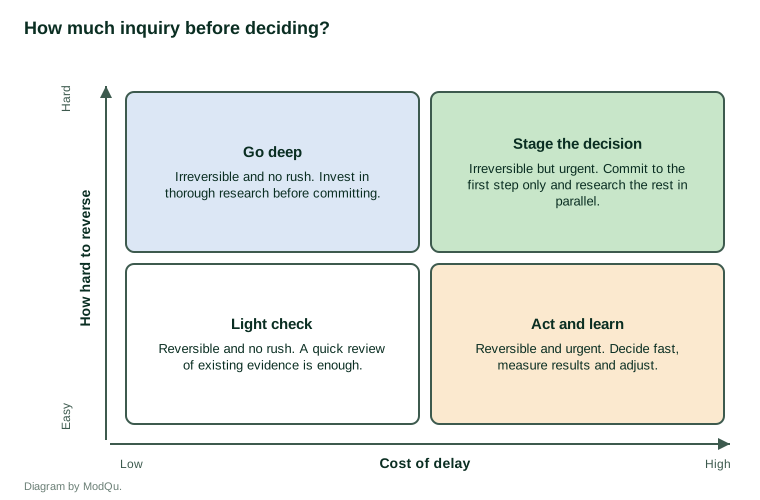
Decisions that are hard to reverse and not urgent deserve thorough research. Decisions that are easy to reverse and urgent are often better made quickly, with results measured and the decision adjusted. When a decision is both urgent and hard to reverse, it can often be split: commit only to the first step, and continue researching the rest in parallel.
A hypothetical example
A retailer learns that a supplier is about to raise prices sharply. Switching suppliers would take months and be hard to undo, so a deep inquiry into alternatives is justified. But the retailer must also decide within days whether to adjust its own prices. That decision is easy to reverse, so it acts quickly, monitors sales and adjusts weekly, while the supplier review proceeds at its own pace. Treating the two decisions separately avoids two common errors: rushing the irreversible choice because the reversible one is urgent, and delaying the urgent choice because the whole situation feels too important to act on without full information.
The same logic applies to research projects. A brief that asks for a full market study before any action is taken may be right for a major investment, but wrong for a pricing test that could be run and reversed in a fortnight. Asking at the outset which kind of decision the research supports helps set its scope, timetable and budget.
Practical guidance
- Ask what would change the decision. Research only what could alter the choice.
- Estimate the cost of waiting in concrete terms.
- Prefer reversible steps when time is short.
- Look at the most important evidence first, so that a quick decision rests on the best of what is available.
- Set a deadline for inquiry before it begins, and say what will be decided if the evidence is still incomplete.
- Record fast decisions and review them, so that they can be corrected as evidence arrives.
References
Eisenhardt, K. M. (1989). Making fast strategic decisions in high-velocity environments. Academy of Management Journal, 32(3), 543–576. https://doi.org/10.5465/256434
Howard, R. A. (1966). Information value theory. IEEE Transactions on Systems Science and Cybernetics, 2(1), 22–26. https://doi.org/10.1109/TSSC.1966.300074
Kahneman, D., & Klein, G. (2009). Conditions for intuitive expertise: A failure to disagree. American Psychologist, 64(6), 515–526. https://doi.org/10.1037/a0016755
Klein, G. (1998). Sources of power: How people make decisions. MIT Press.
Kruglanski, A. W., & Webster, D. M. (1996). Motivated closing of the mind: "Seizing" and "freezing". Psychological Review, 103(2), 263–283. https://doi.org/10.1037/0033-295X.103.2.263
Maule, A. J., Hockey, G. R. J., & Bdzola, L. (2000). Effects of time-pressure on decision-making under uncertainty: Changes in affective state and information processing strategy. Acta Psychologica, 104(3), 283–301. https://doi.org/10.1016/S0001-6918(00)00033-0
Payne, J. W., Bettman, J. R., & Johnson, E. J. (1993). The adaptive decision maker. Cambridge University Press. https://doi.org/10.1017/CBO9781139173933
Simon, H. A. (1956). Rational choice and the structure of the environment. Psychological Review, 63(2), 129–138. https://doi.org/10.1037/h0042769