
Inquiry · Inquiry in organisations
Inquiry-Driven Organisations and Learning Cultures
Some organisations treat questions, evidence and experiments as part of everyday work; others punish the messenger and repeat their mistakes. This article explains what research on organisational learning, culture and experimentation shows about building an inquiry-driven organisation, and what gets in the way.
Every organisation learns something from experience, but some learn far more and far faster than others. In some, people raise problems early, test ideas before committing to them and change course when the evidence changes. In others, bad news travels slowly, assumptions go unchallenged and the same mistakes recur. The difference lies less in the intelligence of the people involved than in the culture and practices of the organisation: whether asking questions, gathering evidence and admitting uncertainty are expected and rewarded. This article draws on research on organisational learning, culture, psychological safety and experimentation to describe what an inquiry-driven organisation looks like, why it is difficult to build and what practices help.
What organisational learning means
Organisations do not learn in the way individuals do, but they can change their routines, knowledge and behaviour in the light of experience. Barbara Levitt and James March (1988) described organisational learning as encoding inferences from history into the routines that guide behaviour. George Huber (1991) identified four processes involved: acquiring knowledge, distributing it, interpreting it and storing it in organisational memory. Each can fail. An organisation may collect information but never share it, share it but interpret it in self-serving ways, or interpret it well but forget it when key people leave.
Chris Argyris and Donald Schön (1978) drew an influential distinction between two kinds of learning. In single-loop learning, an organisation detects and corrects errors within its existing goals, policies and assumptions, much as a thermostat adjusts the heating to keep a set temperature. In double-loop learning, it questions the goals, policies and assumptions themselves: it asks whether the temperature is set correctly. Argyris and Schön found that most organisations are good at single-loop learning and poor at double-loop learning, because questioning basic assumptions is threatening to the people who hold them.
Argyris (1991) went further, arguing that highly educated professionals are often the worst at double-loop learning. Because they have rarely failed, they have little experience of learning from failure, and when their methods are questioned they become defensive and blame others. Learning, he argued, depends on people being willing to examine their own reasoning, not only the environment.
The learning organisation
Peter Senge (1990) popularised the idea of the learning organisation, one in which people continually expand their capacity to create the results they want. He identified five disciplines: personal mastery, mental models, shared vision, team learning and systems thinking. Senge's book was widely read, but critics found the idea hard to put into practice.
David Garvin (1993) offered a more concrete definition: a learning organisation is skilled at creating, acquiring and transferring knowledge, and at modifying its behaviour to reflect new knowledge and insights. He emphasised practical activities, including systematic problem solving, experimentation, learning from past experience and from others, and transferring knowledge quickly. Karen Watkins and Victoria Marsick (1993) described the learning organisation in terms of seven dimensions, including continuous learning opportunities, inquiry and dialogue, collaboration and team learning, and leadership that supports learning. Yang et al. (2004) developed and validated a questionnaire to measure these dimensions, making it possible to study the learning culture of organisations empirically.
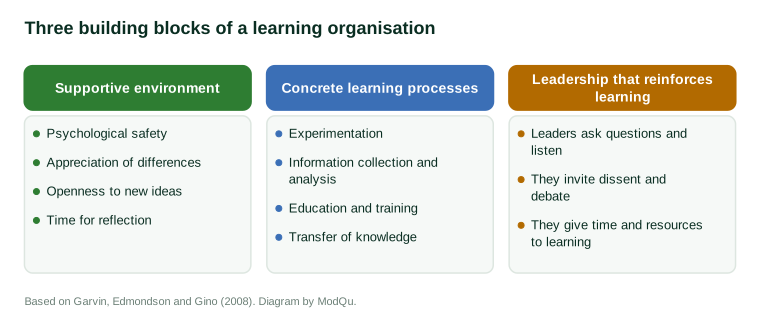
Garvin et al. (2008) later summarised the research in three building blocks, shown in Figure 1: a supportive learning environment, concrete learning processes and practices, and leadership that reinforces learning. They found that the three were related but distinct. An organisation could have good processes but an environment in which people were afraid to use them, or supportive leaders but no structured way of capturing what was learned.
Culture: how organisations treat bad news
Culture shapes what people believe they can say. Edgar Schein (2010) described culture as the shared basic assumptions a group has learned as it solved its problems, assumptions that come to be taken for granted and are taught to new members as the correct way to think. If those assumptions include "do not question senior people" or "admitting a mistake damages your career", inquiry will be suppressed whatever the official policy says.
The sociologist Ron Westrum (2004) proposed a typology of organisational cultures based on how they handle information. Figure 2 summarises it. In pathological cultures, information is a source of power, messengers who bring bad news are punished and failures lead to scapegoating. In bureaucratic cultures, information flows through formal channels, messengers are neglected and failures lead to the application of rules. In generative cultures, information flows to whoever needs it, messengers are trained and rewarded and failure leads to inquiry.
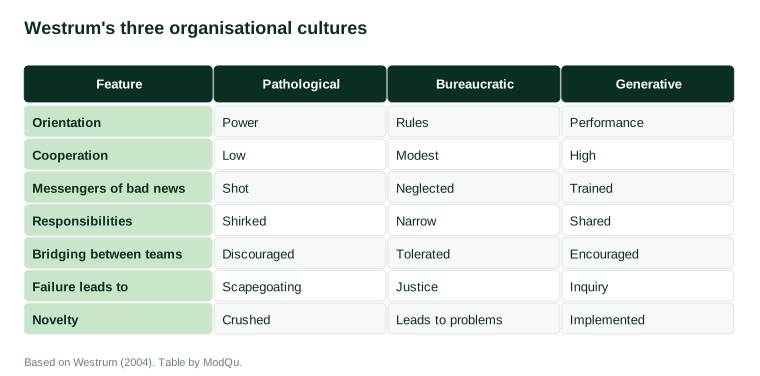
Westrum developed the typology from studies of safety in high-risk industries, but it has since been tested in other settings. Forsgren et al. (2018) surveyed thousands of technology professionals and found that generative cultures, as measured by Westrum's criteria, were associated with better software delivery and organisational performance.
Psychological safety and the problem of silence
The most consistent finding in this research concerns whether people feel able to speak up. Amy Edmondson (1999) defined team psychological safety as a shared belief that the team is safe for interpersonal risk-taking. In a study of manufacturing teams, she found that psychological safety was associated with learning behaviour, such as seeking feedback, discussing errors and asking for help, which in turn was associated with team performance. Edmondson (2018) later reviewed evidence from hospitals, factories, technology firms and government, showing that teams with high psychological safety report more errors, raise more concerns and learn faster.
The opposite of psychological safety is organisational silence. Elizabeth Morrison and Frances Milliken (2000) described how employees in many organisations withhold information about problems, because they fear negative consequences or believe speaking up will make no difference. Silence prevents organisations from hearing about errors and threats, and it becomes self-reinforcing as people learn from one another that it is safer to say nothing.
Anita Tucker and Amy Edmondson (2003) studied how nurses in hospitals dealt with everyday operational failures, such as missing supplies. In most cases, nurses worked around the problem and continued with their work, without reporting it to anyone who could fix the underlying cause. The workaround solved the immediate problem but ensured that the same failure recurred. Tucker and Edmondson argued that hospitals, and organisations generally, fail to learn from failure partly because the people closest to problems are rewarded for coping, not for raising questions.
Learning from failure
Failure contains information, but organisations often fail to extract it. Sim Sitkin (1992) argued that organisations learn more from small failures than from successes, because success breeds complacency while small failures prompt attention and experimentation. He recommended a "strategy of small losses": deliberately undertaking modest experiments whose failure would be informative but not catastrophic.
Mark Cannon and Amy Edmondson (2005) described three barriers to learning from failure: identifying failures, which requires people to report them; analysing failures, which requires time and a willingness to look past blame; and deliberate experimentation, which requires accepting that some experiments will fail. They argued that each barrier is reinforced by technical and social factors, and that leaders must address both.
Karl Weick and Kathleen Sutcliffe (2007) studied high-reliability organisations, such as aircraft carriers and nuclear power plants, which operate in hazardous conditions with few accidents. They found that such organisations share a preoccupation with failure, a reluctance to simplify interpretations, sensitivity to front-line operations, a commitment to resilience and deference to expertise rather than rank. In each case, the practices keep people inquiring into small signs of trouble before they become disasters.
Experimentation as routine
Some organisations have made experimentation a normal part of decision making. Stefan Thomke (2020) describes firms that run thousands of controlled experiments each year to test changes to products, websites and processes. Kohavi et al. (2020) report that in large online businesses, most ideas tested in controlled experiments fail to improve the measures they were intended to improve, a finding that underlines how unreliable intuition about what will work can be. The value of routine experimentation lies not only in finding improvements but in replacing opinion with evidence as the basis for decisions.
James March (1991) warned of a trade-off that affects all learning organisations. Exploitation, refining and using existing knowledge, produces reliable short-term returns. Exploration, searching for new knowledge, is uncertain and slow to pay off. Because exploitation is rewarded more quickly, organisations tend to drift towards it, becoming more efficient at what they already do while losing the capacity to discover anything new. An inquiry-driven organisation must protect some capacity for exploration deliberately.
Cohen and Levinthal (1990) added that an organisation's ability to use new external knowledge, its absorptive capacity, depends on its existing knowledge. Organisations that invest in inquiry are better able to recognise and use what others discover.
Evidence in management decisions
Jeffrey Pfeffer and Robert Sutton (2006) argued that many management decisions rest on casual benchmarking, outdated experience and untested beliefs, rather than evidence. Denise Rousseau (2006) proposed evidence-based management, in which managers combine the best available research evidence with organisational data, professional judgement and the values of those affected. Both argued that the main barrier is not a shortage of evidence but a culture in which asking for it can be seen as a sign of weakness or disloyalty.
Leadership and the asking of questions
Leaders shape culture through what they pay attention to, reward and model. Edgar Schein (2013) described humble inquiry as "the fine art of drawing someone out, of asking questions to which you do not already know the answer". He argued that leaders in Western cultures are trained to tell rather than ask, and that this habit discourages subordinates from sharing information, especially bad news. Leaders who ask genuine questions, admit what they do not know and respond constructively to unwelcome information make it safer for others to do the same.
Incentives also matter. Steven Kerr (1975) described the folly of "rewarding A while hoping for B": organisations often say they want honesty, learning and long-term thinking while rewarding the appearance of success and short-term results. If people are rewarded for hitting targets and punished for reporting problems, no amount of encouragement to inquire will overcome the incentive to stay quiet.
Why inquiry is hard to sustain
Even organisations that value inquiry find it hard to maintain. Several forces push against it.
Time pressure. Inquiry takes time, and most organisations are under pressure to deliver. Tucker and Edmondson (2003) found that the nurses they studied were too busy to report problems; fixing the immediate issue was all their workload allowed. When every hour is allocated to production, reflection and experimentation are the first activities to be cut.
The success trap. March (1991) showed that organisations which succeed through exploitation become more committed to it. Each success makes existing routines more attractive and new ideas less so. Levitt and March (1988) described a related problem, the competency trap: an organisation becomes so skilled at an existing method that it does not adopt a better one, because its skill at the old method makes the new one look worse at first.
Defensive routines. Argyris (1991) observed that people protect themselves from embarrassment by avoiding difficult questions and by making their own reasoning hard to examine. These defensive routines are often unspoken and widely shared, so that everyone knows certain topics are not discussed, and no one says so.
Fragmented knowledge. Huber (1991) noted that organisations often fail to learn because the people who know something are not the people who need to know it. Information collected in one part of the organisation is not shared with another, or is shared in a form that cannot be used.
Hierarchy. Junior staff often see problems first but have the least power to raise them. Weick and Sutcliffe (2007) found that high-reliability organisations deliberately counter this by deferring to expertise rather than rank during critical moments, so that whoever knows most about the problem takes the lead, whatever their position.
Inquiry at three levels
An inquiry-driven culture operates at three levels, and each depends on the others.
At the individual level, people need the skills and disposition to ask good questions, weigh evidence and examine their own reasoning. Argyris (1991) argued that these skills can be taught, but that teaching them requires people to look at the gap between what they say they believe and how they actually act.
At the team level, people need psychological safety and routines for reflection. Edmondson (1999) found that the same organisation could contain teams with very different levels of psychological safety, depending largely on how the team leader behaved. Team learning is therefore something leaders at every level can influence directly.
At the organisational level, inquiry needs structures that carry learning beyond the team that generated it: systems for recording and sharing lessons, processes for testing ideas, and incentives that reward the use of evidence. Garvin (1993) emphasised that knowledge which stays in one team, or one person's head, has not been learned by the organisation.
Diagnostic questions
Leaders who want to assess their own organisation's learning culture can begin with a few questions, drawing on the research described above:
- When someone brings bad news, what happens to them?
- Can people name a recent decision that was changed because of new evidence?
- How often are important changes tested on a small scale before they are adopted?
- Do project reviews examine successes as well as failures, and are their lessons used?
- Do junior staff raise problems directly with senior managers?
- Are people rewarded for reporting problems, or for the absence of reported problems?
- What proportion of time and budget is spent exploring new questions rather than refining existing work?
Honest answers to these questions often reveal a gap between the culture an organisation believes it has and the one its people experience. Validated surveys, such as the questionnaire developed by Yang et al. (2004), can measure that gap more systematically and track it over time.
A hypothetical example
A mid-sized insurance company notices that its customer satisfaction scores have fallen for three consecutive quarters. In a pathological culture, the regional managers would explain the results away, perhaps by blaming the survey, and the people who first raised concerns would be quietly sidelined. In a bureaucratic culture, the company would commission a formal review, which would recommend new procedures and be filed.
In a generative culture, the first response is a set of questions. The executive team asks front-line staff what they are hearing from customers, and it makes clear that candid answers are welcome. Staff report that a recently introduced claims system requires customers to resubmit documents. The company runs a small experiment in one region, simplifying the process, and compares satisfaction with a similar region. The results are clear enough to justify a wider change. In the review that follows, the team also asks why the problem took three quarters to surface, and introduces a monthly forum in which staff can raise operational problems directly with managers.
Building an inquiry-driven organisation
The research suggests several practical steps:
- Make it safe to speak. Respond to bad news with curiosity, not blame. Thank people who raise problems.
- Ask, do not only tell. Leaders should ask genuine questions and admit uncertainty.
- Create learning routines. Hold regular reviews of projects, including successful ones, and record what was learned.
- Experiment. Test important changes on a small scale before committing, and accept that many tests will fail.
- Align incentives. Reward the reporting of problems and the use of evidence, not only the appearance of success.
- Protect exploration. Set aside time and resources for questions whose answers are not yet known.
- Measure the culture. Use validated measures of learning culture or psychological safety to track progress.
Conclusion
An inquiry-driven organisation is one in which questions, evidence and experiments are part of everyday work, not reserved for special projects. Research on organisational learning shows that such organisations are possible but uncommon, because the natural tendencies of organisations work against them: people avoid threatening questions, bad news is suppressed, exploitation crowds out exploration and incentives reward the appearance of success. Overcoming these tendencies requires deliberate effort on several fronts at once: a culture in which it is safe to speak, routines that turn experience into knowledge, leaders who ask rather than tell and incentives that reward learning. The reward is an organisation that finds out what it needs to know sooner, and acts on it more reliably.
References
Argyris, C. (1991). Teaching smart people how to learn. Harvard Business Review, 69(3), 99–109.
Argyris, C., & Schön, D. A. (1978). Organizational learning: A theory of action perspective. Addison-Wesley.
Cannon, M. D., & Edmondson, A. C. (2005). Failing to learn and learning to fail (intelligently): How great organizations put failure to work to innovate and improve. Long Range Planning, 38(3), 299–319. https://doi.org/10.1016/j.lrp.2005.04.005
Cohen, W. M., & Levinthal, D. A. (1990). Absorptive capacity: A new perspective on learning and innovation. Administrative Science Quarterly, 35(1), 128–152. https://doi.org/10.2307/2393553
Edmondson, A. (1999). Psychological safety and learning behavior in work teams. Administrative Science Quarterly, 44(2), 350–383. https://doi.org/10.2307/2666999
Edmondson, A. C. (2018). The fearless organization: Creating psychological safety in the workplace for learning, innovation, and growth. Wiley.
Forsgren, N., Humble, J., & Kim, G. (2018). Accelerate: The science of lean software and DevOps. IT Revolution Press.
Garvin, D. A. (1993). Building a learning organization. Harvard Business Review, 71(4), 78–91.
Garvin, D. A., Edmondson, A. C., & Gino, F. (2008). Is yours a learning organization? Harvard Business Review, 86(3), 109–116.
Huber, G. P. (1991). Organizational learning: The contributing processes and the literatures. Organization Science, 2(1), 88–115. https://doi.org/10.1287/orsc.2.1.88
Kerr, S. (1975). On the folly of rewarding A, while hoping for B. Academy of Management Journal, 18(4), 769–783. https://doi.org/10.5465/255378
Kohavi, R., Tang, D., & Xu, Y. (2020). Trustworthy online controlled experiments: A practical guide to A/B testing. Cambridge University Press. https://doi.org/10.1017/9781108653985
Levitt, B., & March, J. G. (1988). Organizational learning. Annual Review of Sociology, 14, 319–338. https://doi.org/10.1146/annurev.so.14.080188.001535
March, J. G. (1991). Exploration and exploitation in organizational learning. Organization Science, 2(1), 71–87. https://doi.org/10.1287/orsc.2.1.71
Morrison, E. W., & Milliken, F. J. (2000). Organizational silence: A barrier to change and development in a pluralistic world. Academy of Management Review, 25(4), 706–725. https://doi.org/10.5465/amr.2000.3707697
Pfeffer, J., & Sutton, R. I. (2006). Hard facts, dangerous half-truths, and total nonsense: Profiting from evidence-based management. Harvard Business School Press.
Rousseau, D. M. (2006). Is there such a thing as "evidence-based management"? Academy of Management Review, 31(2), 256–269. https://doi.org/10.5465/amr.2006.20208679
Schein, E. H. (2010). Organizational culture and leadership (4th ed.). Jossey-Bass.
Schein, E. H. (2013). Humble inquiry: The gentle art of asking instead of telling. Berrett-Koehler.
Senge, P. M. (1990). The fifth discipline: The art and practice of the learning organization. Doubleday.
Sitkin, S. B. (1992). Learning through failure: The strategy of small losses. Research in Organizational Behavior, 14, 231–266.
Thomke, S. H. (2020). Experimentation works: The surprising power of business experiments. Harvard Business Review Press.
Tucker, A. L., & Edmondson, A. C. (2003). Why hospitals don't learn from failures: Organizational and psychological dynamics that inhibit system change. California Management Review, 45(2), 55–72. https://doi.org/10.2307/41166165
Watkins, K. E., & Marsick, V. J. (1993). Sculpting the learning organization: Lessons in the art and science of systemic change. Jossey-Bass.
Weick, K. E., & Sutcliffe, K. M. (2007). Managing the unexpected: Resilient performance in an age of uncertainty (2nd ed.). Jossey-Bass.
Westrum, R. (2004). A typology of organisational cultures. Quality and Safety in Health Care, 13(Suppl. 2), ii22–ii27. https://doi.org/10.1136/qshc.2003.009522
Yang, B., Watkins, K. E., & Marsick, V. J. (2004). The construct of the learning organization: Dimensions, measurement, and validation. Human Resource Development Quarterly, 15(1), 31–55. https://doi.org/10.1002/hrdq.1094