
Inquiry · Ethics and limits
Epistemic Responsibility in an Age of Misinformation
When false information spreads easily, each person who believes, shares or publishes a claim carries some responsibility for its accuracy. This article explains the idea of epistemic responsibility, from the classic ethics of belief to research on misinformation, trust in experts and echo chambers, and what responsible knowing looks like for individuals and organisations.
Most of what any person believes comes from others: teachers, books, news, colleagues, friends and, increasingly, whatever appears on a screen. No one can check more than a tiny fraction of it personally. This dependence on others is unavoidable and, for the most part, reasonable. But it creates a shared vulnerability. When false information can be produced cheaply and spread instantly, the quality of what everyone knows depends on how carefully each person believes, shares and passes on claims. Philosophers call this epistemic responsibility: responsibility for how we form and transmit beliefs. The idea is old, but the conditions of modern information make it newly urgent.
The ethics of belief
In 1877, the mathematician W. K. Clifford published an essay arguing that "it is wrong always, everywhere, and for anyone, to believe anything upon insufficient evidence" (Clifford, 1877). His example was a shipowner who sent an ageing ship to sea, persuading himself without inspection that it was sound. When the ship sank, Clifford argued, the owner was guilty not only of the loss but of the belief itself, because he had no right to believe on such evidence. Even if the ship had arrived safely, the owner would have been just as wrong to believe as he did.
William James (1896) replied that Clifford's standard was too strict. Some questions cannot be settled by evidence in advance, and in such cases, James argued, people may legitimately believe in ways that let them act. The debate between the two positions continues, but both agree that belief is not merely something that happens to us. It is shaped by choices about what to look at, whom to trust and how hard to think, and those choices can be made well or badly.
Lorraine Code (1987) developed the idea of epistemic responsibility as a virtue: a settled disposition to seek knowledge carefully, to be honest about what one knows and does not know, and to take seriously the effects of one's beliefs on others. Jason Baehr (2011) described a family of intellectual virtues, such as curiosity, open-mindedness, intellectual carefulness, thoroughness and intellectual courage, that together make up the character of a good inquirer.
Depending on others
John Hardwig (1985) pointed out that much rational belief is necessarily based on trust. A scientist relies on colleagues' results she cannot check; a patient relies on a doctor's diagnosis. Such epistemic dependence is not a failure of rationality but a condition of complex knowledge. The responsible question is not whether to trust others, but whom to trust and how much.
Alvin Goldman (2001) asked how non-experts can choose between experts who disagree. He suggested several kinds of evidence a layperson can use: the arguments each expert offers, the extent of agreement among other experts, the credentials and track record of each, and evidence of interests or biases that might distort their judgment. None of these is decisive, but together they allow better than random choices.
Trust can also be misdirected in systematic ways. Miranda Fricker (2007) described testimonial injustice: the tendency to give less credibility to a speaker because of prejudice about their identity, for example because of their gender, race or social class. Such injustice harms the speaker and also damages the listener's knowledge, since it leads them to dismiss accurate information. Onora O'Neill (2002) argued that trust should be placed in sources whose claims can be checked, and that the aim should be not maximum trust but well-directed trust.
The problem of misinformation
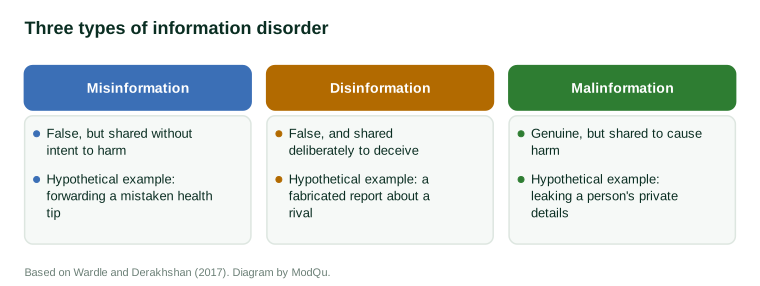
Claire Wardle and Hossein Derakhshan (2017) proposed a widely used framework for what they called information disorder, shown in Figure 1. Misinformation is false information shared without intent to harm. Disinformation is false information shared deliberately to deceive. Malinformation is genuine information shared to cause harm, such as leaked private details.
False information spreads well. Vosoughi et al. (2018) studied the spread of true and false news stories on a major social media platform over more than a decade and found that false stories reached more people, more quickly, than true ones. The difference was driven by people rather than automated accounts, and false stories were more novel and provoked stronger reactions of surprise and disgust.
Exposure and sharing are, however, concentrated. Grinberg et al. (2019) studied the exposure of a large sample of registered voters to fake news sources on a social media platform during the 2016 United States presidential election and found that a very small fraction of users accounted for the great majority of exposures and shares. Guess et al. (2019) found that sharing links to fake news sites on another platform was rare overall, and was far more common among users over 65 than among younger users. Misinformation is a serious problem, but it is not equally distributed, and most people share it rarely.
Why false claims are believed
Repetition makes claims feel true. Lynn Hasher, David Goldstein and Thomas Toppino (1977) found that people rated statements as more likely to be true when they had seen them before, an effect now called the illusory truth effect. Fazio et al. (2015) showed that repetition increased the perceived truth of false statements even when participants had the knowledge to recognise them as false. Familiarity is easily mistaken for accuracy.
Inattention matters more than many expect. Gordon Pennycook and David Rand (2019) found that people who scored higher on a test of reflective thinking were better at distinguishing real from fake news headlines, whether or not the headlines matched their political views. They argued that susceptibility to false news is often a matter of not thinking carefully rather than of motivated reasoning. In later experiments, Pennycook et al. (2021) found that simply prompting people to consider the accuracy of a headline improved the quality of the news they subsequently chose to share.
Motivation still plays a part. Kahan et al. (2017) found that people with stronger numerical skills were more likely to interpret data correctly when the answer suited their political views, and no more likely, or even less likely, when it did not. Both inattention and motivated reasoning contribute, and their balance varies with the topic and the person.
Some doubt is manufactured. Naomi Oreskes and Erik Conway (2010) documented how a small number of scientists, often supported by industry funding, worked over several decades to cast doubt on scientific evidence about the harms of smoking, acid rain, ozone depletion and climate change. Their strategy did not require proving the evidence wrong, only creating an impression that the science was unsettled.
Correcting false beliefs
Once a false belief is established, correcting it is difficult. Lewandowsky et al. (2012) reviewed research on the continued influence effect: people continue to rely on false information even after it has been corrected and even when they remember the correction. Corrections work better when they provide an alternative explanation to fill the gap left by the false claim, come from trusted sources, and avoid repeating the false claim more than necessary.
Echo chambers and epistemic bubbles
C. Thi Nguyen (2020) distinguished two structures that limit what people hear. In an epistemic bubble, relevant voices are simply missing, for example because a person's social network contains few people with different views. Bubbles can be burst by exposure to new information. In an echo chamber, outside voices are actively discredited: members are taught to distrust anyone outside the group. Exposure to contrary evidence does not help, and may even strengthen the chamber, since the group has been prepared to dismiss outsiders. Escaping an echo chamber requires rebuilding trust, not just supplying information.
What responsible knowing requires
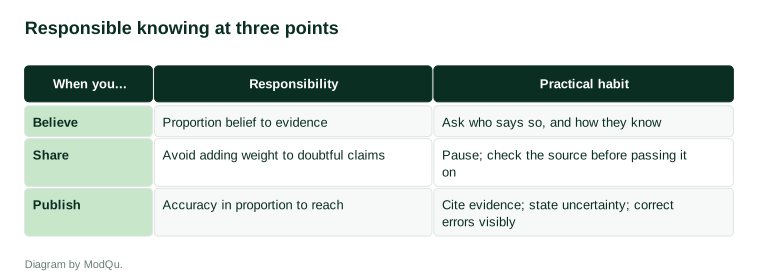
Epistemic responsibility applies at three points: when we form beliefs, when we share them, and, for organisations and professionals, when we publish them. Figure 2 summarises what each involves.
Sam Wineburg and Sarah McGrew (2019) compared how professional fact-checkers, historians and university students evaluated unfamiliar websites. The fact-checkers were faster and more accurate, because they practised lateral reading: instead of studying a website closely, they quickly left it and searched for what other sources said about it. Reading less of the page and more about the source proved the better strategy. Students, by contrast, often judged sites by their appearance, their design or the presence of official-looking logos and references, features that are easy to imitate.
For organisations, responsibility extends to what they publish. Reports, press releases and marketing claims are read by people who cannot check them, and so carry a duty of accuracy proportionate to their reach. Claims should be supported by evidence that is cited and available; uncertainty should be stated; and errors should be corrected promptly and visibly.
Responsibility for numbers
Statistics deserve particular care, because numbers carry an air of precision that words do not. A percentage quoted without its source, its sample or the exact question asked can mean almost anything. "Seven in ten consumers prefer" might describe a large, representative survey or a handful of replies to an online poll; it might refer to all consumers or only those who already buy a product; and the answer might depend heavily on how the question was phrased. Statistics also travel well. Once a figure appears in one article, it is easily copied into others, losing its context at each step until no one can say where it came from.
Responsible use of statistics therefore involves a few simple questions. Who collected the figure, and how? How many people were asked, and how were they chosen? What exactly were they asked? When was it collected? Does the figure say what the person quoting it claims? Producers of research carry the corresponding duty: to publish enough detail about their methods for these questions to be answered, so that their findings can be judged rather than simply believed.
An example
The following example is hypothetical. A company's marketing team finds a striking statistic on social media claiming that most consumers will pay more for sustainable products, and plans to feature it in a campaign. A colleague asks where the figure comes from. Tracing it, the team finds that it originated in a small online poll conducted years earlier, was rounded upward in a blog post, and has since been repeated without its source. The team decides not to use it, commissions a survey of its own customers with clearly worded questions, and reports the results with the sample size and the exact wording. The campaign is less dramatic but defensible, and the company avoids adding one more voice to the repetition of an unsupported claim.
Conclusion
Epistemic responsibility asks each person and organisation to take care over what they believe, share and publish, in proportion to the effects their beliefs and claims can have on others. It does not require checking everything personally, which is impossible, but it does require choosing sources carefully, noticing when a claim is too convenient or too surprising to accept without checking, correcting mistakes, and remembering that every share and every publication adds weight to a claim. In a world where false information travels easily, the reliability of shared knowledge depends on many small acts of care.
References
Baehr, J. (2011). The inquiring mind: On intellectual virtues and virtue epistemology. Oxford University Press. https://doi.org/10.1093/acprof:oso/9780199604074.001.0001
Clifford, W. K. (1877). The ethics of belief. Contemporary Review, 29, 289–309.
Code, L. (1987). Epistemic responsibility. University Press of New England.
Fazio, L. K., Brashier, N. M., Payne, B. K., & Marsh, E. J. (2015). Knowledge does not protect against illusory truth. Journal of Experimental Psychology: General, 144(5), 993–1002. https://doi.org/10.1037/xge0000098
Fricker, M. (2007). Epistemic injustice: Power and the ethics of knowing. Oxford University Press. https://doi.org/10.1093/acprof:oso/9780198237907.001.0001
Goldman, A. I. (2001). Experts: Which ones should you trust? Philosophy and Phenomenological Research, 63(1), 85–110. https://doi.org/10.1111/j.1933-1592.2001.tb00093.x
Grinberg, N., Joseph, K., Friedland, L., Swire-Thompson, B., & Lazer, D. (2019). Fake news on Twitter during the 2016 U.S. presidential election. Science, 363(6425), 374–378. https://doi.org/10.1126/science.aau2706
Guess, A., Nagler, J., & Tucker, J. (2019). Less than you think: Prevalence and predictors of fake news dissemination on Facebook. Science Advances, 5(1), Article eaau4586. https://doi.org/10.1126/sciadv.aau4586
Hardwig, J. (1985). Epistemic dependence. The Journal of Philosophy, 82(7), 335–349. https://doi.org/10.2307/2026523
Hasher, L., Goldstein, D., & Toppino, T. (1977). Frequency and the conference of referential validity. Journal of Verbal Learning and Verbal Behavior, 16(1), 107–112. https://doi.org/10.1016/S0022-5371(77)80012-1
James, W. (1896). The will to believe. The New World, 5, 327–347.
Kahan, D. M., Peters, E., Dawson, E. C., & Slovic, P. (2017). Motivated numeracy and enlightened self-government. Behavioural Public Policy, 1(1), 54–86. https://doi.org/10.1017/bpp.2016.2
Lewandowsky, S., Ecker, U. K. H., Seifert, C. M., Schwarz, N., & Cook, J. (2012). Misinformation and its correction: Continued influence and successful debiasing. Psychological Science in the Public Interest, 13(3), 106–131. https://doi.org/10.1177/1529100612451018
Nguyen, C. T. (2020). Echo chambers and epistemic bubbles. Episteme, 17(2), 141–161. https://doi.org/10.1017/epi.2018.32
O'Neill, O. (2002). A question of trust. Cambridge University Press.
Oreskes, N., & Conway, E. M. (2010). Merchants of doubt: How a handful of scientists obscured the truth on issues from tobacco smoke to global warming. Bloomsbury Press.
Pennycook, G., Epstein, Z., Mosleh, M., Arechar, A. A., Eckles, D., & Rand, D. G. (2021). Shifting attention to accuracy can reduce misinformation online. Nature, 592(7855), 590–595. https://doi.org/10.1038/s41586-021-03344-2
Pennycook, G., & Rand, D. G. (2019). Lazy, not biased: Susceptibility to partisan fake news is better explained by lack of reasoning than by motivated reasoning. Cognition, 188, 39–50. https://doi.org/10.1016/j.cognition.2018.06.011
Vosoughi, S., Roy, D., & Aral, S. (2018). The spread of true and false news online. Science, 359(6380), 1146–1151. https://doi.org/10.1126/science.aap9559
Wardle, C., & Derakhshan, H. (2017). Information disorder: Toward an interdisciplinary framework for research and policymaking (Council of Europe Report DGI(2017)09). Council of Europe.
Wineburg, S., & McGrew, S. (2019). Lateral reading and the nature of expertise: Reading less and learning more when evaluating digital information. Teachers College Record, 121(11), 1–40.