
Inquiry · Inquiry in organisations
Double-Loop Learning and Questioning Assumptions
Single-loop learning fixes errors within existing assumptions; double-loop learning questions the assumptions themselves. This article explains Chris Argyris and Donald Schön's theory, why double-loop learning is rare, and practical techniques for surfacing and testing the assumptions behind decisions.
When a plan fails, the natural response is to try harder or to try a different tactic. Sometimes that is enough. But sometimes the plan failed because the assumptions behind it were wrong, and no amount of better execution will fix it. The organisational theorists Chris Argyris and Donald Schön called the first kind of response single-loop learning and the second double-loop learning. Their distinction has become one of the most widely used ideas in management, yet the behaviour it describes remains uncommon. This article explains the theory, why double-loop learning is difficult and how assumptions can be brought into the open and tested.
Two loops
Argyris and Schön borrowed the idea of two feedback loops from the cybernetician W. Ross Ashby (1960), who described how adaptive systems adjust their behaviour in two ways: by correcting actions within fixed limits and, when that fails, by changing the limits themselves. Argyris and Schön (1978) applied this to human and organisational learning. Figure 1 shows the two loops.
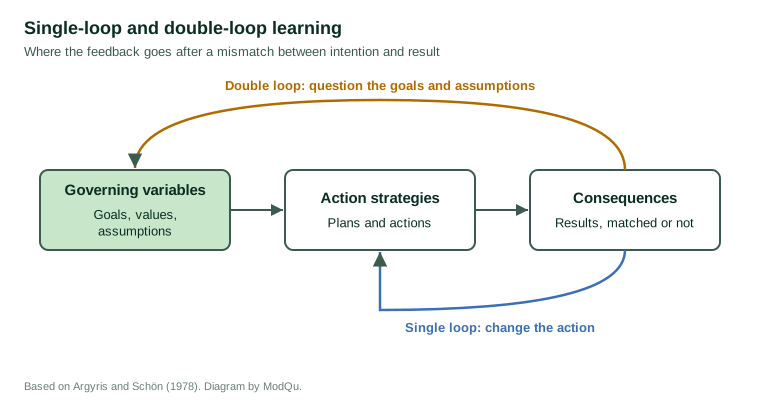
Every action is guided by governing variables: the goals, values, norms and assumptions that the actor is trying to satisfy. These lead to action strategies, which produce consequences. When the consequences are not what was intended, there are two possible responses. In single-loop learning, the actor changes the action strategy while leaving the governing variables untouched. In double-loop learning, the actor questions the governing variables themselves.
Argyris (1977) gave a simple illustration. A thermostat that turns the heating on when the temperature falls below a set point is performing single-loop learning. A thermostat that could ask whether the set point was right, and why it should be kept at that temperature at all, would be performing double-loop learning. In organisations, a sales team that responds to falling sales by making more calls is learning in a single loop. A team that asks whether it is selling to the right customers, or whether the product meets their needs, is learning in a double loop.
The anthropologist Gregory Bateson (1972) had earlier described a similar hierarchy of learning levels, distinguishing learning within a set of alternatives from learning that changes the set of alternatives itself. Later writers proposed triple-loop learning, concerned with how an organisation learns to learn, although Tosey et al. (2012) found that the term has been used in many inconsistent ways.
Espoused theories and theories-in-use
Argyris and Schön (1974) drew a second distinction that explains why double-loop learning is hard. People hold espoused theories, the beliefs and values they state when asked how they act, and theories-in-use, the beliefs and values that can be inferred from how they actually act. The two often differ, and people are usually unaware of the gap.
Argyris and Schön found that most people's theories-in-use follow a pattern they called Model I. Its governing variables are to achieve one's intended purpose, to win and not lose, to suppress negative feelings and to appear rational. In practice, this means advocating one's own position without inviting challenge, saving face for oneself and others, and avoiding open testing of one's assumptions. Model I behaviour is effective in many routine situations, but it blocks double-loop learning, because questioning governing variables threatens to expose errors and cause embarrassment.
The alternative, Model II, has different governing variables: valid information, free and informed choice, and internal commitment to the choice. In Model II, people combine advocacy with inquiry. They state their views and the reasoning behind them, and they invite others to challenge them. Argyris and Schön found that although many people espouse Model II, very few act on it.
Defensive routines
Argyris (1990) described organisational defensive routines: actions or policies intended to prevent individuals or groups from experiencing embarrassment or threat, which also prevent them from identifying and reducing the causes of that embarrassment. A typical example is a meeting in which everyone privately doubts a strategy but no one says so, because raising the doubt would embarrass its sponsor. Afterwards, the doubts are expressed in private, and the strategy proceeds. Defensive routines are self-sealing: the fact that a topic is undiscussable is itself undiscussable.
Argyris (1991) argued that highly educated professionals are especially prone to defensive reasoning. Having rarely experienced failure, they have little practice in learning from it, and when their performance is criticised they tend to blame others or circumstances. His studies of management consultants found that they were adept at diagnosing problems in clients' organisations but became defensive when asked to examine their own role in projects that went wrong.
Tucker and Edmondson (2003) found a similar pattern in hospitals. Nurses who encountered operational problems, such as missing supplies, typically worked around them, which they called first-order problem solving. They rarely engaged in second-order problem solving, which would mean alerting someone who could change the system that caused the problem. The workaround met the immediate goal but left the underlying assumptions and routines unchanged, so the same problems recurred.
Techniques for surfacing assumptions
Because assumptions are often taken for granted, they must be deliberately brought into view before they can be tested. Several techniques help.
The ladder of inference. Senge et al. (1994) popularised a tool, based on Argyris's work, that describes how people move from observable data to conclusions through a series of steps: selecting data, adding meanings, making assumptions, drawing conclusions and adopting beliefs that then shape what data they select next. Walking back down the ladder, by asking "what data led you to that conclusion?", makes the reasoning visible and open to challenge.
The left-hand column. Argyris and Schön (1974) asked people to write down a difficult conversation, putting what was said in the right-hand column and what they thought but did not say in the left-hand column. The exercise reveals the unspoken assumptions and feelings that shape the conversation and often shows why it failed.
Assumption surfacing and testing. Mason and Mitroff (1981) developed a structured process in which groups identify the assumptions underlying a proposed strategy, rate them for importance and certainty, and focus inquiry on those that are both important and uncertain.
Structured debate. Schweiger et al. (1986) compared groups that made strategic decisions by consensus with groups that used devil's advocacy, in which one member critiques the proposal, or dialectical inquiry, in which a counter-proposal based on opposite assumptions is developed. Both structured approaches produced higher-quality recommendations and assumptions than consensus. A meta-analysis by Charles Schwenk (1990) found that devil's advocacy in particular improved decision quality compared with expert-based approaches.
Why it matters
Failures of double-loop learning can be costly. Clayton Christensen (1997) described how well-managed companies lose their markets to new technologies because their processes, values and assumptions about what customers want are tuned to their existing business. They respond to the threat with single-loop improvements to existing products, while the assumptions that make the new technology look unattractive go unquestioned.
Barbara Levitt and James March (1988) described a related danger, the competency trap. An organisation that becomes skilled at a particular way of working gets good results from it, which encourages it to keep using that approach and to become even more skilled at it. Meanwhile, a different approach that might eventually be better looks worse, because the organisation has little experience with it. Single-loop learning steadily improves the existing approach and so deepens the trap. Only by questioning the assumption that the existing approach is the right one can the organisation see the alternative fairly. The same pattern affects research teams. A team that has always measured customer loyalty in a particular way may keep refining that measure long after the market has changed what loyalty means.
A hypothetical example
A subscription business sees its renewal rate fall. Its first response is single-loop: offer larger discounts at renewal time. Renewals improve slightly, at a high cost. A team then asks what assumptions lie behind the discount strategy. The central one is that customers leave because of price. Using the ladder of inference, the team traces this belief back to a handful of exit comments that mentioned price. When they look at the full data, they find that most customers who leave have barely used the service in the preceding months. The governing assumption changes from "customers leave because of price" to "customers leave because they do not get value from the service", and the strategy shifts from discounts to helping new customers use the service effectively.
Putting double-loop learning into practice
- Ask what must be true. For any strategy, list the assumptions it depends on.
- Combine advocacy with inquiry. State your view and your reasoning, and ask others what they see differently.
- Look for the undiscussable. Ask what topics people avoid raising in meetings, and why.
- Use structured challenge. Assign someone to argue against a proposal, or develop a counter-plan from opposite assumptions.
- Review assumptions after outcomes. When results disappoint, ask whether the assumptions, not only the actions, were wrong.
Schön (1983) described the professionals who do this well as reflective practitioners: people who notice when a situation does not fit their expectations and treat the surprise as a reason to rethink, not merely to try harder.
References
Argyris, C. (1977). Double loop learning in organizations. Harvard Business Review, 55(5), 115–125.
Argyris, C. (1990). Overcoming organizational defenses: Facilitating organizational learning. Allyn and Bacon.
Argyris, C. (1991). Teaching smart people how to learn. Harvard Business Review, 69(3), 99–109.
Argyris, C., & Schön, D. A. (1974). Theory in practice: Increasing professional effectiveness. Jossey-Bass.
Argyris, C., & Schön, D. A. (1978). Organizational learning: A theory of action perspective. Addison-Wesley.
Ashby, W. R. (1960). Design for a brain: The origin of adaptive behaviour (2nd ed.). Chapman & Hall.
Bateson, G. (1972). Steps to an ecology of mind. Chandler.
Christensen, C. M. (1997). The innovator's dilemma: When new technologies cause great firms to fail. Harvard Business School Press.
Levitt, B., & March, J. G. (1988). Organizational learning. Annual Review of Sociology, 14, 319–338. https://doi.org/10.1146/annurev.so.14.080188.001535
Mason, R. O., & Mitroff, I. I. (1981). Challenging strategic planning assumptions: Theory, cases, and techniques. Wiley.
Schweiger, D. M., Sandberg, W. R., & Ragan, J. W. (1986). Group approaches for improving strategic decision making: A comparative analysis of dialectical inquiry, devil's advocacy, and consensus. Academy of Management Journal, 29(1), 51–71. https://doi.org/10.5465/255859
Schwenk, C. R. (1990). Effects of devil's advocacy and dialectical inquiry on decision making: A meta-analysis. Organizational Behavior and Human Decision Processes, 47(1), 161–176. https://doi.org/10.1016/0749-5978(90)90051-A
Schön, D. A. (1983). The reflective practitioner: How professionals think in action. Basic Books.
Senge, P. M., Kleiner, A., Roberts, C., Ross, R. B., & Smith, B. J. (1994). The fifth discipline fieldbook: Strategies and tools for building a learning organization. Currency Doubleday.
Tosey, P., Visser, M., & Saunders, M. N. K. (2012). The origins and conceptualizations of 'triple-loop' learning: A critical review. Management Learning, 43(3), 291–307. https://doi.org/10.1177/1350507611426239
Tucker, A. L., & Edmondson, A. C. (2003). Why hospitals don't learn from failures: Organizational and psychological dynamics that inhibit system change. California Management Review, 45(2), 55–72. https://doi.org/10.2307/41166165