
Inquiry · Inquiry in organisations
Design Thinking as a Process of Inquiry
Design thinking is often presented as a creative workshop method, but at its core it is a way of inquiring into problems that cannot be fully defined in advance. This article explains its roots in design research, its main stages, what the evidence shows and where it falls short.
Design thinking has become one of the most popular approaches to innovation in business, government and education. It is often presented as a sequence of workshop activities: empathise with users, define the problem, generate ideas, build prototypes and test them. Behind the workshops lies a more substantial idea, developed over decades of research into how designers actually work. Designers deal with problems that cannot be fully specified at the start, and they learn about the problem by proposing and testing possible solutions. In this sense, design thinking is a form of inquiry, and understanding it that way explains both its strengths and its limits.
Design as a way of knowing
Herbert Simon (1969) argued that design is the core of all professional activity, defining it as devising "courses of action aimed at changing existing situations into preferred ones". Where the natural sciences ask how things are, the sciences of the artificial, as Simon called them, ask how things might be. Peter Rowe (1987) used the phrase design thinking for the reasoning of architects and planners as they worked through design problems.
Donald Schön (1983) studied architects and other professionals and described design as a "reflective conversation with the situation". The designer frames the problem in a particular way, makes a move such as a sketch, sees how the situation responds and reframes accordingly. The situation "talks back", and the designer learns from it. Bryan Lawson (2006), drawing on many studies of designers, found that they do not analyse the problem fully before starting to generate solutions. Instead, they propose early solutions as a way of understanding the problem.
Kees Dorst and Nigel Cross (2001) described this as the co-evolution of problem and solution. In studies of designers at work, they found that creative insights occurred when designers saw a new way of framing the problem that fitted a solution they were developing. The problem and the solution developed together, each shaping the other. Cross (2011) summarised decades of research as showing that designers are solution-focused, use sketches and models to think, and are comfortable working with problems that are not well defined.
Why design problems need this kind of inquiry
Richard Buchanan (1992) argued that design deals with wicked problems, the term Rittel and Webber (1973) had used for problems that have no definitive formulation, no stopping rule and no single correct solution. For such problems, analysis alone cannot specify what the answer should be, because the problem itself is partly a matter of choice. Dorst (2011) argued that the distinctive contribution of design is framing: proposing a new way of seeing a problematic situation that opens up possible solutions. He linked this to abduction, the form of reasoning that proposes a hypothesis to explain or address a situation, which design shares with scientific discovery.
Roger Martin (2009) argued that businesses tend to favour analytical thinking, which exploits existing knowledge, over intuitive thinking, which explores new possibilities. He presented design thinking as a way of balancing the two, using abductive reasoning to generate ideas that can then be tested and refined.
The process
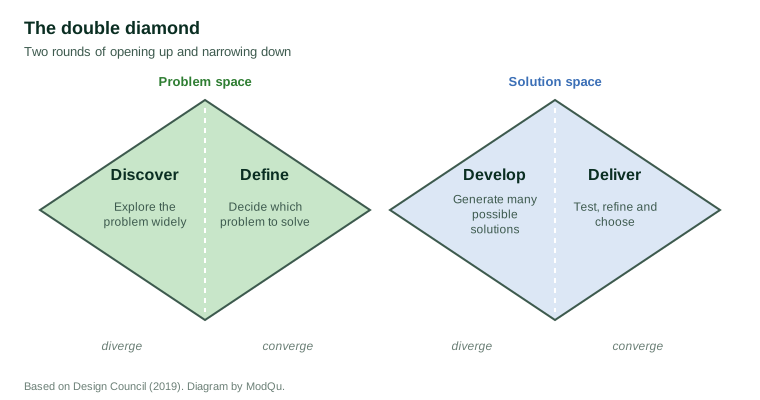
Popular versions of design thinking divide the process into stages. One widely used model is the double diamond, shown in Figure 1, which describes two phases of opening up and narrowing down (Design Council, 2019). In the first diamond, the team explores the problem widely, gathering insights from users and other sources, and then defines the specific problem to address. In the second, it develops many possible solutions and then tests and refines them to choose what to deliver.
Tim Brown (2008), chief executive of the design firm IDEO, described design thinking as a human-centred approach built around three overlapping spaces: inspiration, in which the team observes people and their problems; ideation, in which it generates and develops ideas; and implementation, in which it brings the best ideas to market. Whatever the model, the stages are not strictly sequential. Teams loop back as prototypes reveal new aspects of the problem.
Several practices are central.
Empathic observation. Designers study people in their own settings, not only through surveys. Leonard and Rayport (1997) described empathic design, in which observers watch customers use products in their own environments and notice needs that customers themselves may not articulate, because they have learned to work around them.
Reframing. The team questions the brief and considers alternative ways of stating the problem. A request to design a faster lift might be reframed as a problem of making the wait feel shorter.
Prototyping. Rough, inexpensive models of possible solutions are built early so that they can be tested with users. Prototypes are a means of asking questions, not a preview of the final product. Beckman and Barry (2007) described design thinking as a learning process in which prototypes allow teams to move between concrete experience and abstract understanding.
Iteration. Each round of testing feeds back into the understanding of the problem and the next version of the solution.
What the evidence shows
Design thinking has been widely adopted, but research on its effects is less developed than its popularity suggests. Johansson-Sköldberg et al. (2013) distinguished between designerly thinking, the academic research on how professional designers work, and design thinking as a management approach, and noted that the latter often draws loosely on the former. Lucy Kimbell (2011) argued that popular accounts treat design thinking as a general cognitive style, neglecting the situated practices and materials through which designers actually work.
Micheli et al. (2019) reviewed the research literature and identified a set of attributes commonly associated with design thinking, including creativity and innovation, user-centredness, problem solving, iteration and experimentation, interdisciplinary collaboration, ability to visualise and tolerance of ambiguity. They found that empirical evidence on its effects remains limited and that definitions vary widely.
There is, however, good evidence for some of its component practices. Dow et al. (2010) found that designers who created several prototypes in parallel, and received feedback on all of them, produced better and more diverse designs than those who developed one prototype in sequence. Jansson and Smith (1991) demonstrated design fixation: when designers were shown an example solution, they tended to reproduce its features, including its flaws. Generating multiple options before committing helps counter this tendency. Jeanne Liedtka (2015) argued that design thinking's main value lies in reducing well-known cognitive biases, such as the tendency to project one's own views onto customers, to favour the first idea and to avoid testing assumptions. Seidel and Fixson (2013) found that novice multidisciplinary teams benefited from design methods, but that the benefits depended on applying the right methods at the right stage, such as more reflection during concept generation.
Design thinking as inquiry
Seen as inquiry, design thinking has a distinctive structure. Conventional research asks a question and gathers evidence to answer it. Design inquiry proposes a possible answer, in the form of a prototype, and uses the response to sharpen both the question and the answer. This is especially useful when people cannot easily say what they want, because they are responding to something that does not yet exist. Don Norman (2013) emphasised that observing how people use, and fail to use, real objects reveals needs that are invisible in abstract discussion.
The approach also has limits as a method of inquiry. Small numbers of observations and user tests can reveal problems and possibilities, but they cannot show how common a need is or how large a market might be. Prototype testing with a few users can be misleading if those users are unrepresentative. Design thinking is therefore strongest when combined with other methods: qualitative observation to discover needs, prototyping to explore solutions, and quantitative research to test how widely the findings apply.
Common pitfalls
Several problems recur when organisations adopt design thinking.
Theatre instead of inquiry. Workshops with sticky notes and brainstorming can produce energy without learning. If the team does not observe real users or test real prototypes, the process becomes a ritual that confirms what participants already believed.
Skipping the first diamond. Teams under time pressure often move straight to generating solutions for the problem as briefed. The research on co-evolution and framing suggests that much of the value lies in questioning the brief, so skipping this stage removes the part of the process that is most distinctive.
Falling in love with the first idea. Design fixation (Jansson & Smith, 1991) affects teams as well as individuals. Once a prototype has been built and shown, it can be hard to abandon, even when tests are disappointing.
Treating small samples as proof. A prototype that delights five users is promising, not proven. Observations from small samples are best used to generate and refine ideas, with larger studies used to test them.
Ignoring implementation. Brown (2008) emphasised implementation as one of the three spaces of design thinking, but many projects stop at the concept stage. Ideas that are never built and tested in real conditions teach little about whether they work.
A hypothetical example
A regional bank asks a team to design a better mobile app for small business customers. The brief assumes the problem is the app's features. The team begins by observing business owners at work and finds that many do their banking late at night, after closing, and that their main frustration is not the app but the time it takes to reconcile payments with their own records. The problem is reframed: how might the bank help owners understand their cash position quickly at the end of the day? The team builds three rough prototypes, including a simple daily summary sent by message, and tests them with a dozen owners. The summary proves most valuable. Before investing in development, the bank runs a survey of a larger, representative sample of business customers to estimate how many share the need, and finds that it is widespread among the smallest businesses but less so among larger ones. The design process discovered the opportunity; the survey sized it.
Using design thinking well
- Treat the brief as a hypothesis. Question the stated problem before solving it.
- Observe, do not only ask. Watch what people do in their own settings.
- Prototype early and in parallel. Several rough options teach more than one polished one.
- Test assumptions explicitly. List what must be true for a solution to work, and test the riskiest first.
- Combine with other evidence. Use larger studies to check how far insights from small samples generalise.
Conclusion
Design thinking is best understood not as a set of workshop activities but as a mode of inquiry suited to problems that cannot be fully defined in advance. Its roots lie in research showing that designers learn about problems by proposing and testing solutions, framing and reframing as they go. The evidence supports several of its core practices, particularly parallel prototyping and the deliberate generation of alternatives, while broader claims for its effects remain less well tested. Used as one method among several, and combined with research that can test how widely its insights apply, it is a valuable way of discovering what problem is worth solving and what a good solution might look like.
References
Beckman, S. L., & Barry, M. (2007). Innovation as a learning process: Embedding design thinking. California Management Review, 50(1), 25–56. https://doi.org/10.2307/41166415
Brown, T. (2008). Design thinking. Harvard Business Review, 86(6), 84–92.
Buchanan, R. (1992). Wicked problems in design thinking. Design Issues, 8(2), 5–21. https://doi.org/10.2307/1511637
Cross, N. (2011). Design thinking: Understanding how designers think and work. Berg.
Design Council. (2019). What is the framework for innovation? Design Council's evolved Double Diamond. Design Council.
Dorst, K. (2011). The core of 'design thinking' and its application. Design Studies, 32(6), 521–532. https://doi.org/10.1016/j.destud.2011.07.006
Dorst, K., & Cross, N. (2001). Creativity in the design process: Co-evolution of problem–solution. Design Studies, 22(5), 425–437. https://doi.org/10.1016/S0142-694X(01)00009-6
Dow, S. P., Glassco, A., Kass, J., Schwarz, M., Schwartz, D. L., & Klemmer, S. R. (2010). Parallel prototyping leads to better design results, more divergence, and increased self-efficacy. ACM Transactions on Computer-Human Interaction, 17(4), Article 18. https://doi.org/10.1145/1879831.1879836
Jansson, D. G., & Smith, S. M. (1991). Design fixation. Design Studies, 12(1), 3–11. https://doi.org/10.1016/0142-694X(91)90003-F
Johansson-Sköldberg, U., Woodilla, J., & Çetinkaya, M. (2013). Design thinking: Past, present and possible futures. Creativity and Innovation Management, 22(2), 121–146. https://doi.org/10.1111/caim.12023
Kimbell, L. (2011). Rethinking design thinking: Part I. Design and Culture, 3(3), 285–306. https://doi.org/10.2752/175470811X13071166525216
Lawson, B. (2006). How designers think: The design process demystified (4th ed.). Architectural Press.
Leonard, D., & Rayport, J. F. (1997). Spark innovation through empathic design. Harvard Business Review, 75(6), 102–113.
Liedtka, J. (2015). Perspective: Linking design thinking with innovation outcomes through cognitive bias reduction. Journal of Product Innovation Management, 32(6), 925–938. https://doi.org/10.1111/jpim.12163
Martin, R. (2009). The design of business: Why design thinking is the next competitive advantage. Harvard Business Press.
Micheli, P., Wilner, S. J. S., Bhatti, S. H., Mura, M., & Beverland, M. B. (2019). Doing design thinking: Conceptual review, synthesis, and research agenda. Journal of Product Innovation Management, 36(2), 124–148. https://doi.org/10.1111/jpim.12466
Norman, D. A. (2013). The design of everyday things (Rev. ed.). Basic Books.
Rittel, H. W. J., & Webber, M. M. (1973). Dilemmas in a general theory of planning. Policy Sciences, 4(2), 155–169. https://doi.org/10.1007/BF01405730
Rowe, P. G. (1987). Design thinking. MIT Press.
Schön, D. A. (1983). The reflective practitioner: How professionals think in action. Basic Books.
Seidel, V. P., & Fixson, S. K. (2013). Adopting design thinking in novice multidisciplinary teams: The application and limits of design methods and reflexive practices. Journal of Product Innovation Management, 30(S1), 19–33. https://doi.org/10.1111/jpim.12061
Simon, H. A. (1969). The sciences of the artificial. MIT Press.