
Inquiry · Inquiry in organisations
Decision Framing: Getting the Question Right Before Answering It
How a decision is framed determines which options are considered, which evidence is gathered and which answer looks best. This article explains framing effects and the error of solving the wrong problem, what research shows about problem formulation, and practical ways to get the question right before answering it.
A team can analyse a problem rigorously, gather excellent evidence and reach a well-reasoned conclusion, and still fail, because it was working on the wrong problem. The statistician Allyn Kimball (1957) called this an error of the third kind: giving the right answer to the wrong question. Decision framing is the work of deciding what question a decision should answer: what is being decided, why, within what limits and judged against what objectives. Research in psychology, management and decision analysis shows that framing has large effects on outcomes and that it is often done carelessly or not at all. This article explains why framing matters, how frames go wrong and how to frame decisions well.
Framing effects
The most famous demonstration of framing comes from Amos Tversky and Daniel Kahneman (1981). Participants were told that a country was preparing for an unusual disease expected to kill 600 people and were asked to choose between two programmes. In one version, the options were described in terms of lives saved: Programme A would save 200 people for certain; Programme B had a one-third probability of saving all 600 and a two-thirds probability of saving no one. Most participants chose the certain option. In another version, the same options were described in terms of deaths: under Programme C, 400 people would die for certain; under Programme D, there was a one-third probability that nobody would die and a two-thirds probability that all 600 would die. Most participants chose the risky option. Figure 1 shows the result.
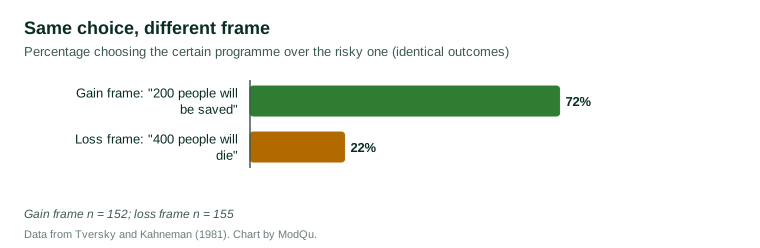
The outcomes were identical; only the description differed. Kahneman and Tversky (1979) explained such effects through prospect theory, which holds that people evaluate outcomes as gains or losses relative to a reference point and are typically risk-averse for gains and risk-seeking for losses. Changing the reference point, by describing outcomes as lives saved or lives lost, changes which option looks better.
Framing effects are not confined to laboratory puzzles. McNeil et al. (1982) found that patients, students and doctors were more likely to prefer surgery over radiation therapy for lung cancer when outcomes were described in terms of survival rather than mortality, even though the statistics were the same. Levin et al. (1998) reviewed the research and distinguished several kinds of framing effect: risky choice framing, as in the disease problem; attribute framing, in which a single attribute is described positively or negatively, such as beef described as "75% lean" or "25% fat"; and goal framing, in which the consequences of an action are described as gains from acting or losses from not acting. All three affected judgements, though in different ways and to different degrees.
The deeper problem: choosing the question
Framing effects show that the description of a choice can change the decision. A more fundamental problem concerns which choice is being considered at all. Ian Mitroff and Tom Featheringham (1974) described the error of the third kind as "the probability of having solved the wrong problem when one should have solved the right problem", and argued that it is often more costly than errors in analysis. Organisations invest heavily in methods for answering questions correctly and much less in methods for choosing which questions to answer.
Paul Nutt (2002) studied hundreds of organisational decisions and found that the way the decision was initially framed was among the strongest predictors of success. Decisions framed around a ready-made solution, in which someone proposed an idea and the organisation evaluated it, failed more often than decisions framed around an explicit objective, in which the organisation first established what it was trying to achieve and then searched for ways to achieve it. Solution-framed decisions limited the search for alternatives and tended to become exercises in justifying the initial idea.
Markus Baer, Kurt Dirks and Jackson Nickerson (2013) argued that the formulation of strategic problems has been neglected in management research, even though it determines which solutions an organisation will consider. They proposed that problem formulation is a distinct activity requiring its own processes, and that groups formulate problems better when members with different knowledge are able to contribute and when the group avoids converging prematurely on a single definition.
Research on creativity points the same way. Getzels and Csikszentmihalyi (1976) found that art students who spent longer exploring and formulating their task produced more original work, and were more successful years later, than students who quickly settled on a problem. Donald Schön (1983) described professional practice as beginning with problem setting: the process of naming the things to be attended to and framing the context in which they will be attended to. John Dewey (1938) had made the same point earlier, arguing that a problem well stated is half solved, and that a problem wrongly stated sends all subsequent inquiry astray.
How frames go wrong
Several common patterns lead to poor frames.
Framing around a solution. As Nutt (2002) found, the most common error is to frame a decision as a yes-or-no choice about a proposal, such as "should we acquire this company?", rather than as a question about the objective, such as "how should we enter this market?".
Narrow framing. Read et al. (1999) described choice bracketing: people tend to evaluate decisions one at a time rather than together, so that a series of choices, each reasonable on its own, adds up to a poor overall outcome. A manager who evaluates each project in isolation may take on too little risk overall, or too much.
The wrong reference point. Because people evaluate outcomes relative to a reference point, the choice of comparison matters. A result that looks like a gain compared with last year may look like a loss compared with a competitor. Hammond et al. (1998) warned that the initial frame often anchors the reference point without anyone deciding it should.
The wrong time horizon. A decision framed around next quarter's results will favour different options from one framed around the next five years.
Inherited frames. Frames are often inherited from how a problem was first described, by whoever happened to raise it. Thomas Wedell-Wedellsborg (2017) observed that teams frequently accept the first framing of a problem without question, and recommended deliberately reframing it: looking outside the frame, rethinking the goal and examining bright spots where the problem does not occur.
The elements of a frame
Decision analysts have developed explicit procedures for framing. Ronald Howard (1988), a founder of decision analysis, argued that the frame is the first element of decision quality, because it determines what is to be decided and therefore everything that follows. Spetzler et al. (2016) describe an appropriate frame as one that makes clear the purpose of the decision, what is taken as given, what is to be decided now and what can be decided later. Figure 2 summarises the main elements.
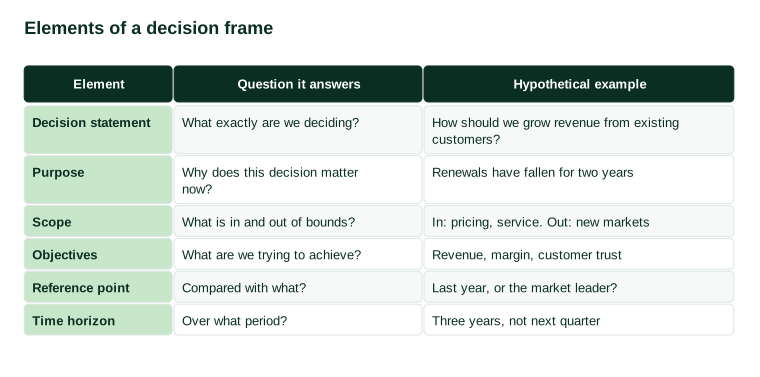
Ralph Keeney (1992) argued that the most important element is the set of objectives. In value-focused thinking, decision makers begin by asking what they care about in the situation, and only then look for alternatives. Starting from values tends to reveal options that would not have appeared if the analysis had started from the alternatives on the table. Hammond et al. (1999) recommended that decision makers write down a clear statement of the problem, list the objectives, identify the alternatives, consider the consequences and examine the trade-offs, beginning with the problem statement because errors there propagate through every later step.
Reframing deliberately
Because the first frame is often accidental, good practice is to generate several frames before choosing one. Useful techniques include:
Ask "why?" and "how?" Asking why a goal matters moves the frame to a broader objective; asking how it could be achieved moves it to a narrower one. A request to "reduce call centre costs" becomes, on asking why, "improve customer service at a sustainable cost", which opens up options such as fixing the problems that generate calls.
Change the reference point. Describe the outcomes of each option as gains and as losses, compared with different benchmarks, to see whether the preference changes. If it does, the choice depends on the frame and deserves closer thought.
Widen the bracket. Consider a decision together with related decisions. Would the conclusion be the same if all similar decisions were made under the same rule?
Ask who else would frame it differently. Customers, staff, competitors and regulators may describe the same situation in different terms. Each description suggests different evidence and different options.
Look for bright spots. Find cases where the problem does not occur, and ask what is different about them (Wedell-Wedellsborg, 2017). This often reveals a cause that the original frame missed.
Heath and Heath (2013) found that many organisational decisions are framed as "whether or not" choices, and that simply asking what else could be done improves results. Larrick (2004) found that prompting people to consider the opposite of their initial view was one of the more effective ways of reducing judgement bias. Both techniques work partly by loosening the original frame.
Framing in teams
Frames are usually set in groups, and group dynamics affect how well it is done. Members of a team often hold different pieces of relevant knowledge, but Stasser and Titus (1985) found that group discussions tend to focus on information that everyone already shares, while information held by only one member is often never mentioned. A frame built only from shared information will reflect what the group already agrees on, not what it most needs to consider. Baer et al. (2013) suggested that groups formulate problems better when they first work separately, with each member drafting their own statement of the problem, and only then compare and combine them. This reduces the pull towards an early consensus and brings more of the group's knowledge into the frame.
Status also matters. When the most senior person states their view of the problem first, others tend to adopt it. Asking each member to write down their framing before discussion begins, and having the most senior member speak last, helps keep the frame open long enough to be examined.
"We do not have time to frame"
A common objection is that framing slows decisions down. The evidence suggests the opposite. Nutt (2002) found that decisions which began with a ready-made solution often took longer overall, because the solution met resistance, failed and had to be revisited. Time spent on framing at the start is usually small compared with the time lost when a decision has to be reopened. Framing need not be elaborate. For most decisions, writing a one-paragraph statement of the decision, its purpose and its objectives, and asking two or three colleagues whether they would frame it differently, takes less than an hour. For major decisions, a structured framing session involving the people who hold relevant knowledge is a modest investment against the cost of solving the wrong problem.
Framing and research
Framing matters especially when decisions rely on research. A survey question, like a decision, can be framed in ways that change the answer. Druckman (2001) reviewed research showing that framing effects on public opinion are substantial but depend on the credibility of the source and on whether respondents encounter competing frames. For organisations using research to inform decisions, this has two implications. First, the research brief should be framed around the decision's objectives, not around a proposed solution, so that the research can reveal options the organisation has not yet considered. Second, the questions put to respondents should be checked for framing effects, for example by testing alternative wordings with comparable samples.
Thaler and Sunstein (2008) argued that because some frame is unavoidable, those who design choices for others carry a responsibility to choose frames that help people decide well. The same applies to those who frame decisions for organisations: the frame is not a neutral starting point but a choice with consequences.
A hypothetical example
A software company's board asks the management team whether it should build a mobile app. The question is framed as a yes-or-no decision about a solution. The team reframes it by asking why the board raised it. The answer is that customer engagement has been falling, and several competitors have launched apps. The decision is restated: "How can we increase active use of our product among existing customers over the next two years?" The objectives are listed: engagement, retention, development cost and speed.
With the new frame, the team generates several alternatives: build an app, improve the mobile version of the existing website, add notifications and reminders, or improve onboarding for new users. Research into how customers use the product shows that most disengaged customers stopped using it within their first month, before mobile access would have mattered. The team recommends investing first in onboarding, with a mobile app as a later option. The original question would have produced a well-researched answer about whether to build an app, and might have missed the cause of the problem.
A framing checklist
- State the decision as a question about objectives, not as a yes-or-no choice about a proposal.
- Write down the purpose, scope, objectives, reference point and time horizon.
- Generate at least two alternative frames before choosing one.
- Test the frame for sensitivity: would the preferred option change if outcomes were described differently?
- Ask who would frame it differently, and what they would see.
- Revisit the frame when new evidence suggests the problem has been misunderstood.
Conclusion
Every decision rests on a frame, chosen deliberately or by default. Research on framing effects shows that even the wording of a choice can reverse people's preferences, and research on organisational decisions shows that the way a problem is first defined strongly influences whether the decision succeeds. The error of solving the wrong problem is often more costly than any error made in the analysis that follows. Getting the question right requires stating the decision in terms of objectives, examining its scope and reference points, generating alternative frames and treating the frame as provisional. Time spent on framing is rarely wasted, because every later step of inquiry and decision depends on it.
References
Baer, M., Dirks, K. T., & Nickerson, J. A. (2013). Microfoundations of strategic problem formulation. Strategic Management Journal, 34(2), 197–214. https://doi.org/10.1002/smj.2004
Dewey, J. (1938). Logic: The theory of inquiry. Henry Holt.
Druckman, J. N. (2001). The implications of framing effects for citizen competence. Political Behavior, 23(3), 225–256. https://doi.org/10.1023/A:1015006907312
Getzels, J. W., & Csikszentmihalyi, M. (1976). The creative vision: A longitudinal study of problem finding in art. Wiley.
Hammond, J. S., Keeney, R. L., & Raiffa, H. (1998). The hidden traps in decision making. Harvard Business Review, 76(5), 47–58.
Hammond, J. S., Keeney, R. L., & Raiffa, H. (1999). Smart choices: A practical guide to making better decisions. Harvard Business School Press.
Heath, C., & Heath, D. (2013). Decisive: How to make better choices in life and work. Crown Business.
Howard, R. A. (1988). Decision analysis: Practice and promise. Management Science, 34(6), 679–695. https://doi.org/10.1287/mnsc.34.6.679
Kahneman, D., & Tversky, A. (1979). Prospect theory: An analysis of decision under risk. Econometrica, 47(2), 263–291. https://doi.org/10.2307/1914185
Keeney, R. L. (1992). Value-focused thinking: A path to creative decisionmaking. Harvard University Press.
Kimball, A. W. (1957). Errors of the third kind in statistical consulting. Journal of the American Statistical Association, 52(278), 133–142. https://doi.org/10.1080/01621459.1957.10501374
Larrick, R. P. (2004). Debiasing. In D. J. Koehler & N. Harvey (Eds.), Blackwell handbook of judgment and decision making (pp. 316–338). Blackwell. https://doi.org/10.1002/9780470752937.ch16
Levin, I. P., Schneider, S. L., & Gaeth, G. J. (1998). All frames are not created equal: A typology and critical analysis of framing effects. Organizational Behavior and Human Decision Processes, 76(2), 149–188. https://doi.org/10.1006/obhd.1998.2804
McNeil, B. J., Pauker, S. G., Sox, H. C., Jr., & Tversky, A. (1982). On the elicitation of preferences for alternative therapies. The New England Journal of Medicine, 306(21), 1259–1262. https://doi.org/10.1056/NEJM198205273062103
Mitroff, I. I., & Featheringham, T. R. (1974). On systemic problem solving and the error of the third kind. Behavioral Science, 19(6), 383–393. https://doi.org/10.1002/bs.3830190605
Nutt, P. C. (2002). Why decisions fail: Avoiding the blunders and traps that lead to debacles. Berrett-Koehler.
Read, D., Loewenstein, G., & Rabin, M. (1999). Choice bracketing. Journal of Risk and Uncertainty, 19(1–3), 171–197. https://doi.org/10.1023/A:1007879411489
Schön, D. A. (1983). The reflective practitioner: How professionals think in action. Basic Books.
Spetzler, C., Winter, H., & Meyer, J. (2016). Decision quality: Value creation from better business decisions. Wiley.
Stasser, G., & Titus, W. (1985). Pooling of unshared information in group decision making: Biased information sampling during discussion. Journal of Personality and Social Psychology, 48(6), 1467–1478. https://doi.org/10.1037/0022-3514.48.6.1467
Thaler, R. H., & Sunstein, C. R. (2008). Nudge: Improving decisions about health, wealth, and happiness. Yale University Press.
Tversky, A., & Kahneman, D. (1981). The framing of decisions and the psychology of choice. Science, 211(4481), 453–458. https://doi.org/10.1126/science.7455683
Wedell-Wedellsborg, T. (2017). Are you solving the right problems? Harvard Business Review, 95(1), 76–83.