
Inquiry · Inquiry in organisations
Customer Discovery Interviews
Customer discovery interviews test whether a problem is real before a solution is built. This article explains how to plan and conduct them, which questions produce reliable answers, how many interviews are enough and where interviews need to be followed by larger studies.
Before investing in a new product or service, a business needs to know whether the problem it hopes to solve is real, how much it matters and to whom. Customer discovery interviews are one of the quickest ways to find out. Steve Blank (2013) made them the first step of his customer development method: founders "get out of the building" and talk to potential customers to test their assumptions before building anything. Done well, a few dozen conversations can save months of misdirected effort. Done badly, they produce polite encouragement that confirms whatever the interviewer hoped to hear.
The purpose: learn about the problem, not sell the solution
A discovery interview is an inquiry into the customer's world: what they are trying to achieve, what gets in the way and what they do about it now. Christensen et al. (2016) describe this as understanding the "job" a customer is trying to get done, including its practical, emotional and social dimensions. The interview is not a sales pitch, and describing the proposed solution too early tends to steer the conversation towards it.
Asking questions that produce reliable answers
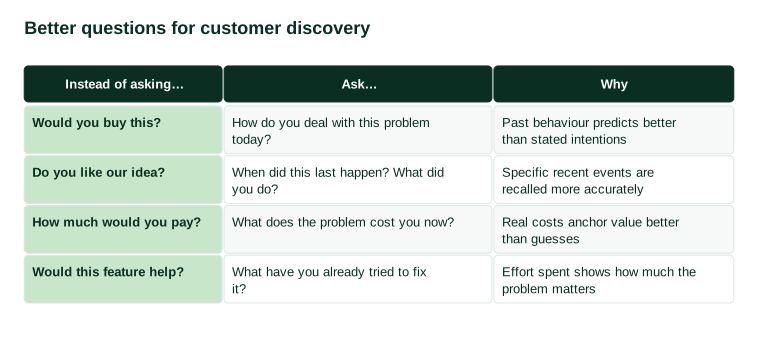
The most common mistake is asking people to predict their own behaviour. Rob Fitzpatrick (2013) observed that people are polite about other people's ideas, so "would you use this?" produces encouraging answers that mean little. Research supports his caution. Morwitz et al. (2007) found that stated purchase intentions are an imperfect guide to actual purchases, and that their accuracy varies widely between products. Better questions ask about past behaviour and specific recent events, as Figure 1 shows.
Good interviews follow the standards of qualitative research interviewing. Kvale and Brinkmann (2009) emphasise open questions, careful listening and follow-up questions that ask for concrete examples. Silences should be allowed to run; people often add the most useful detail after a pause.
Who to interview
Choose people who experience the problem directly, not only those who are easy to reach. Friends, colleagues and existing enthusiasts tend to be supportive and similar to the interviewer, which narrows what can be learned. It helps to include people who have tried and abandoned other solutions, and people who have decided the problem is not worth solving, because their reasons often reveal the limits of the opportunity. Where a purchase involves several people, such as a user, a manager and a budget holder, each should be interviewed, since they often describe different problems.
How many interviews?
Discovery interviews need not be numerous to be useful. Griffin and Hauser (1993) found that interviews with 20 to 30 customers were enough to identify most of the needs in a product category. Guest et al. (2006) found that in a set of 60 interviews, most themes had appeared within the first 12. A practical rule is to keep interviewing a defined customer group until new conversations stop revealing new problems.
What interviews cannot tell you
Interviews show what problems exist and why they matter to the people interviewed. They cannot show how common a problem is across a market or how many customers would pay to solve it. For that, the findings should be turned into a structured survey of a representative sample, or tested with a small pilot.
A hypothetical example shows the sequence. A company planning a booking service for physiotherapy clinics interviews 15 clinic managers. Most say booking is easy, but several describe losing income from late cancellations. The company changes its focus from booking to cancellation management, then surveys 400 clinics to estimate how many share the problem. The interviews found the problem worth solving; the survey showed whether enough clinics share it to support a business.
Practical checklist
- Define the customer group and the assumptions to test before the first interview.
- Ask about past behaviour and real costs, not future intentions.
- Do not pitch; describe the solution, if at all, only at the end.
- Record and summarise each interview the same day.
- Stop when new interviews stop producing new problems.
- Test what you learn with a larger, representative study.
References
Blank, S. (2013). The four steps to the epiphany: Successful strategies for products that win (2nd ed.). K&S Ranch.
Christensen, C. M., Hall, T., Dillon, K., & Duncan, D. S. (2016). Competing against luck: The story of innovation and customer choice. HarperBusiness.
Fitzpatrick, R. (2013). The mom test: How to talk to customers and learn if your business is a good idea when everyone is lying to you. CreateSpace.
Griffin, A., & Hauser, J. R. (1993). The voice of the customer. Marketing Science, 12(1), 1–27. https://doi.org/10.1287/mksc.12.1.1
Guest, G., Bunce, A., & Johnson, L. (2006). How many interviews are enough? An experiment with data saturation and variability. Field Methods, 18(1), 59–82. https://doi.org/10.1177/1525822X05279903
Kvale, S., & Brinkmann, S. (2009). InterViews: Learning the craft of qualitative research interviewing (2nd ed.). Sage.
Morwitz, V. G., Steckel, J. H., & Gupta, A. (2007). When do purchase intentions predict sales? International Journal of Forecasting, 23(3), 347–364. https://doi.org/10.1016/j.ijforecast.2007.05.015