
Inquiry · Philosophy of inquiry
Aristotle's Four Causes as a Framework for Inquiry
Aristotle argued that to understand anything we must answer four different "why" questions. This article explains the four causes, how they shaped science, how they survive in modern biology and psychology, and how to use them as a practical framework for inquiry.
Ask "why?" about almost anything and you will find that the question can be answered in several ways. Why does a bridge stand? Because of the steel and concrete it is made of; because of the shape of its arches and trusses; because engineers and builders put it there; and because people needed to cross the river. Each answer is correct, and none on its own is complete. More than two thousand years ago, Aristotle made this observation the foundation of his theory of explanation. His doctrine of the four causes is one of the oldest frameworks of inquiry still in use, and it remains a useful checklist for anyone who wants to understand something thoroughly.
Aristotle and the question "why?"
Aristotle (384–322 BCE) studied in Plato's Academy for twenty years before founding his own school, the Lyceum, in Athens. Unlike his teacher, he spent much of his time observing the natural world: he dissected animals, classified hundreds of species and recorded the behaviour of fish in the lagoon of Lesbos. The biologist Armand Leroi (2014) argues that this work makes Aristotle the first systematic natural scientist.
For Aristotle, knowledge meant understanding why something is as it is. In the Physics and again in the Metaphysics, he wrote that we think we know a thing only when we have grasped its "why", which means grasping its primary cause (Aristotle, 1984, Physics II.3, 194b17–20). The Greek word he used, aitia, is usually translated as "cause", but it has a broader meaning closer to "explanation" or "reason". Max Hocutt (1974) suggested that the four causes are better called the "four becauses": four different kinds of answer to a why-question. Julius Moravcsik (1974) similarly argued that the doctrine is a theory of what makes an explanation adequate, not a theory of causation in the modern sense of one event producing another.
The four causes
Aristotle's standard example is a bronze statue (Aristotle, 1984, Physics II.3). To explain the statue fully, we must say:
The material cause: what is it made of? The statue is made of bronze. The material cause is the stuff out of which something comes to be and which persists in it. For a house, it is bricks and timber; for a living organism, its tissues and ultimately its elements.
The formal cause: what is it? The statue has the shape of a particular figure. The formal cause is the form, structure or definition that makes the thing the kind of thing it is. A heap of bronze is not a statue; the arrangement matters. For Aristotle, form also includes the essence of a thing, captured in its definition.
The efficient cause: what brought it about? The sculptor, or more precisely the art of sculpture in the sculptor, made the statue. The efficient cause is the primary source of change or rest. This is the cause closest to the modern idea of causation, in which one thing makes another happen.
The final cause: what is it for? The statue was made to honour a god or commemorate a victory. The final cause is the end or purpose, "that for the sake of which" a thing exists or a process occurs. Walking is for the sake of health; teeth are, in Aristotle's view, for the sake of chewing.
Aristotle did not think that every question needs all four answers, nor that the four are always separate. In living things, he argued, the formal, efficient and final causes often coincide: the form of an oak is what the acorn grows into (final cause), what directs its growth (efficient cause) and what makes it an oak (formal cause). But he insisted that a natural scientist should know all four kinds of cause and use each where relevant (Aristotle, 1984, Physics II.7).
The four causes as four questions
Stripped of their technical vocabulary, the four causes become four questions that can be asked of almost anything an inquirer wants to understand. Figure 1 applies them to Aristotle's statue and to a modern example, a new product.
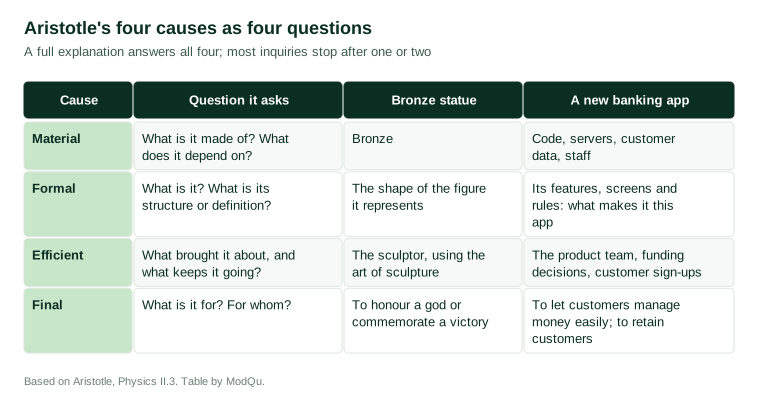
The practical value of the framework is that it reveals which questions an inquiry has left unanswered. A market report that describes what a product is made of and how it works, but not what customers use it for, has answered the material and formal questions and neglected the final one. An incident investigation that identifies who did what (efficient cause) but not what the system was designed to achieve, or what conditions made the failure possible (material conditions), will tend to blame individuals and miss structural problems.
Aristotle's method of inquiry
Aristotle did not only theorise about causes; he used them to organise research. His biological works collect observations on the parts of animals (their material and structure), their generation (the efficient processes of development) and the functions their parts serve (final causes). James Lennox (2001) shows how Aristotle used the search for causes to decide which observations mattered and how to group them. Geoffrey Lloyd (1968) and Christopher Shields (2014) describe the same pattern across his work: begin with the reputable opinions and the observed facts, identify the puzzles they raise, and then seek the causes that resolve them.
Aristotle also connected causes to the structure of reasoning. In the Posterior Analytics, he argued that scientific knowledge takes the form of a demonstration in which a "middle term" links a subject to a property, and that the middle term is the cause (Aristotle, 1984, Posterior Analytics II.2). To know why the moon is eclipsed is to know that the earth comes between it and the sun; the earth's interposition is the middle term that connects "moon" with "eclipsed". Inquiry, on this view, is largely a search for middle terms. Aristotle listed four basic questions an inquirer can ask: whether a thing is so, why it is so, whether a thing exists, and what it is. The first and third establish the facts; the second and fourth seek the cause or definition, and he argued that the answers to these turn out to be closely linked (Barnes, 1995). The sequence still describes good research practice: establish that a phenomenon is real before trying to explain it.
His approach to final causes in biology was especially influential. When he asked why ducks have webbed feet, his answer was that webbed feet are for swimming. This kind of explanation, which explains a feature by what it does for the organism, is called teleological, from the Greek telos, meaning end or goal. Monte Ransome Johnson (2005) argues that Aristotle's teleology was not the claim that nature has conscious intentions, but that many natural processes are regularly directed towards outcomes that benefit the organism.
The fall and return of final causes
The scientific revolution of the seventeenth century turned sharply against final causes. Francis Bacon argued that the search for purposes in nature had distracted inquiry from the efficient and material causes that could be discovered by experiment and used to control nature. In a famous image, he compared final causes in physics to virgins consecrated to God: they bear no offspring (Bacon, 1620/2000). Physics came to explain events entirely by efficient causes acting on matter according to laws, and "why" questions about purposes were set aside.
Final causes did not disappear, however. In biology, Darwin's theory of natural selection explained how features could be "for" something without any designer: a trait spreads because it helped ancestors survive and reproduce. Philosophers such as Larry Wright (1973) gave this an analysis: to say that the function of the heart is to pump blood is to say that the heart is there because it pumps blood, in the sense that pumping blood explains why hearts were selected. Ariew (2002) traces how modern accounts of function combine Darwinian selection with an Aristotelian concern for what parts are for.
Modern descendants: Mayr and Tinbergen
Two twentieth-century biologists developed frameworks that echo Aristotle closely. Ernst Mayr (1961) distinguished proximate causes, the physiological and developmental mechanisms by which a trait works, from ultimate causes, the evolutionary reasons why the trait exists. Asking why a bird migrates south in autumn, he noted, can mean asking what triggers the behaviour (changes in day length, hormones) or why birds that migrate have prospered (food supply in winter).
Niko Tinbergen (1963) went further and proposed that the study of behaviour should answer four questions: what mechanism causes the behaviour, how it develops over the individual's life, what its function or survival value is, and how it evolved. Tinbergen's four questions are not identical to Aristotle's four causes, but they share the same insight: a single phenomenon calls for several different kinds of explanation, which complement rather than compete with one another. Bateson and Laland (2013) show that the framework still structures research in animal behaviour fifty years later and argue that confusing the different questions remains a common source of pointless disagreement.
How people explain things
Psychological research shows that Aristotle's categories are deeply rooted in ordinary thinking. Deborah Kelemen (1999) found that young children readily accept explanations based on purpose even for natural objects, saying for example that rocks are pointy "so that animals could scratch on them". Kelemen and Rosset (2009) found that adults, too, fall back on such explanations when forced to answer quickly. Lombrozo and Carey (2006) showed that adults accept a functional explanation ("the trait exists for X") when they believe the function actually played a causal role in the trait's existence, a view remarkably close to Wright's philosophical analysis. Frank Keil (2006) reviews evidence that people use different kinds of explanation, mechanistic and functional, for different purposes and in different domains.
These findings have a practical consequence. Because purpose explanations come easily, inquirers are at risk of accepting them too quickly: assuming that a customer behaviour, an organisational rule or a market trend exists for some reason, when it may simply be the by-product of other causes.
Using the four causes in practice
The four causes work well as a structured set of prompts at the start of an inquiry. Faced with any object of study, an inquirer can ask:
- Material: What is it made of? What resources, components, people or data does it depend on? What conditions must be present?
- Formal: What is it, exactly? What is its structure, design or definition? How would we recognise a case of it?
- Efficient: What brought it about, and what keeps it going? Who or what acts on it? What sequence of events produced the current state?
- Final: What is it for? What purpose does it serve, for whom? What would count as it working well?
Suppose a company wants to understand why a loyalty programme is underperforming. A material inquiry examines the budget, the rewards and the customer data it runs on. A formal inquiry asks what the programme actually is: its rules, tiers and the experience a member goes through. An efficient inquiry traces how customers join, earn and redeem, and what prompts them to act. A final inquiry asks what the programme is for, from the company's point of view and from the customer's, and whether those purposes are compatible. Problems often appear at the boundaries: a well-funded programme (material) with a confusing structure (formal), or a programme designed to increase spending (company purpose) that customers value only for occasional discounts (customer purpose). Herbert Simon (1996) argued that designed artefacts must always be understood in this double way, as an inner environment shaped to meet the goals set by an outer one.
The four causes in investigation
The framework is also useful when something has gone wrong. Accident investigators have long warned against stopping at the efficient cause, usually the person who made the last error before a failure. James Reason (1997) argued that most organisational accidents result from latent conditions, such as poor design, inadequate training or conflicting goals, that lie dormant until an active failure triggers them. In Aristotelian terms, a thorough investigation asks not only who acted (efficient cause) but what materials and conditions made the failure possible (material cause), how the system was designed and what procedures defined it (formal cause), and what goals the system and the people in it were pursuing (final cause). Conflicts between official purposes, such as safety, and operational purposes, such as speed or cost, often turn out to be at the root of the problem. An investigation that asks all four questions is much less likely to end with the comfortable but incomplete conclusion that someone made a mistake.
Limits of the framework
The four causes are a framework for organising questions, not a method for answering them. They say nothing about how to test whether a proposed cause is correct; modern accounts of causal inference, based on intervention and comparison, are needed for that (Woodward, 2003; Pearl & Mackenzie, 2018). The final cause also needs care. Attributing purposes to people and designed systems is usually appropriate, but attributing them to markets, natural processes or emergent social patterns can mislead. Richard Sorabji (1980) shows that Aristotle himself was careful about where purpose explanations apply and where events happen by necessity or coincidence.
Conclusion
Aristotle's four causes have outlasted the physics and biology in which he embedded them because they capture something permanent about inquiry: understanding requires answering several different questions, and a single answer, however correct, is rarely complete. Asking what something is made of, what it is, what produced it and what it is for remains one of the simplest ways to check that an investigation has not stopped too soon. Each question also points to different evidence: specifications and inventories for the material cause, definitions and designs for the formal, records of events and decisions for the efficient, and the stated and revealed goals of the people involved for the final. An inquiry plan that lists its sources under all four headings is unlikely to miss a whole dimension of the problem.
References
Ariew, A. (2002). Platonic and Aristotelian roots of teleological arguments in cosmology and biology. In A. Ariew, R. Cummins, & M. Perlman (Eds.), Functions: New essays in the philosophy of psychology and biology (pp. 7–32). Oxford University Press.
Aristotle. (1984). The complete works of Aristotle: The revised Oxford translation (J. Barnes, Ed.; Vols. 1–2). Princeton University Press.
Bacon, F. (2000). The new organon (L. Jardine & M. Silverthorne, Eds.). Cambridge University Press. https://doi.org/10.1017/CBO9781139164030 (Original work published 1620)
Barnes, J. (Ed.). (1995). The Cambridge companion to Aristotle. Cambridge University Press. https://doi.org/10.1017/CCOL0521411335
Bateson, P., & Laland, K. N. (2013). Tinbergen's four questions: An appreciation and an update. Trends in Ecology & Evolution, 28(12), 712–718. https://doi.org/10.1016/j.tree.2013.09.013
Hocutt, M. (1974). Aristotle's four becauses. Philosophy, 49(190), 385–399. https://doi.org/10.1017/S0031819100063324
Johnson, M. R. (2005). Aristotle on teleology. Clarendon Press.
Keil, F. C. (2006). Explanation and understanding. Annual Review of Psychology, 57, 227–254. https://doi.org/10.1146/annurev.psych.57.102904.190100
Kelemen, D. (1999). Why are rocks pointy? Children's preference for teleological explanations of the natural world. Developmental Psychology, 35(6), 1440–1452. https://doi.org/10.1037/0012-1649.35.6.1440
Kelemen, D., & Rosset, E. (2009). The human function compunction: Teleological explanation in adults. Cognition, 111(1), 138–143. https://doi.org/10.1016/j.cognition.2009.01.001
Lennox, J. G. (2001). Aristotle's philosophy of biology: Studies in the origins of life science. Cambridge University Press.
Leroi, A. M. (2014). The lagoon: How Aristotle invented science. Viking.
Lloyd, G. E. R. (1968). Aristotle: The growth and structure of his thought. Cambridge University Press.
Lombrozo, T., & Carey, S. (2006). Functional explanation and the function of explanation. Cognition, 99(2), 167–204. https://doi.org/10.1016/j.cognition.2004.12.009
Mayr, E. (1961). Cause and effect in biology. Science, 134(3489), 1501–1506. https://doi.org/10.1126/science.134.3489.1501
Moravcsik, J. M. E. (1974). Aristotle on adequate explanations. Synthese, 28(1), 3–17. https://doi.org/10.1007/BF00869493
Pearl, J., & Mackenzie, D. (2018). The book of why: The new science of cause and effect. Basic Books.
Reason, J. (1997). Managing the risks of organizational accidents. Ashgate.
Shields, C. (2014). Aristotle (2nd ed.). Routledge.
Simon, H. A. (1996). The sciences of the artificial (3rd ed.). MIT Press.
Sorabji, R. (1980). Necessity, cause, and blame: Perspectives on Aristotle's theory. Duckworth.
Tinbergen, N. (1963). On aims and methods of ethology. Zeitschrift für Tierpsychologie, 20(4), 410–433. https://doi.org/10.1111/j.1439-0310.1963.tb01161.x
Woodward, J. (2003). Making things happen: A theory of causal explanation. Oxford University Press.
Wright, L. (1973). Functions. The Philosophical Review, 82(2), 139–168. https://doi.org/10.2307/2183766