
The Generation of Knowledge · Trust, quality and the future
The Generation of Knowledge: Surveys, Research, Statistics, Intelligence, Insights, Inquiry and Investigation as One System
How seven disciplines, inquiry, research, surveys, statistics, investigation, intelligence and insights, each contribute a distinct step to the generation of knowledge, how they depend on one another, and why treating them as one system produces more reliable knowledge than treating them apart.
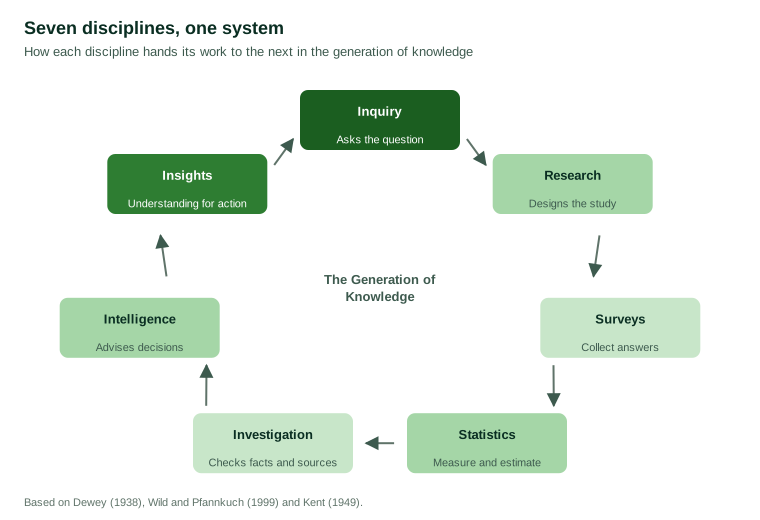
Knowledge is rarely produced by a single method. A finding that guides a decision usually passes through several hands: someone frames a question, someone designs a study, people answer questions, analysts measure and estimate, others check facts and sources, advisers assess what the results mean for a decision, and finally someone sees the new understanding that the evidence makes possible. ModQu organises its work around seven disciplines that correspond to these steps: inquiry, research, surveys, statistics, investigation, intelligence and insights. This article explains what each contributes and why they work best as one system.
Seven disciplines
Inquiry is the starting point. Dewey (1938) described inquiry as the process of turning an unsettled, doubtful situation into a settled one, beginning with the formulation of a definite problem. Peirce (1877) argued that doubt is what drives inquiry, and that the method of science is the only way of settling doubt that answers to how things actually are rather than to what people wish were true. Inquiry asks the question and keeps asking whether it is the right one.
Research designs the study that will answer the question. It decides what evidence is needed, from whom and how it will be gathered, and it connects the new study to what is already known.
Surveys collect information systematically from people. Groves et al. (2009) described survey methodology as the study of the sources of error in surveys, from how a sample is drawn to how questions are worded and answered, and of the methods that reduce them. Surveys allow a carefully chosen sample to speak for a larger population.
Statistics turns data into measurements and estimates and states how uncertain they are. Wild and Pfannkuch (1999) described statistical thinking as a cycle of problem, plan, data, analysis and conclusions, in which each conclusion raises new questions. Box (1976) emphasised that science advances through this kind of iteration between theory and data.
Investigation checks facts and sources. It asks whether what has been reported is accurate, whether documents are authentic and whether accounts agree. In policing and journalism, investigation follows evidence step by step to establish what happened. Innes (2003), in a study of murder investigations in England, described how detectives build an account of events by gathering, testing and ordering information until it can support a conclusion that will stand up to challenge. In research, it tests claims and data before they are relied upon.
Intelligence assesses what the evidence means for a decision. Kent (1949) described intelligence as knowledge collected and analysed to serve those who must act, independent enough to report unwelcome findings. Heuer (1999) showed how analysts can test competing explanations rather than accepting the first that fits.
Insights are the new understanding that changes what people see and therefore what they do. Klein (2013) found that insights arise from noticing connections, spotting contradictions and questioning assumptions that block progress.
Why one system
Each discipline has its own traditions and experts, and each can be practised alone. But each also depends on the others. A survey cannot be better than the question behind it. A statistical estimate is only as good as the data collected. An intelligence assessment that rests on unchecked facts may lead decision-makers astray. An insight that no one has tested is a hypothesis, not knowledge.
Ackoff (1989) described a progression from data to information, knowledge, understanding and wisdom, in which each level adds context and meaning to the one below. The seven disciplines can be seen as the practical steps that move evidence along this progression: from questions and raw answers to measured findings, checked facts, assessed implications and, finally, understanding that can guide action.
The system is also a cycle. Every insight raises new questions, which start a new round of inquiry. Nonaka (1994) described organisational knowledge creation as a spiral in which knowledge moves between individuals and groups and between tacit and explicit forms, growing with each turn. Davenport and Prusak (1998) noted that organisations gain most from knowledge when it flows between the people who create it and the people who use it.
The seven disciplines in one project
A single project shows how the disciplines connect. Suppose a regional health authority is concerned that people are not using a new walk-in clinic. Inquiry turns the concern into a question: which groups are not using the clinic, and why? Research reviews what is already known about access to health services and designs a study that combines a survey of residents with an analysis of clinic records. The survey asks a carefully drawn sample of residents whether they know about the clinic, whether they have used it and what stops them. Statistics weights the results to the population, estimates the proportion in each group who are aware of the clinic and states the margin of error. Investigation checks the clinic's records against the survey, and finds that opening hours advertised online differ from those posted at the door. Intelligence assesses what the findings mean for the authority's decision, weighing alternative explanations such as distance and transport. Insights bring the pieces together: younger working adults know about the clinic but believe it closes before they finish work, because of the conflicting information. Correcting the hours and extending them on two evenings is the action that follows, and a follow-up survey becomes the next inquiry.
Weak links
Treating the disciplines as one system also shows where knowledge can fail. Common weak links include:
- a question that does not match the decision it is meant to inform;
- a study design that cannot answer the question;
- a sample or questions that bias the answers;
- analyses that overstate precision;
- facts that are not checked against independent sources;
- assessments that ignore alternative explanations;
- insights that are not tested before they are acted on.
A failure at any step weakens everything that follows. Quality therefore depends on attention to every link and on clear handovers between them, so that each discipline knows what the previous one assumed and what the next one needs.
Conclusion
The generation of knowledge is a system with seven parts. Inquiry asks the question; research designs the study; surveys collect answers; statistics measures and estimates; investigation checks facts; intelligence assesses meaning for decisions; and insights deliver the new understanding that guides action and prompts new questions. Each discipline is valuable on its own, but together they produce knowledge that is more reliable, more useful and more trustworthy than any could produce alone.
References
Ackoff, R. L. (1989). From data to wisdom. Journal of Applied Systems Analysis, 16, 3–9.
Box, G. E. P. (1976). Science and statistics. Journal of the American Statistical Association, 71(356), 791–799. https://doi.org/10.1080/01621459.1976.10480949
Davenport, T. H., & Prusak, L. (1998). Working knowledge: How organizations manage what they know. Harvard Business School Press.
Dewey, J. (1938). Logic: The theory of inquiry. Henry Holt.
Groves, R. M., Fowler, F. J., Jr., Couper, M. P., Lepkowski, J. M., Singer, E., & Tourangeau, R. (2009). Survey methodology (2nd ed.). Wiley.
Heuer, R. J., Jr. (1999). Psychology of intelligence analysis. Center for the Study of Intelligence, Central Intelligence Agency.
Innes, M. (2003). Investigating murder: Detective work and the police response to criminal homicide. Oxford University Press.
Kent, S. (1949). Strategic intelligence for American world policy. Princeton University Press.
Klein, G. (2013). Seeing what others don't: The remarkable ways we gain insights. PublicAffairs.
Nonaka, I. (1994). A dynamic theory of organizational knowledge creation. Organization Science, 5(1), 14–37. https://doi.org/10.1287/orsc.5.1.14
Peirce, C. S. (1877). The fixation of belief. Popular Science Monthly, 12, 1–15.
Wild, C. J., & Pfannkuch, M. (1999). Statistical thinking in empirical enquiry. International Statistical Review, 67(3), 223–248. https://doi.org/10.1111/j.1751-5823.1999.tb00442.x