
The Generation of Knowledge · Knowledge production
The Difference Between Discovering, Interpreting, and Deciding
Why finding out what is the case, working out what it means and choosing what to do are different activities with different standards, how they become confused, where values legitimately enter, and how research organisations can keep the three distinct while connecting them.
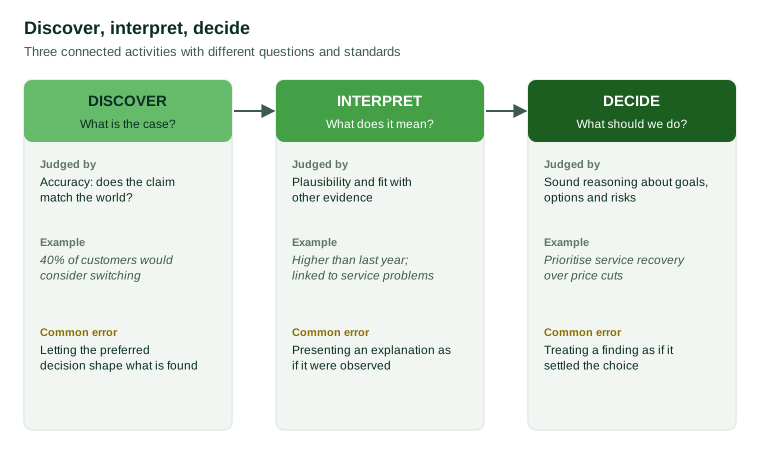
A survey finds that 40% of a company's customers would consider switching to a competitor. That is a discovery: a claim about what is the case. Is 40% high or low? Is it rising? Does it reflect dissatisfaction with price, service or something else? Those are questions of interpretation: what the finding means. Should the company cut prices, improve service or accept the risk? That is a decision: a choice about what to do, which depends on the company's goals, resources and appetite for risk as well as on the evidence.
The three activities are connected, but they are not the same. They answer different questions, rely on different kinds of reasoning and are judged by different standards. Confusing them is one of the most common ways in which research is misused: findings are presented as if they dictated decisions, interpretations are passed off as facts, or the decision someone wants shapes what they are willing to discover. This article explains the differences, shows how values and judgement enter at each stage, and offers practical ways for organisations to keep the activities distinct while connecting them well.
Three questions
Discovering: what is the case?
Discovery establishes facts. In research, it includes measuring a quantity, estimating a proportion, detecting a difference or identifying a relationship. Its central standard is accuracy: does the claim correspond to the world? Discovery relies on sound methods of observation, measurement, sampling and analysis, and its results can be checked by other researchers using the same or different methods.
Interpreting: what does it mean?
Interpretation places facts in context. It asks whether a finding is large or small, surprising or expected, what explains it and what it implies. Interpretation draws on comparisons, such as with past results, other groups or benchmarks, and on theories about how things work. The anthropologist Clifford Geertz argued that understanding human action requires thick description, an account of the meanings that actions have for the people involved, not only a record of the actions themselves (Geertz, 1973). Interpretation in this sense is not mere opinion; it can be done well or badly, and it can be supported or challenged by evidence. But it involves judgement in a way that measurement alone does not, and reasonable interpreters can disagree.
Deciding: what should we do?
Decision chooses among courses of action. It depends on facts and interpretations, but also on values: the goals the decision-maker is pursuing, the risks they are willing to accept and the interests they must weigh. Simon (1947) argued that every decision rests on two kinds of premises: factual premises, which can be tested against evidence, and value premises, which express what the decision-maker wants or ought to want. Research can inform the factual premises, but it cannot by itself supply the value premises.
The gap between facts and decisions
The philosopher David Hume observed that writers on morality often move from statements about what is to statements about what ought to be, without explaining how the second follows from the first (Hume, 2000). This observation, often called the is–ought gap, is the philosophical basis of the distinction between discovering and deciding. No collection of facts, on its own, implies what anyone should do. To reach a decision, facts must be combined with goals or values.
The sociologist Max Weber drew a practical conclusion for social science. Weber (1949) argued that social scientists can show which means will achieve given ends, what the consequences and costs of different courses of action are likely to be, and whether goals are consistent with one another. What science cannot do is tell people which ends they should pursue. He insisted that researchers should keep clear, for themselves and their audiences, the difference between establishing facts and expressing their own evaluations.
Where values enter research
The distinction does not mean that research is free of values. Philosophers of science have shown that judgements of value play a part even in discovery.
Rudner (1953) argued that whenever a scientist accepts or rejects a hypothesis, they must decide whether the evidence is strong enough, and that how strong is "strong enough" depends on how serious it would be to be wrong. Accepting that a drug is safe requires stronger evidence than accepting that a batch of buttons is defective, because the consequences of error are graver. Douglas (2000) developed this idea under the name of inductive risk. She argued that values legitimately influence choices about evidential standards, such as significance levels and the treatment of uncertain data, because these choices determine which kinds of error are more likely. Values should not, however, determine the content of findings directly: wishing a result were true is never evidence that it is.
Putnam (2002) argued more broadly that facts and values are often entangled in language itself. Many descriptive terms, such as "cruel", "reliable" or "satisfied", carry evaluative meaning, so that describing a situation already involves some evaluation.
These arguments do not erase the difference between discovering and deciding. They show that the boundary needs care. Researchers should make their value-laden choices explicit, such as the level of confidence required or the definition of a key term, so that others can see where judgement entered and can disagree if they choose.
How the activities get confused
Letting the decision shape the discovery
The most damaging confusion occurs when a preferred decision influences what is found. Psychologists have documented how people's beliefs and wishes shape their reasoning. Kunda (1990) reviewed evidence for motivated reasoning: when people want to reach a particular conclusion, they search memory and evidence selectively and construct justifications that seem reasonable to them. Lord et al. (1979) gave people who supported or opposed the death penalty the same mixed evidence about whether it deterred crime. Each group rated the studies supporting its own view as more convincing, and both groups became more confident in their original positions. In organisations, the same tendencies can lead to surveys designed to produce a desired answer, analyses that stop once a convenient result appears, or findings that are reported selectively.
Treating a finding as if it were a decision
The opposite confusion presents a finding as if it settled what to do. "Customers want lower prices, so we must cut prices" skips the questions of cost, competition, brand position and long-term strategy. Sarewitz (2004) argued that in many public controversies, such as those over environmental policy, more scientific research does not settle disputes, because the disagreements are really about values and interests. Each side selects the science that supports its preferred action, and new findings simply supply new ammunition. Kahan et al. (2012) found that people with greater scientific literacy and numeracy were more, not less, polarised in their perceptions of climate change risks, because they were better at interpreting evidence in line with the views of their cultural group.
Treating interpretation as fact
A third confusion presents interpretations as if they were direct observations. "Satisfaction is falling because of the new pricing" may be a reasonable interpretation of falling scores that followed a price change, but it is not the same as measuring the cause. Weick (1995) showed that people make sense of situations by constructing plausible stories, and that once a story is accepted, it guides what they notice next. Interpretations that are not labelled as such can harden into accepted facts without ever being tested.
Jumping from data to story
Interpretation is vulnerable to the speed of intuitive thought. Kahneman (2011) described how the mind constructs coherent stories from whatever information is available, without registering what is missing, a tendency he summarised as "what you see is all there is". A single striking figure in a report can therefore prompt a confident explanation and a recommended action within seconds, before anyone has asked whether the figure is reliable, how it compares with other data or what else might explain it. The remedy is not to distrust intuition altogether but to slow down at the points where it matters: to ask, before interpreting, whether the finding is solid, and before deciding, whether the interpretation is the only plausible one.
Judging decisions by their outcomes
Finally, people often judge a decision by how things turned out rather than by how well it was made. Howard (1988), one of the founders of decision analysis, stressed the difference between a good decision, one made with sound reasoning given the information and values at the time, and a good outcome, which may depend on luck. Fischhoff (1975) showed that once people know an outcome, they overestimate how predictable it was, a tendency known as hindsight bias. This makes it easy to blame decision-makers for outcomes they could not reasonably have foreseen, and to credit them for outcomes that were fortunate.
Deciding under uncertainty
Most decisions informed by research are made under uncertainty. A survey estimate has a margin of error; an interpretation may be one of several plausible explanations; the future may not resemble the past. Good decision-making acknowledges this uncertainty rather than hiding it. Decision analysts recommend setting out the main options, the possible outcomes of each, how likely those outcomes seem and how much each would matter to the decision-maker, and then choosing the option that best serves the decision-maker's objectives given the uncertainty (Howard, 1988). This process makes clear which uncertainties actually matter for the choice. Sometimes a large uncertainty in a finding makes no difference, because every plausible value points to the same decision. At other times a small uncertainty is critical, because the decision turns on whether a figure lies just above or just below a threshold. Knowing which situation applies tells researchers where further discovery would be most valuable, and tells decision-makers when they can act on the evidence they already have.
Keeping the activities distinct
Several fields have developed practices for separating discovery, interpretation and decision while keeping them connected.
Intelligence analysis
Intelligence services face the problem directly, since their analysis informs decisions with high stakes. Kent (1949), an early theorist of American intelligence, argued that intelligence must be close enough to policymakers to know what they need, but independent enough to report unwelcome truths without being drawn into advocating particular policies. Heuer (1999) described the mental traps that affect analysts and proposed structured techniques, such as the analysis of competing hypotheses, in which analysts list all plausible explanations and assess how well the evidence fits each, rather than seeking support for the first explanation that occurs to them.
Risk assessment
Public agencies that regulate risk have long debated how to separate scientific assessment from policy choices. Jasanoff (1990) studied scientific advisory committees in the United States and found that the boundary between science and policy was constantly negotiated rather than fixed. The National Research Council (1996) recommended an analytic–deliberative process, in which systematic analysis of evidence is combined with deliberation among scientists, officials and affected parties about what matters, what questions to ask and how to weigh the results. In this approach, analysis and values are kept distinct but brought together deliberately.
Science advice
Pielke (2007) described four roles that experts can take in relation to decisions. The pure scientist reports findings without engaging with decisions. The science arbiter answers specific factual questions posed by decision-makers. The issue advocate argues for a particular course of action. The honest broker of policy alternatives sets out the range of available options and their likely consequences, leaving the choice to the decision-maker. Pielke argued that each role has its place, but that problems arise when experts present advocacy as if it were neutral science.
Decision analysis
Decision analysts have developed methods for making the value side of decisions explicit. Keeney (1992) argued that decision-makers should begin by clarifying their objectives, what they actually care about, before generating alternatives, so that the options considered serve their real goals. Making objectives explicit allows the factual question, "which option best achieves these objectives?", to be separated from the value question, "which objectives matter most?"
Communicating across the boundaries
How findings are communicated affects whether the three activities stay distinct. Spiegelhalter (2017) reviewed research on communicating risk and uncertainty, and recommended that communicators state clearly what is known, how confident they are, and what the main sources of uncertainty are, using formats such as natural frequencies that audiences find easier to understand. Separating these statements from recommendations allows audiences to evaluate each on its own terms.
Weiss (1979) showed that research often influences decisions not by dictating them but by changing how decision-makers understand a problem. This "enlightenment" role depends on research being trusted as an honest account of what is known, rather than as an argument for a particular choice.
Dewey (1938) described inquiry as a process that begins with a problematic situation and ends when the situation is resolved through action. On his view, discovering, interpreting and deciding are phases of one continuous process of inquiry, each feeding into the next. The aim of distinguishing them is not to isolate them but to make each phase as sound as it can be, so that the whole process produces good action.
Practical lessons for research organisations
Organisations that produce research for clients work at the junction of all three activities. Several practices help keep them distinct and connected.
Label each kind of statement. In reports, separate findings ("40% would consider switching"), interpretations ("this is higher than last year and appears linked to service problems") and implications or recommendations ("the client may wish to prioritise service recovery"). Readers can then judge each on its merits. A useful test is to ask, of every sentence in a summary, whether it reports something measured, offers an explanation or proposes an action, and to make sure the wording signals which.
Protect discovery from the preferred answer. Agree on questions, samples and analysis plans before seeing results. Report all relevant findings, not only those that support a client's hopes.
Offer competing interpretations. Where evidence supports more than one explanation, present the alternatives and what evidence would distinguish them.
Make value judgements visible. State the choices that involve judgement, such as the confidence level used or the definition of a key term, and why they were made.
Clarify the decision-maker's objectives. Before recommending action, ask what the client is trying to achieve and what risks they will accept. Recommendations then follow from stated goals rather than from the researcher's own preferences. Where clients have not settled their objectives, helping them do so may be the most valuable contribution the research can make.
Prefer the honest broker role. Setting out options and their likely consequences usually serves clients better than advocating a single course, unless they have asked for a recommendation and their goals are clear.
Judge decisions by their reasoning. When reviewing past decisions, ask whether they were reasonable given what was known, not only how they turned out.
Conclusion
Discovering, interpreting and deciding are distinct activities. Discovery asks what is the case and is judged by accuracy. Interpretation asks what it means and is judged by its plausibility and fit with the evidence. Decision asks what to do and depends on values as well as facts. Values and judgement enter each stage, but in different ways, and confusing the stages leads to biased findings, overconfident interpretations and decisions that claim more support from evidence than they have. Research organisations serve their clients best by keeping the three activities distinct, making their judgements visible, and connecting findings to decisions through clear reasoning about goals and options.
References
Dewey, J. (1938). Logic: The theory of inquiry. Henry Holt.
Douglas, H. (2000). Inductive risk and values in science. Philosophy of Science, 67(4), 559–579. https://doi.org/10.1086/392855
Fischhoff, B. (1975). Hindsight ≠ foresight: The effect of outcome knowledge on judgment under uncertainty. Journal of Experimental Psychology: Human Perception and Performance, 1(3), 288–299. https://doi.org/10.1037/0096-1523.1.3.288
Geertz, C. (1973). The interpretation of cultures: Selected essays. Basic Books.
Heuer, R. J., Jr. (1999). Psychology of intelligence analysis. Center for the Study of Intelligence, Central Intelligence Agency.
Howard, R. A. (1988). Decision analysis: Practice and promise. Management Science, 34(6), 679–695. https://doi.org/10.1287/mnsc.34.6.679
Hume, D. (2000). A treatise of human nature (D. F. Norton & M. J. Norton, Eds.). Oxford University Press. (Original work published 1739–1740)
Jasanoff, S. (1990). The fifth branch: Science advisers as policymakers. Harvard University Press.
Kahan, D. M., Peters, E., Wittlin, M., Slovic, P., Ouellette, L. L., Braman, D., & Mandel, G. (2012). The polarizing impact of science literacy and numeracy on perceived climate change risks. Nature Climate Change, 2(10), 732–735. https://doi.org/10.1038/nclimate1547
Kahneman, D. (2011). Thinking, fast and slow. Farrar, Straus and Giroux.
Keeney, R. L. (1992). Value-focused thinking: A path to creative decisionmaking. Harvard University Press.
Kent, S. (1949). Strategic intelligence for American world policy. Princeton University Press.
Kunda, Z. (1990). The case for motivated reasoning. Psychological Bulletin, 108(3), 480–498. https://doi.org/10.1037/0033-2909.108.3.480
Lord, C. G., Ross, L., & Lepper, M. R. (1979). Biased assimilation and attitude polarization: The effects of prior theories on subsequently considered evidence. Journal of Personality and Social Psychology, 37(11), 2098–2109. https://doi.org/10.1037/0022-3514.37.11.2098
National Research Council. (1996). Understanding risk: Informing decisions in a democratic society. National Academy Press. https://doi.org/10.17226/5138
Pielke, R. A., Jr. (2007). The honest broker: Making sense of science in policy and politics. Cambridge University Press. https://doi.org/10.1017/CBO9780511818110
Putnam, H. (2002). The collapse of the fact/value dichotomy and other essays. Harvard University Press.
Rudner, R. (1953). The scientist qua scientist makes value judgments. Philosophy of Science, 20(1), 1–6. https://doi.org/10.1086/287231
Sarewitz, D. (2004). How science makes environmental controversies worse. Environmental Science & Policy, 7(5), 385–403. https://doi.org/10.1016/j.envsci.2004.06.001
Simon, H. A. (1947). Administrative behavior: A study of decision-making processes in administrative organization. Macmillan.
Spiegelhalter, D. (2017). Risk and uncertainty communication. Annual Review of Statistics and Its Application, 4, 31–60. https://doi.org/10.1146/annurev-statistics-010814-020148
Weber, M. (1949). The methodology of the social sciences (E. A. Shils & H. A. Finch, Eds. & Trans.). Free Press.
Weick, K. E. (1995). Sensemaking in organizations. SAGE.
Weiss, C. H. (1979). The many meanings of research utilization. Public Administration Review, 39(5), 426–431. https://doi.org/10.2307/3109916