
The Generation of Knowledge · Epistemology
Know-How Versus Know-That
Gilbert Ryle's distinction between knowing facts and knowing how to do things, the modern debate over whether it holds, what memory research adds, and why research organisations need both kinds of knowledge.
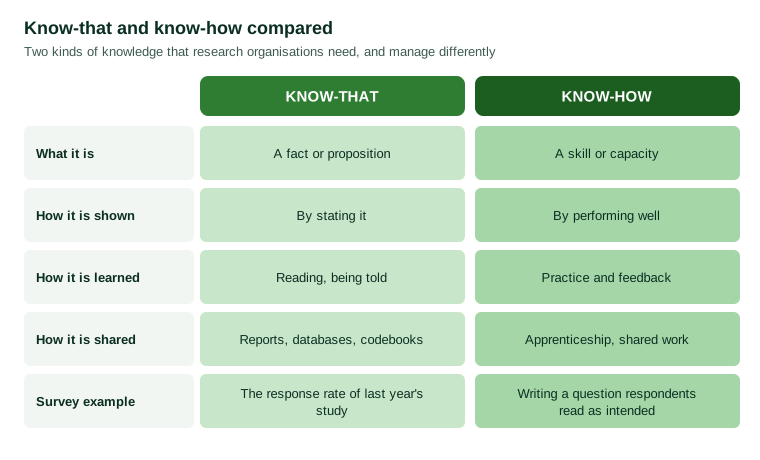
Knowing that Paris is the capital of France is different from knowing how to ride a bicycle. The first is a fact that can be stated, written down and checked. The second is a skill: it shows itself in performance, and someone can have it while being unable to explain it. The philosopher Gilbert Ryle made this contrast famous in a 1945 lecture to the Aristotelian Society, and it remains one of the most useful distinctions in the study of knowledge.
Ryle's argument
Ryle (1946) attacked what he called the "intellectualist legend": the idea that every intelligent action is guided by first considering a fact or rule. If that were so, he argued, applying the rule would itself be an intelligent act, which would require considering a further rule about how to apply it, and so on without end. Somewhere intelligence must show itself directly in what we do. Knowing how, Ryle concluded, is not a kind of knowing that. It is a capacity or disposition to perform well.
In The Concept of Mind Ryle (1949) developed the point. A skilled chess player, a witty speaker or a careful surgeon displays intelligence in the way they act, not in a hidden act of theorising before they act. Their competence is real knowledge, even when they cannot put it into words.
The intellectualist reply
For half a century Ryle's view was widely accepted. Then Stanley and Williamson (2001) argued that it is mistaken. Drawing on linguistics, they noted that sentences such as "Hannah knows how to ride a bicycle" have the same structure as "Hannah knows where to buy bread": both say that Hannah knows the answer to a question. On their account, knowing how to do something is knowing a fact of a special kind, that this way is a way to do it, held under a practical mode of presentation. Know-how is a species of know-that.
The debate continues. Fantl (2008) reviews the main positions, from Ryle's anti-intellectualism to Stanley and Williamson's intellectualism and various middle views. Critics of intellectualism point to cases in which a person knows all the relevant facts, such as a ski instructor who can describe every move, yet cannot perform, and to people who perform expertly while holding false beliefs about how they do it.
What memory research adds
Psychology offers independent evidence that the two kinds of knowledge can come apart. Cohen and Squire (1980) studied patients with amnesia who could not remember facts about recent events. Over several days the patients improved at reading mirror-reversed words at about the same rate as healthy volunteers, and kept the skill months later, yet their memory for the specific words they had read was poor. The researchers described this as a dissociation between "knowing how" and "knowing that", and it helped establish the distinction between declarative and procedural memory.
Anderson (1982) proposed that skills often begin as declarative knowledge, such as rules followed consciously and slowly, and become procedural through practice, until they run quickly and automatically. Dreyfus and Dreyfus (1986) described a similar progression from novice, who follows explicit rules, to expert, who responds to whole situations intuitively. Ericsson et al. (1993) showed that expert performance in fields such as music and chess depends on long periods of deliberate practice, not on knowledge of facts alone.
Why both matter in research
A research organisation depends on both kinds of knowledge, and they are managed differently.
Know-that can be documented. Facts about a market, the results of past surveys and the definitions of variables can be written into reports, databases and codebooks. They can be searched, checked and shared.
Know-how is harder to capture. Writing a question that respondents interpret as intended, spotting a suspicious pattern in data, or judging which finding matters most to a client are skills. Polanyi (1966) observed that "we can know more than we can tell", and skilled researchers often cannot fully explain what they do. Know-how is passed on mainly through apprenticeship, practice and feedback: reviewing drafts together, discussing analyses, and learning from experienced colleagues.
Some know-how can be partly converted into know-that. Checklists, annotated examples of good and bad questions, and written accounts of how difficult analyses were handled give newcomers a starting point, much as Anderson's (1982) model suggests: explicit guidance first, fluent skill later. But the conversion is never complete. A checklist can remind an analyst to test whether a pattern holds within subgroups; it cannot supply the judgement about which subgroups matter for this client and this decision. That judgement develops through experience, which is why the most effective research teams pair junior staff with experienced colleagues on real projects.
The lesson is practical. Organisations that invest only in recording facts may find that their most valuable knowledge walks out of the door when experienced staff leave. Building know-how requires time for practice, mentoring and shared work, alongside the systems that store know-that.
References
Anderson, J. R. (1982). Acquisition of cognitive skill. Psychological Review, 89(4), 369–406. https://doi.org/10.1037/0033-295X.89.4.369
Cohen, N. J., & Squire, L. R. (1980). Preserved learning and retention of pattern-analyzing skill in amnesia: Dissociation of knowing how and knowing that. Science, 210(4466), 207–210. https://doi.org/10.1126/science.7414331
Dreyfus, H. L., & Dreyfus, S. E. (1986). Mind over machine: The power of human intuition and expertise in the era of the computer. Free Press.
Ericsson, K. A., Krampe, R. T., & Tesch-Römer, C. (1993). The role of deliberate practice in the acquisition of expert performance. Psychological Review, 100(3), 363–406. https://doi.org/10.1037/0033-295X.100.3.363
Fantl, J. (2008). Knowing-how and knowing-that. Philosophy Compass, 3(3), 451–470. https://doi.org/10.1111/j.1747-9991.2008.00137.x
Polanyi, M. (1966). The tacit dimension. Doubleday.
Ryle, G. (1946). Knowing how and knowing that: The presidential address. Proceedings of the Aristotelian Society, 46(1), 1–16. https://doi.org/10.1093/aristotelian/46.1.1
Ryle, G. (1949). The concept of mind. Hutchinson.
Stanley, J., & Williamson, T. (2001). Knowing how. The Journal of Philosophy, 98(8), 411–444. https://doi.org/10.2307/2678403