
The Generation of Knowledge · Epistemology
Tacit and Explicit Knowledge: Polanyi's Distinction
Michael Polanyi's claim that "we can know more than we can tell", how it was developed by management theorists and sociologists, what research shows about knowledge that resists being written down, and how organisations can work with it.
"We can know more than we can tell." With this sentence, the chemist turned philosopher Michael Polanyi introduced an idea that has shaped thinking about knowledge in philosophy, psychology, sociology and management (Polanyi, 1966, p. 4). Much of what people know, he argued, cannot be fully put into words. We recognise a face among thousands without being able to say how. A skilled craftsperson judges the right moment to stop working a material by feel. An experienced researcher senses that a set of results is not quite right before they can explain why. Polanyi called this tacit knowledge, in contrast to explicit knowledge, which can be stated, written down and passed on in documents.
This article explains Polanyi's distinction, how it was taken up and changed by later writers, what empirical research shows, and why the distinction matters for any organisation whose value depends on what its people know.
Polanyi's account
Polanyi trained as a physician and became a distinguished physical chemist before turning to philosophy in mid-career. His main philosophical work, Personal Knowledge (Polanyi, 1958), argued against the ideal of completely impersonal, objective knowledge. All knowing, he claimed, involves the personal participation of the knower: commitment, skill and judgement that cannot be reduced to explicit rules.
In The Tacit Dimension (Polanyi, 1966) he gave this view a precise structure. Every act of knowing, he argued, has two terms. We attend from some things in order to attend to something else. When we use a hammer, we attend from the feeling of the handle in our palm to the nail we are driving. When we read, we attend from the marks on the page to their meaning. The things we attend from are known tacitly: we rely on them, but we do not focus on them, and if we switch our attention to them, the skilled performance breaks down. A pianist who concentrates on the movement of individual fingers loses the music.
Two features of this account are important. First, for Polanyi, tacit knowledge is not a separate kind of knowledge that sits alongside explicit knowledge. It is the foundation of all knowledge, including explicit knowledge. Even understanding a written formula depends on tacit skills of reading, interpreting and applying it. Second, tacit knowledge cannot in principle be made fully explicit, because any attempt to state it rests on further tacit knowledge.
From philosophy to management
Polanyi's idea reached a wide audience through management theory. Nonaka (1994) and Nonaka and Takeuchi (1995) built a theory of organisational knowledge creation around the interplay between tacit and explicit knowledge. In their SECI model, knowledge is created through four kinds of conversion: socialisation (tacit to tacit, as when an apprentice learns by watching a master), externalisation (tacit to explicit, as when experience is articulated in concepts and models), combination (explicit to explicit, as when documents are combined into new reports) and internalisation (explicit to tacit, as when people absorb written knowledge into their own practice). Their famous example is the development of a home bread-making machine at Matsushita, for which a software developer trained with a hotel's head baker to understand the kneading technique and then translated it into the machine's design.
This interpretation was enormously influential, but critics argued that it changed Polanyi's idea. Tsoukas (2003) pointed out that Nonaka and Takeuchi treat tacit knowledge as knowledge that has not yet been articulated, which can be converted into explicit form with enough effort. For Polanyi, by contrast, tacit knowledge is an inseparable dimension of all knowing. It can be drawn on and shown, and people can be helped to notice it, but it cannot be extracted and stored in a document. On Tsoukas's reading, the bread-making engineer did not convert the baker's tacit knowledge into explicit knowledge. She acquired a new skill of her own, which then informed the design.
Economists of the firm also drew on tacit knowledge. Nelson and Winter (1982) argued that much of a firm's capability resides in routines, patterns of coordinated activity that members carry out skilfully without being able to describe them completely. Kogut and Zander (1992) argued that the tacit, hard-to-codify parts of a firm's knowledge make it difficult for competitors to copy, and therefore a source of advantage. Grant (1996) built a knowledge-based theory of the firm on the observation that specialist, largely tacit knowledge is held by individuals and must be integrated through organisational mechanisms.
Three kinds of tacit knowledge
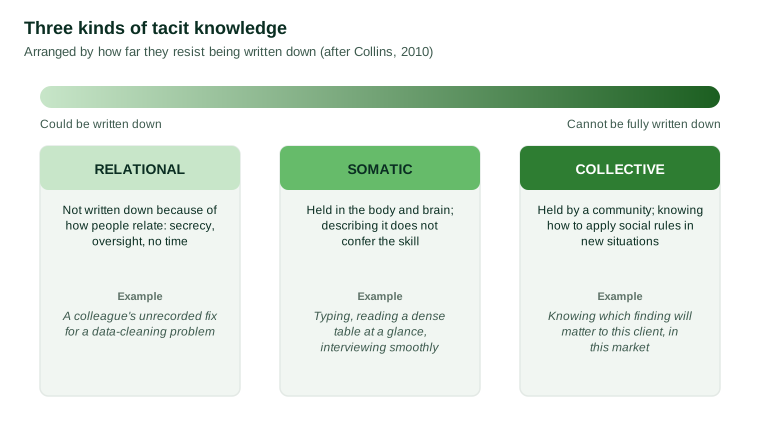
The sociologist Harry Collins offered one of the most careful analyses of what makes knowledge tacit. Collins (2010) distinguished three types, depending on why the knowledge is not, or cannot be, made explicit.
Relational tacit knowledge could in principle be made explicit, but is not, for reasons that depend on the relationships between people: someone keeps it secret, does not realise it matters, or simply never gets round to writing it down. Somatic tacit knowledge is embodied in the human body and brain, such as the balance needed to ride a bicycle. It could in principle be described in scientific terms, but no description would let a person perform the skill. Collective tacit knowledge is held by society, not individuals: the ability to follow social rules in new situations, such as knowing how close to stand to someone in a queue in a given culture. Collins argued that this third kind is the deepest and the hardest for machines to acquire.
Related ideas
Polanyi was not alone in stressing knowledge that resists explicit statement. Ryle (1949) distinguished "knowing how" from "knowing that", arguing that intelligent performance is not the application of a prior theory but a capacity shown in action. Ryle's distinction concerns the kind of thing known, a skill rather than a fact, while Polanyi's concerns the way it is known, by relying on particulars that we do not focus on. The two ideas overlap, since most know-how is tacit, but they are not the same: some know-that is also tacit, as when we recognise a familiar face.
Dreyfus and Dreyfus (1986) drew on both traditions in their model of skill acquisition. Novices, they argued, follow explicit, context-free rules. As experience grows, they learn to recognise situations as wholes and respond fluidly, until experts often cannot say what rules they are following, because they are no longer following rules at all. On this view, expertise does not consist in having more explicit knowledge than a novice. It consists in having moved beyond the need for it in familiar situations. The Dreyfuses used this argument to predict the limits of rule-based expert systems in the 1980s, and their analysis remains relevant to debates about what machines can learn from data.
What empirical research shows
Tacit knowledge in science
Collins (1974) studied the attempts of British laboratories to build a new kind of laser, the TEA laser, in the early 1970s. Laboratories that had only written descriptions, however detailed, failed to make the laser work. Those that succeeded had spent time with scientists who had already built one, often through visits or the movement of staff between laboratories. The knowledge needed to build the laser travelled with people, not papers. MacKenzie and Spinardi (1995) found something similar in nuclear weapons design. Designers relied heavily on judgement acquired through experience in testing, and the authors argued that if that experience were lost, the knowledge could in a sense be "uninvented" despite the existence of extensive documentation.
Tacit knowledge in individuals
Psychologists have studied tacit knowledge in several ways. Reber (1989) reviewed experiments on implicit learning, in which people learn complex patterns, such as the rules of an artificial grammar, and use them accurately, while being unable to state the rules they are following. Nisbett and Wilson (1977) showed that people are often unable to report accurately what influenced their judgements and decisions, and instead offer plausible explanations that do not match the factors that actually affected them.
Wagner and Sternberg (1985) developed tests of practical, tacit knowledge in academic psychology and business management, asking people how they would handle realistic work situations. Scores on these tests were related to career success and were largely independent of conventional measures of intelligence. Klein (1998) studied experienced firefighters, military commanders and nurses, and found that they usually made good decisions not by comparing options but by recognising situations as familiar types and knowing what to do, often without being able to explain how.
Tacit knowledge and transfer
Organisational research has shown that tacit knowledge makes the transfer of good practice slow and difficult. Szulanski (1996) studied transfers of best practice within companies and found that the main barriers were not lack of motivation but the recipient's lack of capacity to absorb the knowledge, the ambiguity about why the practice worked, and difficult relationships between source and recipient. Knowledge that cannot be fully written down has to be learned, and learning takes time, contact and a shared context. Lave and Wenger (1991) described learning as participation in a community of practice, in which newcomers acquire skills by gradually taking part in the community's real work.
Working with tacit knowledge
The distinction has practical consequences for organisations, including those that generate research and evidence. Hansen et al. (1999) observed that companies tend to adopt one of two knowledge strategies: a codification strategy that invests in documents and databases, or a personalisation strategy that invests in networks of people who share knowledge through conversation. Neither strategy is right for every organisation, but each suits a different kind of knowledge.
For a research organisation, several practices help.
Pair documentation with people. Methodology manuals, codebooks and analysis scripts capture explicit knowledge and are essential. But they do not capture the judgement needed to apply them well. Pairing new staff with experienced researchers on real projects is the most reliable way to pass on what cannot be written down.
Make tacit knowledge visible, even if it cannot be captured. Reviews in which analysts talk through how they reached a conclusion, or in which experienced staff explain what made them suspicious of a result, help others notice and learn the cues that experts use. Polanyi's point is not that nothing can be said about tacit knowledge, only that saying is never enough by itself.
Expect self-reports of reasoning to be incomplete. Nisbett and Wilson's (1977) findings apply to research participants as much as to employees. When respondents explain why they made a choice, their explanations may be sincere but inaccurate. Research that relies on such explanations should, where possible, combine them with evidence of actual behaviour.
Protect knowledge when people leave. Because tacit knowledge travels with people, the departure of experienced staff can remove capabilities that no document replaces. Overlapping handovers, shared work and deliberately broad experience across a team reduce this risk.
Value the expertise that cannot be automated. As more analysis is automated, the distinctive value of experienced researchers increasingly lies in tacit skills: framing the right question, sensing when results do not make sense and judging what matters to a decision. Collins's (2010) analysis suggests that collective tacit knowledge, the understanding of how things work in a particular social setting, is the hardest kind for machines to replace.
Conclusion
Polanyi's distinction reminds us that knowledge is not only a stock of statements that can be stored, searched and transmitted. Much of it lives in skills, judgement and shared practices that can be shown but never fully told. Organisations that treat knowledge as purely explicit underestimate what they have and what they can lose. Those that recognise the tacit dimension invest in people, apprenticeship and communities of practice alongside documents and systems, and so keep the capacity that makes their explicit knowledge useful.
References
Collins, H. (2010). Tacit and explicit knowledge. University of Chicago Press. https://doi.org/10.7208/chicago/9780226113821.001.0001
Collins, H. M. (1974). The TEA set: Tacit knowledge and scientific networks. Science Studies, 4(2), 165–185. https://doi.org/10.1177/030631277400400203
Dreyfus, H. L., & Dreyfus, S. E. (1986). Mind over machine: The power of human intuition and expertise in the era of the computer. Free Press.
Grant, R. M. (1996). Toward a knowledge-based theory of the firm. Strategic Management Journal, 17(S2), 109–122. https://doi.org/10.1002/smj.4250171110
Hansen, M. T., Nohria, N., & Tierney, T. (1999). What's your strategy for managing knowledge? Harvard Business Review, 77(2), 106–116.
Klein, G. (1998). Sources of power: How people make decisions. MIT Press.
Kogut, B., & Zander, U. (1992). Knowledge of the firm, combinative capabilities, and the replication of technology. Organization Science, 3(3), 383–397. https://doi.org/10.1287/orsc.3.3.383
Lave, J., & Wenger, E. (1991). Situated learning: Legitimate peripheral participation. Cambridge University Press. https://doi.org/10.1017/CBO9780511815355
MacKenzie, D., & Spinardi, G. (1995). Tacit knowledge, weapons design, and the uninvention of nuclear weapons. American Journal of Sociology, 101(1), 44–99. https://doi.org/10.1086/230699
Nelson, R. R., & Winter, S. G. (1982). An evolutionary theory of economic change. Belknap Press of Harvard University Press.
Nisbett, R. E., & Wilson, T. D. (1977). Telling more than we can know: Verbal reports on mental processes. Psychological Review, 84(3), 231–259. https://doi.org/10.1037/0033-295X.84.3.231
Nonaka, I. (1994). A dynamic theory of organizational knowledge creation. Organization Science, 5(1), 14–37. https://doi.org/10.1287/orsc.5.1.14
Nonaka, I., & Takeuchi, H. (1995). The knowledge-creating company: How Japanese companies create the dynamics of innovation. Oxford University Press.
Polanyi, M. (1958). Personal knowledge: Towards a post-critical philosophy. University of Chicago Press.
Polanyi, M. (1966). The tacit dimension. Doubleday.
Reber, A. S. (1989). Implicit learning and tacit knowledge. Journal of Experimental Psychology: General, 118(3), 219–235. https://doi.org/10.1037/0096-3445.118.3.219
Ryle, G. (1949). The concept of mind. Hutchinson.
Szulanski, G. (1996). Exploring internal stickiness: Impediments to the transfer of best practice within the firm. Strategic Management Journal, 17(S2), 27–43. https://doi.org/10.1002/smj.4250171105
Tsoukas, H. (2003). Do we really understand tacit knowledge? In M. Easterby-Smith & M. A. Lyles (Eds.), The Blackwell handbook of organizational learning and knowledge management (pp. 410–427). Blackwell.
Wagner, R. K., & Sternberg, R. J. (1985). Practical intelligence in real-world pursuits: The role of tacit knowledge. Journal of Personality and Social Psychology, 49(2), 436–458. https://doi.org/10.1037/0022-3514.49.2.436