
The Generation of Knowledge · Knowledge production
Intelligence and Insights as Bridges Between Evidence and Action
How intelligence and insight work connect evidence to decisions, from the intelligence cycle and key intelligence topics to the language of probability, forecasting accuracy and the conditions under which insights can be trusted.
Evidence does not act on its own. Between a set of findings and a decision lies a gap that must be bridged by people who understand both: what the evidence shows and what the decision-maker needs to know. In government, that bridge is called intelligence. In business, it goes by many names, including market intelligence, competitive intelligence and, increasingly, insights. This article examines what intelligence and insight work involve, the lessons learned from decades of experience in national intelligence and business, and the practices that make the bridge between evidence and action reliable.
What intelligence is
Intelligence, in the sense used by governments, is knowledge collected and analysed to support decisions, especially about threats and opportunities that others may wish to conceal. Kent (1949), one of the founders of intelligence analysis in the United States, described intelligence as three things at once: a kind of knowledge, the organisation that produces it and the activity of producing it. He stressed that intelligence exists to serve policy, but must remain independent enough to report what decision-makers may not want to hear.
The process is often described as an intelligence cycle: decision-makers state their requirements, information is collected, processed and analysed, the results are disseminated, and the users' responses lead to new requirements. Lowenthal (2019) noted that the real process is less tidy than the cycle suggests, with steps overlapping and repeating, but that the cycle captures an important truth: intelligence starts with the user's needs and ends with the user's decisions.
Wilensky (1967) studied how governments and companies gather and use intelligence. He found that organisations often failed not for lack of information but because of their structure: hierarchy filtered out unwelcome news, specialisation divided knowledge between units that did not communicate, and secrecy kept information from those who needed it. Good organisational intelligence required channels through which accurate information could reach decision-makers quickly and without distortion.
From requirements to insights
Starting from the decision
The first lesson of intelligence work is to start from the decision, not the data. Herring (1999) developed the concept of key intelligence topics for business intelligence. Through interviews with senior managers, analysts identify the topics that matter most to the organisation, which typically fall into three groups: information needed for strategic decisions, early warning of threats and opportunities, and understanding of key players such as competitors, customers and regulators. Intelligence efforts are then focused on these topics rather than spread across everything that could be known.
Gilad (2004) argued that one of the most valuable functions of business intelligence is early warning: detecting signs of change in markets and competitors before they become obvious, so that the organisation has time to respond.
Insight
The word "insight" is used loosely, but it has a definite meaning. An insight is a new understanding that changes how a situation is seen and therefore what can be done about it. Klein (2013) studied over a hundred cases of insight and found three main paths to it: noticing a connection between pieces of information that others had not linked; noticing a contradiction that does not fit the accepted story; and, in moments of creative desperation, questioning an assumption that had blocked progress. Each path depends on close engagement with evidence and on a willingness to revise beliefs.
Davenport and Harris (2007) described organisations that compete on analytics, using data and analysis systematically to make decisions. In such organisations, analysis is not a support function at the edge of the business but a central part of how decisions are made.
Communicating uncertainty
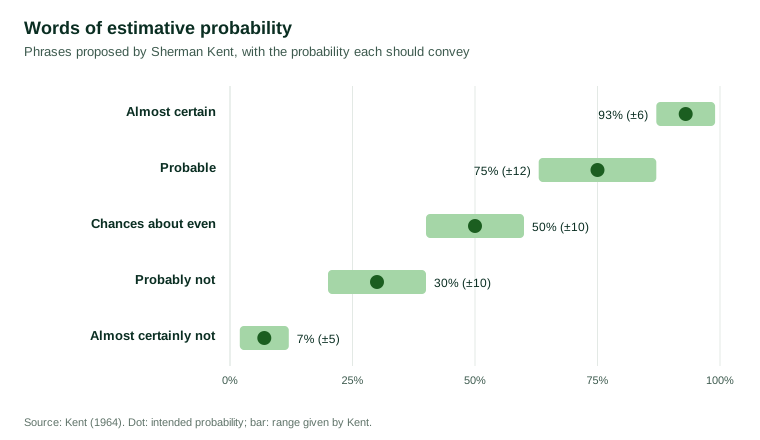
The bridge between evidence and action carries uncertainty. Kent (1964) discovered how easily it is lost. After a national intelligence estimate stated that an attack was a "serious possibility", he asked colleagues what probability the phrase meant, and found their answers ranged widely, from about 20% to 80%. He proposed a set of words of estimative probability, each linked to a numerical range, so that phrases such as "probable" or "almost certainly not" would mean the same thing to writers and readers.
Friedman and Zeckhauser (2012) argued that intelligence analysts should go further and state probabilities numerically where possible, because vague language allows readers to interpret estimates in line with their own expectations and makes it impossible to check later whether analysts were accurate. Spiegelhalter (2017) reviewed evidence on communicating risk and uncertainty and recommended clear numerical statements, expressed in formats that audiences understand, together with honest acknowledgement of the quality of the underlying evidence.
How accurate are judgements?
If intelligence and insights are to guide action, their accuracy should be measured. Mandel and Barnes (2014) examined more than a thousand probabilistic forecasts made by strategic intelligence analysts in Canada and compared them with what actually happened. They found that the forecasts were generally well calibrated, meaning that events judged to be, say, 70% likely occurred about 70% of the time, although analysts tended to be somewhat underconfident.
Tetlock and Gardner (2015) described a large forecasting tournament sponsored by the United States intelligence community, in which thousands of volunteers forecast world events. A small group of "superforecasters" proved consistently more accurate than others. They tended to break questions into parts, start from base rates, update their estimates frequently in small steps and actively seek out views that challenged their own. Teams that shared information and debated their reasoning performed better still.
Kahneman and Klein (2009) addressed when expert intuition can be trusted. They concluded that intuitive judgement is reliable only when the environment is regular enough to be predictable and when experts have had extensive practice with timely feedback on their judgements. In many business and policy settings, these conditions are only partly met, so intuitive insights should be checked against evidence.
Insight in survey and market research
In survey and market research, the bridge between evidence and action usually takes the form of an insight report or briefing. The raw material is a set of findings: percentages, differences between groups, trends and verbatim comments. The insight lies in what connects them and what they imply for the client. A finding that younger customers are less satisfied with a service becomes an insight when the analysis shows why, for example because the service relies on a channel that younger customers rarely use, and what could be done about it.
Producing such insights responsibly requires the same disciplines as intelligence analysis. The analyst must understand the client's decisions well enough to know which findings matter. They must distinguish robust differences from those that could have arisen by chance, especially when many subgroups are compared. They must look for evidence that contradicts the emerging story as well as evidence that supports it. And they must express the confidence of each conclusion in a way the client can understand, rather than presenting every finding with equal certainty. An insight that is striking but fragile can do more harm than no insight at all, because it invites confident action on weak grounds.
Good insight work also involves listening. Analysts who meet decision-makers regularly learn what questions are coming, which assumptions are being made and which findings would change plans. That knowledge allows research to be designed around real decisions and findings to be presented in terms that connect directly with them.
Why the bridge fails
Intelligence failures are rarely failures of collection alone. Betts (1978) argued that some intelligence failures are inevitable, because the evidence is ambiguous, because analysts must choose between competing interpretations, and because decision-makers may ignore or misread warnings they receive. He noted that the most serious failures often occurred not because information was missing but because it was not believed or acted upon. Heuer (1999) showed how analysts' own mental models cause them to overlook evidence that does not fit, and recommended structured methods for testing alternative explanations.
Weiss (1979) and Nutley et al. (2007) found similar patterns in the use of research by governments: research is used when it arrives at the right time, in a usable form, through people whom decision-makers trust, and when it fits, or convincingly challenges, the way decision-makers understand the problem.
Building a reliable bridge
For organisations whose role is to turn evidence into action, the experience of intelligence and insight work suggests several practices.
Start with the decision. Identify the decisions the evidence must inform and the questions on which they turn. Revisit these regularly as circumstances change.
Separate collection, analysis and advocacy. Keep the reporting of evidence distinct from interpretation and from recommendations, so that each can be judged on its merits.
State uncertainty clearly. Use consistent language or numbers for likelihood, explain what the estimate rests on and say what would change it.
Test the story. Before presenting an insight, ask what else could explain the evidence and whether any evidence contradicts the preferred account.
Track accuracy. Record forecasts and judgements and compare them with outcomes, so that the organisation learns which methods and analysts are reliable.
Deliver at the right moment. Evidence that arrives after the decision has no value. Work to the decision-maker's timetable, and provide early warning when signals change.
Build trust through independence. Decision-makers rely on intelligence that is honest even when unwelcome. Protect the freedom of analysts to report what the evidence shows.
Conclusion
Intelligence and insights are the bridge between evidence and action. They depend on understanding the decision-maker's needs, analysing evidence honestly, communicating uncertainty clearly and delivering findings when and where they can be used. Decades of experience in national intelligence and business show that the bridge fails less often for lack of information than through mental traps, vague language, poor timing and organisational barriers. Organisations that address these failures, and that measure the accuracy of their judgements, provide decision-makers with something more valuable than data: knowledge they can act on with appropriate confidence.
References
Betts, R. K. (1978). Analysis, war, and decision: Why intelligence failures are inevitable. World Politics, 31(1), 61–89. https://doi.org/10.2307/2009967
Davenport, T. H., & Harris, J. G. (2007). Competing on analytics: The new science of winning. Harvard Business School Press.
Friedman, J. A., & Zeckhauser, R. (2012). Assessing uncertainty in intelligence. Intelligence and National Security, 27(6), 824–847. https://doi.org/10.1080/02684527.2012.708275
Gilad, B. (2004). Early warning: Using competitive intelligence to anticipate market shifts, control risk, and create powerful strategies. AMACOM.
Herring, J. P. (1999). Key intelligence topics: A process to identify and define intelligence needs. Competitive Intelligence Review, 10(2), 4–14.
Heuer, R. J., Jr. (1999). Psychology of intelligence analysis. Center for the Study of Intelligence, Central Intelligence Agency.
Kahneman, D., & Klein, G. (2009). Conditions for intuitive expertise: A failure to disagree. American Psychologist, 64(6), 515–526. https://doi.org/10.1037/a0016755
Kent, S. (1949). Strategic intelligence for American world policy. Princeton University Press.
Kent, S. (1964). Words of estimative probability. Studies in Intelligence, 8(4), 49–65.
Klein, G. (2013). Seeing what others don't: The remarkable ways we gain insights. PublicAffairs.
Lowenthal, M. M. (2019). Intelligence: From secrets to policy (8th ed.). CQ Press.
Mandel, D. R., & Barnes, A. (2014). Accuracy of forecasts in strategic intelligence. Proceedings of the National Academy of Sciences, 111(30), 10984–10989. https://doi.org/10.1073/pnas.1406138111
Nutley, S. M., Walter, I., & Davies, H. T. O. (2007). Using evidence: How research can inform public services. Policy Press.
Spiegelhalter, D. (2017). Risk and uncertainty communication. Annual Review of Statistics and Its Application, 4, 31–60. https://doi.org/10.1146/annurev-statistics-010814-020148
Tetlock, P. E., & Gardner, D. (2015). Superforecasting: The art and science of prediction. Crown.
Weiss, C. H. (1979). The many meanings of research utilization. Public Administration Review, 39(5), 426–431. https://doi.org/10.2307/3109916
Wilensky, H. L. (1967). Organizational intelligence: Knowledge and policy in government and industry. Basic Books.