
The Generation of Knowledge · Trust, quality and the future
Ethics of Knowledge Generation: Consent, Fairness and Benefit
The ethical principles that govern research with people, how they arose from past abuses, and what consent, fairness and benefit mean in practice for surveys, market research and other knowledge-generating work.
Generating knowledge about people requires something from them: their time, their information and sometimes their trust in matters that affect their lives. Research ethics sets out what researchers owe in return. The principles were developed largely in medicine, but they apply to every discipline that studies people, including surveys, market research and data analysis. This article outlines how those principles arose and what they mean in practice.
Lessons from past abuses
Modern research ethics grew out of scandal. After the Second World War, the trials of Nazi doctors who had carried out experiments on prisoners led to the Nuremberg Code of 1947, which made voluntary consent essential. The World Medical Association's Declaration of Helsinki, first adopted in 1964 and revised many times since, set out principles for medical research involving people (World Medical Association, 2013).
Abuses continued in democratic countries. Beecher (1966) described 22 published studies in which patients had been exposed to serious risks without their knowledge. In the Tuskegee study in the United States, hundreds of poor Black men with syphilis were observed for decades without being told their diagnosis or offered effective treatment once it became available (Brandt, 1978). Public outrage at Tuskegee led to the creation of a national commission whose Belmont Report set out three principles that still guide research ethics (National Commission for the Protection of Human Subjects of Biomedical and Behavioral Research, 1979).
Three principles
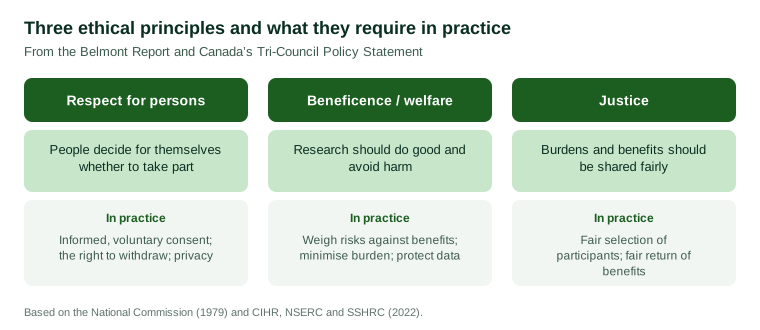
In Canada, the Tri-Council Policy Statement, which governs research funded by the federal research agencies, adopts three closely related core principles: respect for persons, concern for welfare and justice (Canadian Institutes of Health Research et al., 2022).
Respect for persons requires that people decide for themselves whether to take part. In practice this means informed consent: participants should understand what the research involves, what will happen to their information and any risks, and should be free to decline or withdraw without penalty.
Concern for welfare requires researchers to weigh risks against benefits and to minimise harm. In survey research, the main risks are usually not physical but concern privacy, distress from sensitive questions and the misuse of data.
Justice requires that the burdens and benefits of research be shared fairly. Groups should not be studied simply because they are easy to reach, nor excluded from research that could benefit them.
Emanuel et al. (2000) added that ethical research must also have social or scientific value and be scientifically valid. Research that is poorly designed wastes participants' time and cannot justify even small risks.
Consent in the digital age
Digital research has tested these principles. Kramer et al. (2014) reported an experiment in which the news feeds of nearly 700,000 Facebook users were altered to show fewer positive or negative posts, to study whether emotions spread through social networks. Users had agreed to the platform's terms of service but had not been told about the experiment. The study prompted wide criticism, and the journal that published it added an editorial expression of concern about consent.
The lesson is that agreeing to terms and conditions is not the same as informed consent. People should know when they are taking part in research and what will be done with their information.
Fairness and collective rights
Fairness also applies to communities. In Canada, First Nations have set out the principles of ownership, control, access and possession (OCAP), which hold that First Nations communities own information about themselves and should control how it is collected, used and shared (First Nations Information Governance Centre, 2014). These principles respond to a history in which research was done on communities rather than with them, and its benefits flowed elsewhere.
Benefit
The third element in the title of this article, benefit, is often the least discussed. Participants give their time and information, and the knowledge that results may bring commercial or public value to others. Ethical practice asks what participants receive in return. This may be fair payment for their time, access to the findings, or the knowledge that the research will be used to improve services they rely on. Communities that take part in research should be able to see and use the results, not only read about themselves in reports written for others.
Ethics in survey and market research
Commercial research has its own codes. The ICC/ESOMAR International Code (ICC/ESOMAR, 2016) requires researchers to be honest with participants about the purpose of research, to respect their right to refuse, to protect personal data, and to keep research clearly separate from selling. In practice, this means plain explanations at the start of a survey, questions that are no more intrusive than the purpose requires, secure handling of responses, and reporting that never identifies individuals without their agreement.
Conclusion
Research ethics asks that the people who make knowledge possible be treated with respect, protected from harm and treated fairly. Consent must be informed and real, risks must be justified by value, and the benefits of knowledge should reach those who helped create it. These principles protect participants, and they also protect knowledge itself, since research that people do not trust will soon lack people willing to take part.
References
Beecher, H. K. (1966). Ethics and clinical research. New England Journal of Medicine, 274(24), 1354–1360. https://doi.org/10.1056/NEJM196606162742405
Brandt, A. M. (1978). Racism and research: The case of the Tuskegee Syphilis Study. Hastings Center Report, 8(6), 21–29. https://doi.org/10.2307/3561468
Canadian Institutes of Health Research, Natural Sciences and Engineering Research Council of Canada, & Social Sciences and Humanities Research Council of Canada. (2022). Tri-Council policy statement: Ethical conduct for research involving humans – TCPS 2 (2022). Government of Canada.
Emanuel, E. J., Wendler, D., & Grady, C. (2000). What makes clinical research ethical? JAMA, 283(20), 2701–2711. https://doi.org/10.1001/jama.283.20.2701
First Nations Information Governance Centre. (2014). Ownership, control, access and possession (OCAP™): The path to First Nations information governance. First Nations Information Governance Centre.
ICC/ESOMAR. (2016). ICC/ESOMAR international code on market, opinion and social research and data analytics. ESOMAR.
Kramer, A. D. I., Guillory, J. E., & Hancock, J. T. (2014). Experimental evidence of massive-scale emotional contagion through social networks. Proceedings of the National Academy of Sciences, 111(24), 8788–8790. https://doi.org/10.1073/pnas.1320040111
National Commission for the Protection of Human Subjects of Biomedical and Behavioral Research. (1979). The Belmont report: Ethical principles and guidelines for the protection of human subjects of research. U.S. Department of Health, Education, and Welfare.
World Medical Association. (2013). World Medical Association Declaration of Helsinki: Ethical principles for medical research involving human subjects. JAMA, 310(20), 2191–2194. https://doi.org/10.1001/jama.2013.281053