
Surveys · Incentives and engagement
Building Trust With Survey Respondents Through Transparency
People take part in surveys when they trust the organisation asking and believe their answers will be handled properly. This article reviews the evidence on how transparency about sponsorship, purpose, data protection and results builds that trust.
A survey asks people to give time and information to an organisation they may know little about. Whether they agree depends in large part on trust: trust that the request is genuine, that their answers will be used for the stated purpose and that their information will be protected. Social exchange theory, which underlies much practical guidance on survey design, places trust alongside rewards and costs as one of the three main influences on participation (Dillman et al., 2014).
Trust cannot be demanded, but it can be earned through transparency: telling people clearly who is asking, why, what is involved and what will happen to their information. This article reviews the evidence on how transparency affects participation and the quality of answers, and offers practical guidance.
Why trust matters
People receive many requests that look like surveys, from marketing calls to phishing emails. Some "surveys" are really attempts to sell products or collect personal data. In this environment, a genuine survey request must establish its legitimacy quickly. Groves et al. (1992) identified authority and legitimacy as cues that people use when deciding whether to take part: requests from recognised, legitimate organisations are more likely to be accepted.
Trust also affects what people say. Respondents who doubt that their answers will be kept confidential may refuse sensitive questions or give socially acceptable answers. Concerns about privacy have been linked to lower participation in official surveys. Singer et al. (1993) found that people who expressed greater concern about privacy and confidentiality were less likely to return their census forms in the United States.
Sponsorship and the sender
Who sponsors a survey affects response. Meta-analyses of mail surveys found that sponsorship by a university or government agency produced higher response rates than commercial sponsorship (Fox et al., 1988). Identifying the sponsor clearly, using official letterhead or a recognisable email address and providing a named contact person all signal that the request is genuine. Joinson and Reips (2007) found that invitations from a sender of higher status produced higher response in web surveys.
Commercial researchers face a particular challenge, since their names are less familiar and their purposes may be suspected. Explaining that the research company is independent, naming the client where possible and stating that no sales approach will follow can help.
What to tell respondents
Figure 1 summarises the information that respondents need in order to decide whether to trust a survey request.
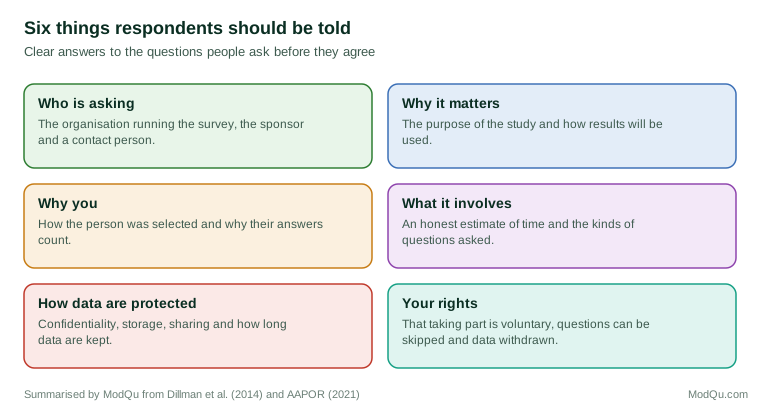
Professional codes require much of this information. The code of the American Association for Public Opinion Research (2021) requires researchers to disclose the sponsor and the purpose of a survey on request and to protect respondents' confidentiality. The international code of ESOMAR and the International Chamber of Commerce (2016) requires that participation be voluntary, that respondents be told the purpose of data collection and that their personal data be protected.
Confidentiality assurances
Assurances of confidentiality are a central part of transparency. Their effect, however, depends on the topic. Singer et al. (1995) reviewed experiments on confidentiality assurances and found that strong assurances increased response and reduced item nonresponse when the survey asked about sensitive topics, but had little effect, or a small negative effect, when topics were not sensitive. Elaborate assurances for innocuous surveys may raise suspicion that something sensitive is coming. Figure 2 illustrates the pattern.
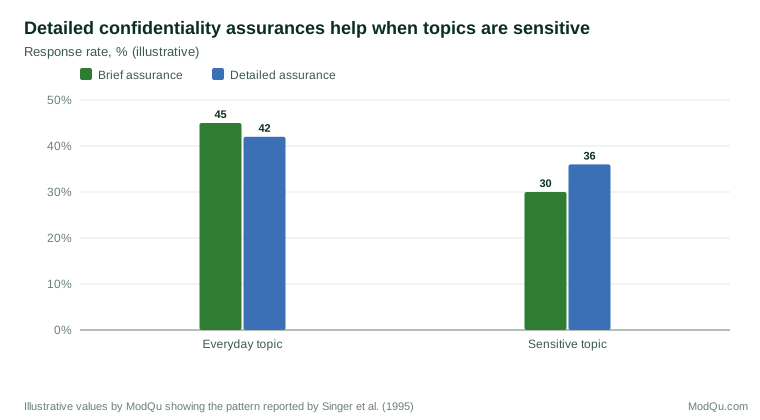
Couper et al. (2008) tested how information about the risk of disclosure affected willingness to take part. They found that the sensitivity of the topic mattered more than the stated risk, and that many people did not distinguish between different levels of risk described in the request. Couper et al. (2010) confirmed that topic sensitivity and perceived harm influenced participation. These findings suggest that assurances should be matched to the topic: brief and clear for routine surveys, more detailed for surveys on sensitive subjects.
Trust at the doorstep and on the telephone
In interviewer surveys, trust is built in conversation. Interviewers who carry identification, leave a card with a telephone number that can be checked and explain the survey in their own words are more likely to be trusted than those who recite a script. Groves and Couper (1998) found that the concerns people raise when first approached, such as doubts about the purpose of the survey or about who will see their answers, are strong predictors of refusal, and that interviewers who address these concerns directly are more successful. Advance letters sent before an interviewer calls let people check that the survey is genuine and reduce suspicion of an unexpected visitor or caller (de Leeuw et al., 2007).
Groups with lower trust
Trust in institutions is not evenly distributed. People who distrust government, large organisations or researchers are less likely to take part in surveys, and their absence can bias estimates of trust, civic participation and related topics. Stoop et al. (2010) analysed refusals in the European Social Survey and found that reluctance to take part was related to attitudes towards surveys and to general social trust, and that converted refusers sometimes differed from early respondents. Reaching such groups may require sponsors they recognise, such as community organisations, interviewers from similar backgrounds, more explanation of how data will be protected and assurances that answers will not be passed to authorities.
Honesty about burden
Being honest about how long a survey will take is part of transparency. Understating the length may increase the number who start but leads to breakoffs and damages trust when respondents discover the truth. Crawford et al. (2001) found that a shorter stated length increased the number who began a web survey, but that respondents who found the survey longer than stated were more likely to break off. Accurate estimates respect respondents and produce more complete data.
Consent and data use
Respondents increasingly expect to know how their data will be used, especially when surveys are linked to other information, such as administrative records. Asking for consent to link data is itself a matter of transparency. Sakshaug and Kreuter (2012) found that most respondents agreed to linkage when asked, and that the biases arising from non-consent were generally small. Clear explanations of why linkage is useful and how data will be protected increase consent rates.
Data protection laws, such as the General Data Protection Regulation in Europe and the Personal Information Protection and Electronic Documents Act in Canada, require that people be told the purposes for which their data are collected and their rights to access and correct them. Meeting these requirements in plain language, rather than in long legal notices, supports trust.
Sharing results
Offering respondents a summary of the results is a simple form of reciprocity and transparency. It shows that the survey has a real purpose and that respondents' contributions matter. Many organisations publish summaries on their websites and include a link in the invitation or the closing screen. For panel surveys, sharing findings between waves helps maintain engagement (Laurie & Lynn, 2009).
Transparency about incentives
How incentives are described also affects trust. An incentive presented as a token of thanks reinforces the social exchange; one presented as payment for a service turns the request into a transaction. Prepaid incentives, which are given before people decide, signal that the sponsor trusts the recipient, which is one reason they work better than promised ones (Singer & Ye, 2013). Being clear about whether a respondent can keep an incentive without taking part, and how a promised incentive will be delivered, avoids suspicion. Singer and Couper (2008) found no evidence that typical incentives pressured people into taking part in research they considered risky, which supports their use alongside full information.
Transparency in online panels
Online panels raise their own trust issues. Members join in return for rewards, and their trust depends on whether rewards are paid reliably, whether their data are protected and whether they are sent surveys that match what they were promised. Buyers of panel samples also need transparency from panel companies: how members were recruited, how often they are invited, how fraud is detected and how quality is checked. ESOMAR (2021) publishes a set of questions to help buyers assess online samples, and Callegaro et al. (2014) reviewed the evidence on panel data quality. Transparent practice on both sides supports trust among members and among the clients who rely on their answers.
The wider climate of trust
Trust in surveys depends not only on individual requests but on the wider climate. Surveys about surveys show that public attitudes towards research have changed over time and that people who view surveys as useful are more likely to take part (Kim et al., 2011). Practices that damage this climate, such as fake surveys used for marketing, "push polls" that spread misleading claims and poorly protected data, reduce trust for all researchers. Transparent practice by each organisation contributes to a better climate for everyone.
Practical guidance
- Identify the organisation, the sponsor and a contact person clearly in every contact.
- State the purpose of the survey and how results will be used.
- Give an honest estimate of the time required.
- Match confidentiality assurances to the sensitivity of the topic.
- Explain data protection and respondents' rights in plain language.
- Never use a survey to sell, and say so.
- Offer a summary of results.
- Follow professional codes and data protection law.
An example
A city council runs an annual residents' survey by mail and web. Response has fallen, and comments suggest some residents think the survey is a marketing exercise. The council redesigns the invitation: it now comes on council letterhead, signed by a named officer with a direct telephone number, explains in two sentences how last year's results changed local services and links to a short page on data protection. The closing screen offers a summary of results. Response rises from 19 to 25 per cent, and fewer respondents skip the questions on income and neighbourhood safety (illustrative example).
Conclusion
Trust is a precondition for survey participation and for honest answers. Transparency about sponsorship, purpose, burden, confidentiality and data use builds that trust. The evidence shows that legitimate sponsors, clear and honest invitations and confidentiality assurances matched to the topic increase response and improve the quality of answers. Because trust in surveys is shared across the research community, transparent practice benefits not only individual surveys but the wider enterprise of generating knowledge through surveys.
References
American Association for Public Opinion Research. (2021). AAPOR code of professional ethics and practices. AAPOR. https://aapor.org/standards-and-ethics/
Callegaro, M., Baker, R., Bethlehem, J., Göritz, A. S., Krosnick, J. A., & Lavrakas, P. J. (Eds.). (2014). Online panel research: A data quality perspective. Wiley. https://doi.org/10.1002/9781118763520
Couper, M. P., Singer, E., Conrad, F. G., & Groves, R. M. (2008). Risk of disclosure, perceptions of risk, and concerns about privacy and confidentiality as factors in survey participation. Journal of Official Statistics, 24(2), 255–275.
Couper, M. P., Singer, E., Conrad, F. G., & Groves, R. M. (2010). Experimental studies of disclosure risk, disclosure harm, topic sensitivity, and survey participation. Journal of Official Statistics, 26(2), 287–300.
Crawford, S. D., Couper, M. P., & Lamias, M. J. (2001). Web surveys: Perceptions of burden. Social Science Computer Review, 19(2), 146–162. https://doi.org/10.1177/089443930101900202
de Leeuw, E., Callegaro, M., Hox, J., Korendijk, E., & Lensvelt-Mulders, G. (2007). The influence of advance letters on response in telephone surveys: A meta-analysis. Public Opinion Quarterly, 71(3), 413–443. https://doi.org/10.1093/poq/nfm014
Dillman, D. A., Smyth, J. D., & Christian, L. M. (2014). Internet, phone, mail, and mixed-mode surveys: The tailored design method (4th ed.). Wiley.
ESOMAR & International Chamber of Commerce. (2016). ICC/ESOMAR international code on market, opinion and social research and data analytics. ESOMAR. https://esomar.org/code-and-guidelines/icc-esomar-code
ESOMAR. (2021). Questions to help buyers of online samples. ESOMAR.
Fox, R. J., Crask, M. R., & Kim, J. (1988). Mail survey response rate: A meta-analysis of selected techniques for inducing response. Public Opinion Quarterly, 52(4), 467–491. https://doi.org/10.1086/269125
Groves, R. M., & Couper, M. P. (1998). Nonresponse in household interview surveys. Wiley. https://doi.org/10.1002/9781118490082
Groves, R. M., Cialdini, R. B., & Couper, M. P. (1992). Understanding the decision to participate in a survey. Public Opinion Quarterly, 56(4), 475–495. https://doi.org/10.1086/269338
Joinson, A. N., & Reips, U.-D. (2007). Personalized salutation, power of sender and response rates to Web-based surveys. Computers in Human Behavior, 23(3), 1372–1383. https://doi.org/10.1016/j.chb.2004.12.011
Kim, J., Gershenson, C., Glaser, P., & Smith, T. W. (2011). The polls—trends: Trends in surveys on surveys. Public Opinion Quarterly, 75(1), 165–191. https://doi.org/10.1093/poq/nfq047
Laurie, H., & Lynn, P. (2009). The use of respondent incentives on longitudinal surveys. In P. Lynn (Ed.), Methodology of longitudinal surveys (pp. 205–233). Wiley. https://doi.org/10.1002/9780470743874.ch12
Sakshaug, J. W., & Kreuter, F. (2012). Assessing the magnitude of non-consent biases in linked survey and administrative data. Survey Research Methods, 6(2), 113–122. https://doi.org/10.18148/srm/2012.v6i2.5094
Singer, E., & Couper, M. P. (2008). Do incentives exert undue influence on survey participation? Experimental evidence. Journal of Empirical Research on Human Research Ethics, 3(3), 49–56. https://doi.org/10.1525/jer.2008.3.3.49
Singer, E., & Ye, C. (2013). The use and effects of incentives in surveys. The Annals of the American Academy of Political and Social Science, 645(1), 112–141. https://doi.org/10.1177/0002716212458082
Singer, E., Mathiowetz, N. A., & Couper, M. P. (1993). The impact of privacy and confidentiality concerns on survey participation: The case of the 1990 U.S. Census. Public Opinion Quarterly, 57(4), 465–482. https://doi.org/10.1086/269391
Singer, E., von Thurn, D. R., & Miller, E. R. (1995). Confidentiality assurances and response: A quantitative review of the experimental literature. Public Opinion Quarterly, 59(1), 66–77. https://doi.org/10.1086/269458
Stoop, I., Billiet, J., Koch, A., & Fitzgerald, R. (2010). Improving survey response: Lessons learned from the European Social Survey. Wiley. https://doi.org/10.1002/9780470688335