
Research · Research design
Translational Research: Bridging Discovery and Applied Knowledge
Translational research studies how discoveries become practical use, and why so many never do. This article explains the translational continuum, the gaps along it, the designs that help knowledge cross them and lessons for applied research outside medicine.
A discovery does not become useful on its own. A new molecule must be tested, manufactured, approved, prescribed and taken correctly before it improves health. A new finding about consumer behaviour must be understood, believed, turned into a decision and carried out before it improves a business. Translational research is the research that moves knowledge along this path. It began as a label in biomedical science, where the gap between laboratory and patient became a policy concern, but its central idea applies to any field in which knowledge is produced in one place and used in another.
This article explains what translational research is, how the translational continuum is usually divided, why knowledge so often fails to cross the gaps, and which research designs and practices help it do so.
From linear model to continuum
For much of the twentieth century, science policy assumed a linear model of innovation. Bush (1945) argued that basic research, pursued without thought of practical ends, creates the fund of knowledge from which applications are later drawn. Basic research would flow into applied research, then development, then use. Stokes (1997) criticised this model, pointing out that much important research, such as Pasteur's work on microbiology, is driven both by the search for fundamental understanding and by consideration of use. He proposed a two-dimensional view in which "use-inspired basic research" sits alongside pure basic and pure applied research.
Translational research accepts that the path from discovery to use is not automatic. Woolf (2008) observed that the term had come to mean two different things: the "bench to bedside" work of turning laboratory discoveries into new treatments, and the work of ensuring that proven treatments actually reach the patients who need them. These two stages need different skills, settings and methods, and the second had received far less attention and funding.
The translational continuum
Later authors divided the path into a series of stages, often labelled T0 to T4 (Khoury et al., 2007; Drolet & Lorenzi, 2011). Figure 1 shows a common version.
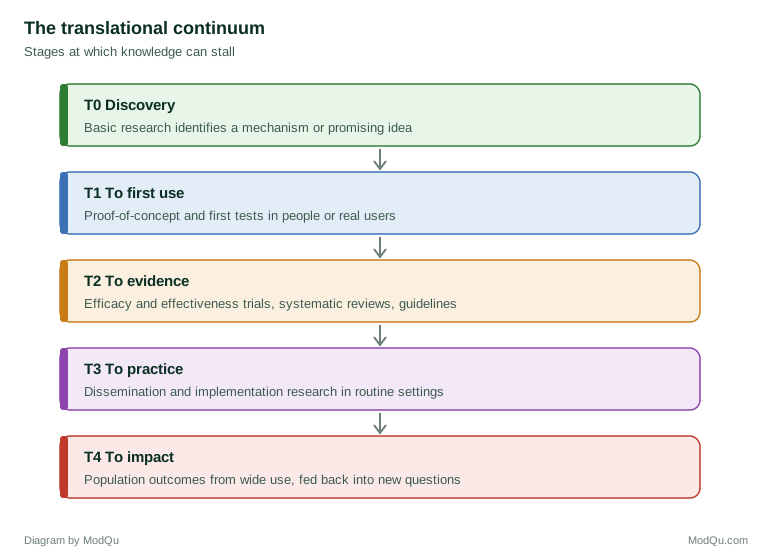
- T0, discovery: basic research that identifies a mechanism, a target or a promising idea.
- T1, from discovery to first use: early tests of whether the idea works in people, such as first-in-human and proof-of-concept studies.
- T2, from first use to evidence-based guidance: trials that establish efficacy and effectiveness, and systematic reviews that turn results into guidelines.
- T3, from guidance to practice: research on how to deliver proven interventions in routine settings, including dissemination and implementation studies.
- T4, from practice to population impact: research on whether wide use actually improves outcomes for populations.
The stages are not strictly sequential. Findings at later stages often send researchers back to earlier ones, for example when an intervention that works in trials fails in practice because of features of the setting.
Translation also runs backwards. Reverse translation uses observations from practice, such as unexpected side effects, patterns in routine data or problems reported by users, to generate new questions for basic research. A continuum that only pushes discoveries outward misses this source of ideas.
Westfall et al. (2007) argued that the later stages need their own research infrastructure. They described practice-based research networks, in which practitioners and researchers work together in ordinary clinics, as "blue highways" connecting research to the communities where care is delivered.
Why knowledge gets lost
Evidence of delay and loss along the continuum is substantial. Morris et al. (2011) reviewed studies of time lags in health research and found that estimates converged on about 17 years from research evidence to routine practice, although the estimates varied widely and depended on how the start and end points were defined. Contopoulos-Ioannidis et al. (2003) followed highly promising basic science claims published in major journals and found that only a small minority led to a randomised trial within two decades, and fewer still to a licensed, widely used treatment.
Butler (2008) described the gap between basic discovery and clinical testing as a "valley of death", where promising ideas die because neither academic researchers nor industry are willing or able to fund the risky, expensive work of early translation. Lenfant (2003) drew attention to the later gap, between proven treatments and their use in practice, noting that many patients did not receive therapies that had been shown to work years earlier.
The reasons are found at every stage:
- Different incentives. Academic researchers are rewarded for publications and grants, not for use; practitioners are rewarded for service, not for adopting evidence.
- Different languages. Research reports are written for other researchers and rarely say what a practitioner should do differently.
- Context. An intervention tested under ideal conditions may not fit the staff, budgets, workflows or populations of real settings.
- Evidence quality. Some promising findings do not replicate, and translation of weak findings wastes resources.
Designs that help knowledge cross the gaps
Effectiveness and pragmatic studies
Efficacy trials ask whether an intervention can work under controlled conditions. Effectiveness studies ask whether it does work in ordinary practice. Pragmatic designs use broad eligibility criteria, typical settings and practitioners, and outcomes that matter to users. They produce evidence that is more directly applicable, at the cost of more variability.
Implementation research
Implementation research studies the methods that promote the uptake of research findings in routine practice. Graham et al. (2006) proposed the knowledge-to-action framework, in which knowledge creation and an action cycle of adapting knowledge to the local context, assessing barriers, selecting interventions, monitoring use and sustaining change run together. Damschroder et al. (2009) brought together constructs from many theories into the Consolidated Framework for Implementation Research, which describes features of the intervention, the outer and inner settings, the people involved and the implementation process that shape success.
Hybrid designs
Curran et al. (2012) proposed effectiveness-implementation hybrid designs, which test an intervention's effectiveness and an implementation strategy at the same time, with different emphasis depending on how much is already known. Hybrids shorten the path by collecting implementation evidence while effectiveness is still being established, rather than waiting for one stage to finish before the next begins.
Evaluation frameworks
Glasgow et al. (1999) proposed the RE-AIM framework, which evaluates interventions on five dimensions: reach, effectiveness, adoption, implementation and maintenance. An intervention that is highly effective but reaches few people, or is adopted by few organisations, has little public impact. RE-AIM makes these dimensions visible and comparable.
Diffusion
Rogers (2003) synthesised decades of research on how innovations spread. Adoption depends on the perceived advantage of the innovation, its compatibility with existing practice, its complexity, whether it can be tried on a small scale and whether its results are visible. These attributes provide a checklist for designing research outputs that are more likely to be used. Rogers also showed that adoption usually follows an S-shaped curve: a few innovators and early adopters take up a new practice first, and the majority follow only when they see it working among peers. Translation strategies that target respected early adopters can therefore speed wider use.
Translation beyond medicine
The same problems appear wherever research is meant to inform practice. Weiss (1979) distinguished several meanings of research use in policy. Only some were direct and instrumental; more often research shaped how problems were understood, a process she called enlightenment, or was used to support positions already taken. Expecting every study to produce an immediate decision misunderstands how knowledge is used.
In business, the link between academic science and industrial innovation has been studied directly. Mansfield (1991) surveyed firms in several industries and estimated that a meaningful share of new products and processes could not have been developed, without substantial delay, in the absence of recent academic research. Narin et al. (1997) traced citations from United States patents to scientific papers and found a rapidly growing reliance of industrial technology on publicly funded science.
Within organisations, translation also applies to market and survey research. A customer study produces findings; translation turns them into decisions, changes to products or services, and measured outcomes. The same gaps occur: findings written for analysts rather than decision-makers, recommendations that do not fit operational constraints and no follow-up to see whether changes worked.
A worked example
Consider a hypothetical retailer whose research team finds, in a survey and a controlled online experiment, that showing delivery times more prominently increases completed orders. This is the T1 stage: a promising effect under controlled conditions. At T2, the team repeats the test across product categories and seasons and combines the results, establishing that the effect is real but smaller than first estimated. At T3, the finding meets operational reality. The warehouse cannot always meet the displayed times, and the web team has competing priorities. Implementation research, in the form of interviews with staff and a staged rollout, identifies the changes needed for the feature to work. At T4, the retailer tracks orders, returns and complaints across all sites over a year. Each stage answers a different question, and stopping at the first would have left the retailer with an overestimated effect and a feature that could not be delivered reliably.
Practical guidance for applied researchers
- Identify the user early. Decide who should act on the findings and involve them in framing the questions.
- Design for the setting. Test ideas under conditions close to those in which they will be used.
- Measure more than effect size. Collect evidence on reach, cost, feasibility and acceptability as well as on outcomes.
- Translate the language. State what should change, for whom and with what expected result, alongside the technical report.
- Plan the next stage. Specify what evidence would be needed to move the finding along the continuum.
- Follow up. Measure whether use occurred and whether it produced the expected benefit, and feed the results back into research.
Common mistakes
- Treating publication or delivery of a report as the end of the research.
- Moving to wide rollout on the strength of a single promising study.
- Testing interventions only under ideal conditions and assuming the effect will transfer.
- Ignoring the people and organisations who must change their behaviour for the knowledge to be used.
Key takeaways
Translational research treats the movement of knowledge from discovery to use as a subject of research in its own right. The translational continuum, from discovery to population impact, shows where knowledge stalls. Effectiveness studies, implementation research, hybrid designs and evaluation frameworks help it move. The lesson applies beyond medicine: research that is not designed with its eventual use in mind is likely to remain on the shelf.
References
Bush, V. (1945). Science, the endless frontier: A report to the President. United States Government Printing Office.
Butler, D. (2008). Translational research: Crossing the valley of death. Nature, 453(7197), 840–842. https://doi.org/10.1038/453840a
Contopoulos-Ioannidis, D. G., Ntzani, E., & Ioannidis, J. P. A. (2003). Translation of highly promising basic science research into clinical applications. The American Journal of Medicine, 114(6), 477–484. https://doi.org/10.1016/S0002-9343(03)00013-5
Curran, G. M., Bauer, M., Mittman, B., Pyne, J. M., & Stetler, C. (2012). Effectiveness-implementation hybrid designs: Combining elements of clinical effectiveness and implementation research to enhance public health impact. Medical Care, 50(3), 217–226. https://doi.org/10.1097/MLR.0b013e3182408812
Damschroder, L. J., Aron, D. C., Keith, R. E., Kirsh, S. R., Alexander, J. A., & Lowery, J. C. (2009). Fostering implementation of health services research findings into practice: A consolidated framework for advancing implementation science. Implementation Science, 4, Article 50. https://doi.org/10.1186/1748-5908-4-50
Drolet, B. C., & Lorenzi, N. M. (2011). Translational research: Understanding the continuum from bench to bedside. Translational Research, 157(1), 1–5. https://doi.org/10.1016/j.trsl.2010.10.002
Glasgow, R. E., Vogt, T. M., & Boles, S. M. (1999). Evaluating the public health impact of health promotion interventions: The RE-AIM framework. American Journal of Public Health, 89(9), 1322–1327. https://doi.org/10.2105/AJPH.89.9.1322
Graham, I. D., Logan, J., Harrison, M. B., Straus, S. E., Tetroe, J., Caswell, W., & Robinson, N. (2006). Lost in knowledge translation: Time for a map? Journal of Continuing Education in the Health Professions, 26(1), 13–24. https://doi.org/10.1002/chp.47
Khoury, M. J., Gwinn, M., Yoon, P. W., Dowling, N., Moore, C. A., & Bradley, L. (2007). The continuum of translation research in genomic medicine: How can we accelerate the appropriate integration of human genome discoveries into health care and disease prevention? Genetics in Medicine, 9(10), 665–674. https://doi.org/10.1097/GIM.0b013e31815699d0
Lenfant, C. (2003). Clinical research to clinical practice: Lost in translation? New England Journal of Medicine, 349(9), 868–874. https://doi.org/10.1056/NEJMsa035507
Mansfield, E. (1991). Academic research and industrial innovation. Research Policy, 20(1), 1–12. https://doi.org/10.1016/0048-7333(91)90080-A
Morris, Z. S., Wooding, S., & Grant, J. (2011). The answer is 17 years, what is the question: Understanding time lags in translational research. Journal of the Royal Society of Medicine, 104(12), 510–520. https://doi.org/10.1258/jrsm.2011.110180
Narin, F., Hamilton, K. S., & Olivastro, D. (1997). The increasing linkage between U.S. technology and public science. Research Policy, 26(3), 317–330. https://doi.org/10.1016/S0048-7333(97)00013-9
Rogers, E. M. (2003). Diffusion of innovations (5th ed.). Free Press.
Stokes, D. E. (1997). Pasteur's quadrant: Basic science and technological innovation. Brookings Institution Press.
Weiss, C. H. (1979). The many meanings of research utilization. Public Administration Review, 39(5), 426–431. https://doi.org/10.2307/3109916
Westfall, J. M., Mold, J., & Fagnan, L. (2007). Practice-based research: "Blue highways" on the NIH roadmap. JAMA, 297(4), 403–406. https://doi.org/10.1001/jama.297.4.403
Woolf, S. H. (2008). The meaning of translational research and why it matters. JAMA, 299(2), 211–213. https://doi.org/10.1001/jama.2007.26