
Research · Research design
Team Science Approaches to Complex Interdisciplinary Knowledge Problems
Why research is increasingly done by teams, how multidisciplinary, interdisciplinary and transdisciplinary collaboration differ, what the science of team science has learned about what makes research teams effective, common obstacles, and practical steps for organising complex collaborative projects.
Many of the most pressing research problems, from climate adaptation to chronic disease to the effects of new technology on work, cannot be solved by one person or one discipline. They require economists, engineers, clinicians, social scientists, data specialists and practitioners to work together. Team science refers to research conducted by two or more people who work interdependently, and increasingly to large collaborations that cross disciplines, institutions and countries. A field known as the science of team science has emerged to study how such collaborations form, what makes them succeed and why they so often struggle (Stokols et al., 2008). This article explains the growth of team research, the different forms collaboration takes, the evidence on what makes research teams effective, the obstacles they face and practical steps for organising them.
The rise of teams
Over the past half-century, knowledge production has shifted decisively from individuals to teams. Wuchty et al. (2007) analysed nearly 20 million research papers and 2 million patents over five decades and found that teams had come to dominate in almost every field. In science and engineering, the average team size nearly doubled between 1955 and 2000. Team-authored papers were also more likely to be highly cited, and the advantage of teams in producing the most influential work grew over time. Larivière et al. (2015), studying papers published since 1900, found a similar pattern: papers with more authors tended to receive more citations, though the relationship varied by field. Jones et al. (2008) showed that collaborations across universities had become increasingly common and that these multi-university teams produced the highest-impact papers, particularly when they included a top-tier institution.
The reasons are partly practical. Many problems require more knowledge than one person can master, more equipment than one laboratory owns, or more data than one group can collect. Some research is inherently large-scale: the Human Genome Project brought together hundreds of scientists across several countries over more than a decade. Collins et al. (2003) drew lessons from it for large-scale biology, emphasising shared goals, clear milestones, data standards and rapid public release of data.
Team size is not simply an advantage, however. Wu et al. (2019) analysed more than 65 million papers, patents and software products and found that large teams tended to develop and refine existing ideas, while small teams were more likely to produce disruptive work that opened new directions. Both are needed, and the right team size depends on the task.
Forms of collaboration
Collaborations that cross disciplines differ in how deeply the disciplines are integrated. Rosenfield (1992) distinguished three forms, and the distinction is now widely used.
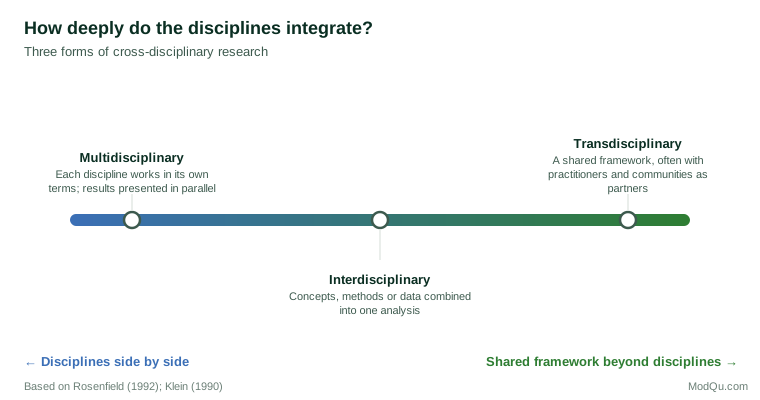
In multidisciplinary research, specialists from different disciplines work on a shared problem, but each works within their own discipline's concepts and methods. The results are often presented side by side, as separate chapters on economic, social and environmental aspects of a problem.
In interdisciplinary research, the disciplines interact more closely. Researchers combine concepts, methods or data from different fields to produce an integrated analysis that none could achieve alone. Klein (1990) traced the history of interdisciplinary research and described it as a process of integration, in which the boundaries between fields are crossed rather than simply placed next to each other.
In transdisciplinary research, collaborators develop a shared conceptual framework that goes beyond any single discipline, and often include non-academic partners, such as practitioners, policy-makers or communities, as full participants. The aim is to address real-world problems in ways that are both scientifically sound and practically useful.
The deeper the integration, the greater the potential for novel insights, and the greater the effort required. Uzzi et al. (2013) found that the papers most likely to have high impact combined conventional knowledge with unusual combinations of ideas from different areas, and that teams were more likely than individuals to produce such combinations.
What makes research teams effective
The National Research Council (2015) conducted a major review of the evidence on team science and concluded that research on teams in other settings, such as business, the military and healthcare, offers a strong foundation for improving research teams. Hall et al. (2018) reviewed empirical studies of scientific collaboration and identified several factors associated with effectiveness, while noting that the evidence base is still developing.
Team composition
Effective teams need the right mix of expertise, but diversity of expertise also creates challenges. Fiore (2008) argued that interdisciplinary collaboration should be understood as a form of teamwork, subject to the same processes of coordination and communication studied in other teams, and complicated by differences in vocabulary, methods and standards of evidence. Lungeanu et al. (2014) studied the assembly of interdisciplinary teams and found that prior collaboration among members and the presence of members who bridged disciplines were associated with better outcomes.
Shared understanding
Team members must develop a shared understanding of the problem, the goals and each other's contributions. In interdisciplinary teams, this often requires learning enough of each other's language to communicate. Salas et al. (2005) identified shared mental models, a common understanding of the task and of the team, as one of the coordinating mechanisms that underlie effective teamwork, along with mutual trust and closed-loop communication.
Psychological safety
Edmondson (1999) found that teams in which members felt safe to raise concerns, admit mistakes and ask questions engaged in more learning behaviour and performed better. In research teams, where junior members may hesitate to challenge senior colleagues and members from one discipline may hesitate to question another's methods, psychological safety is especially important.
Leadership
Hackman (2002) argued that team effectiveness depends less on the actions of leaders in the moment than on conditions they establish: a real team with stable membership, a compelling direction, an enabling structure, a supportive context and expert coaching. In research collaborations, leadership often involves integrating contributions across disciplines, managing conflicts over priorities and credit, and maintaining momentum over long periods. Bennett and Gadlin (2012), drawing on experience at the United States National Institutes of Health, emphasised the value of explicit agreements at the start of a collaboration about roles, authorship, data sharing and how disagreements will be resolved.
Collective intelligence
Woolley et al. (2010) found evidence that groups have a measurable collective intelligence that predicts their performance across a range of tasks. It was only moderately related to the intelligence of individual members, and more strongly related to the members' average social sensitivity, the equality of conversational turn-taking and, in their samples, the proportion of women in the group. The finding suggests that how a team works together matters as much as who is in it.
How research teams develop
Teams change over the life of a project. Tuckman (1965) reviewed studies of small groups and proposed that they typically pass through stages of forming, when members orient themselves and depend on the leader; storming, when conflict emerges over goals, roles and methods; norming, when the group develops shared expectations and cohesion; and performing, when energy is directed at the task. The model is a simplification, and later work has shown that many teams do not follow the stages in order, but it captures a pattern familiar in research collaborations.
Interdisciplinary teams often experience a prolonged storming phase, because disagreements are not only about tasks and roles but about what counts as a good question, a valid method or a convincing result. An economist and an anthropologist studying the same community may disagree about whether a sample of twenty households can say anything useful. These disagreements are not a sign of failure. Handled well, they are where integration happens, as each discipline is forced to make its assumptions explicit and the team arrives at an approach that draws on both. Handled badly, they lead to withdrawal into parallel work. Hall et al. (2018) note that the early phases of a collaboration, when goals and processes are being negotiated, deserve more attention and support than they usually receive.
Membership also changes. Students graduate, staff move on and new partners join. Each change disrupts shared understanding, so long-running teams need ways to bring new members up to speed, such as written project histories, glossaries and documented decisions.
Obstacles
Collaborative research faces recurring difficulties.
Coordination costs. Cummings and Kiesler (2005) studied projects funded by a United States National Science Foundation programme designed to encourage collaboration. Projects involving more universities were less likely to achieve their goals, largely because of the difficulty of coordinating work across institutions. Projects that invested in coordination mechanisms, such as regular meetings, shared workspaces and staff exchanges, did better.
Distance. Olson and Olson (2000) argued that, despite communication technology, geographic distance continues to matter for collaboration. Teams that cannot meet face to face struggle to build trust and shared understanding, and work that requires close coordination is particularly difficult across distance. They identified factors that make distance collaboration more feasible, including common ground, loosely coupled work, readiness to collaborate and readiness to use technology.
Disciplinary differences. Disciplines differ in vocabulary, methods, standards of evidence, publication norms and timelines. A term that is precise in one field may be vague or mean something different in another. Researchers trained to value different kinds of evidence may disagree about what counts as a finding.
Incentives and credit. Academic careers are built on individual recognition, through authorship, citations and grants. Collaborative work can make it hard to identify each person's contribution. Allen et al. (2014) proposed a standard taxonomy of contributor roles, now known as CRediT, so that published papers can specify who did what. McNutt et al. (2018) recommended that journals require authors to describe their contributions, to make responsibility as well as credit transparent.
Funding. Interdisciplinary proposals may fall between the remits of funding panels. Bromham et al. (2016) analysed proposals to the Australian Research Council and found that the more interdisciplinary a proposal was, the lower its chance of being funded.
Evaluating collaborative research
Judging whether a collaboration has succeeded is harder than it looks. Conventional measures, such as publications and citations, capture some outputs but miss others, such as the training of researchers who can work across disciplines, new methods and data resources shared with others, and changes in practice or policy. Stokols et al. (2008) argued that evaluation of team science should consider outcomes at several levels: the individuals involved, the team as a unit, the institutions that host it and the wider field or society. The National Research Council (2015) report similarly emphasises that teams are embedded in organisations and funding systems that shape what they can achieve.
Evaluation should also look at process as well as outcome. A team that produced its planned outputs but whose members never integrated their work, or that left junior members without credit, has succeeded in a narrow sense only. Regular, structured reflection on how the team is working, ideally with input from all members, gives early warning of problems that output measures reveal only after the project ends.
Shared data and infrastructure
Large collaborations depend on shared resources: common data standards, shared storage, agreed analysis tools and clear rules about who may use what. Collins et al. (2003) identified the decision to release genome sequence data rapidly and openly, under principles agreed at the start, as one of the main reasons the Human Genome Project succeeded and why its data were so widely used. Smaller teams face the same issues on a smaller scale. When each partner stores data in its own format, defines variables in its own way and keeps its own version of the analysis, integration becomes slow and error-prone, and results can be difficult to reproduce.
Agreeing early on data formats, variable definitions, file naming, version control and access rights saves considerable effort later. So does appointing someone with responsibility for data management across the team, rather than leaving it to each partner. These arrangements also protect participants: when several organisations handle personal data, a single agreed approach to consent, security and retention reduces the risk of breaches and confusion.
Practical steps for organising team research
Evidence and experience suggest several practices for organising collaborative research.
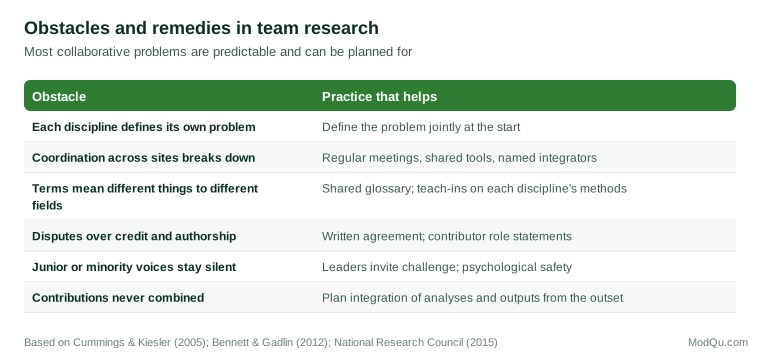
- Start with the problem. Agree on the problem to be solved and why it requires a team. Defining the problem jointly, rather than having each discipline define its own part, builds shared understanding from the outset.
- Make agreements explicit. Before work begins, agree in writing on goals, roles, decision-making, data ownership and sharing, authorship and how disagreements will be handled (Bennett & Gadlin, 2012).
- Invest in shared language. Create a glossary of key terms, hold sessions in which members explain their disciplines' methods and assumptions, and encourage questions across boundaries.
- Build coordination mechanisms. Schedule regular meetings, use shared documents and project management tools, and designate people responsible for integration. Cummings and Kiesler (2005) found that such mechanisms made a measurable difference to project outcomes.
- Create psychological safety. Leaders should invite challenge, acknowledge their own uncertainties and treat errors as learning opportunities (Edmondson, 1999).
- Plan integration, not just division of labour. Identify early how the contributions of different disciplines will be brought together in the analysis and outputs, rather than leaving integration to the end.
- Recognise contributions. Use contributor role statements and agree authorship criteria in advance (Allen et al., 2014).
- Review and adapt. Hold periodic reviews of how the collaboration is working, not only of research progress, and adjust roles and processes as needed.
Team research in commercial settings
Commercial research is increasingly a team activity. A study of customer behaviour may combine survey researchers, data scientists, behavioural economists, designers and people from marketing, operations and finance. The same principles apply. Teams work best when they share a clear definition of the business problem, agree on roles and decision rights, develop a common language across functions, and plan from the start how quantitative findings, qualitative insights and operational knowledge will be combined into recommendations. Without integration, a project risks producing parallel reports from each specialist, each accurate in itself, that together fail to answer the question.
Consider a retailer investigating why online orders are being returned at a rising rate (illustrative). A data scientist can identify which products, customers and delivery routes have the highest return rates. A survey researcher can measure customers' stated reasons. A user researcher can observe how customers choose sizes on the website. Logistics staff know which warehouses have had packing problems. Each source alone gives a partial and possibly misleading picture: the data may show that returns are concentrated in clothing, the survey that customers cite poor fit, and the observation that the size guide is hard to find on mobile phones. Brought together in joint analysis sessions, these strands point to a specific, testable fix. The integration step, in which the team compares and reconciles its findings, is where most of the value lies, and it needs to be scheduled and led rather than left to chance.
Conclusion
Research is increasingly a collective enterprise. Teams produce a growing share of knowledge and much of the most influential work, and complex problems often require collaboration across disciplines, institutions and sectors. But collaboration has costs: coordination is difficult, disciplines speak different languages, and incentives often reward individual rather than collective achievement. The science of team science offers practical guidance: start with a shared problem, make agreements explicit, build shared understanding and psychological safety, invest in coordination and integration, and recognise contributions fairly. Teams that do these things are better placed to produce knowledge that no individual could produce alone.
References
Allen, L., Scott, J., Brand, A., Hlava, M., & Altman, M. (2014). Publishing: Credit where credit is due. Nature, 508(7496), 312–313. https://doi.org/10.1038/508312a
Bennett, L. M., & Gadlin, H. (2012). Collaboration and team science: From theory to practice. Journal of Investigative Medicine, 60(5), 768–775. https://doi.org/10.2310/JIM.0b013e318250871d
Bromham, L., Dinnage, R., & Hua, X. (2016). Interdisciplinary research has consistently lower funding success. Nature, 534(7609), 684–687. https://doi.org/10.1038/nature18315
Collins, F. S., Morgan, M., & Patrinos, A. (2003). The Human Genome Project: Lessons from large-scale biology. Science, 300(5617), 286–290. https://doi.org/10.1126/science.1084564
Cummings, J. N., & Kiesler, S. (2005). Collaborative research across disciplinary and organizational boundaries. Social Studies of Science, 35(5), 703–722. https://doi.org/10.1177/0306312705055535
Edmondson, A. (1999). Psychological safety and learning behavior in work teams. Administrative Science Quarterly, 44(2), 350–383. https://doi.org/10.2307/2666999
Fiore, S. M. (2008). Interdisciplinarity as teamwork: How the science of teams can inform team science. Small Group Research, 39(3), 251–277. https://doi.org/10.1177/1046496408317797
Hackman, J. R. (2002). Leading teams: Setting the stage for great performances. Harvard Business School Press.
Hall, K. L., Vogel, A. L., Huang, G. C., Serrano, K. J., Rice, E. L., Tsakraklides, S. P., & Fiore, S. M. (2018). The science of team science: A review of the empirical evidence and research gaps on collaboration in science. American Psychologist, 73(4), 532–548. https://doi.org/10.1037/amp0000319
Jones, B. F., Wuchty, S., & Uzzi, B. (2008). Multi-university research teams: Shifting impact, geography, and stratification in science. Science, 322(5905), 1259–1262. https://doi.org/10.1126/science.1158357
Klein, J. T. (1990). Interdisciplinarity: History, theory, and practice. Wayne State University Press.
Larivière, V., Gingras, Y., Sugimoto, C. R., & Tsou, A. (2015). Team size matters: Collaboration and scientific impact since 1900. Journal of the Association for Information Science and Technology, 66(7), 1323–1332. https://doi.org/10.1002/asi.23266
Lungeanu, A., Huang, Y., & Contractor, N. S. (2014). Understanding the assembly of interdisciplinary teams and its impact on performance. Journal of Informetrics, 8(1), 59–70. https://doi.org/10.1016/j.joi.2013.10.006
McNutt, M. K., Bradford, M., Drazen, J. M., Hanson, B., Howard, B., Jamieson, K. H., Kiermer, V., Marcus, E., Pope, B. K., Schekman, R., Swaminathan, S., Stang, P. J., & Verma, I. M. (2018). Transparency in authors' contributions and responsibilities to promote integrity in scientific publication. Proceedings of the National Academy of Sciences, 115(11), 2557–2560. https://doi.org/10.1073/pnas.1715374115
National Research Council. (2015). Enhancing the effectiveness of team science. The National Academies Press. https://doi.org/10.17226/19007
Olson, G. M., & Olson, J. S. (2000). Distance matters. Human–Computer Interaction, 15(2–3), 139–178. https://doi.org/10.1207/S15327051HCI1523_4
Rosenfield, P. L. (1992). The potential of transdisciplinary research for sustaining and extending linkages between the health and social sciences. Social Science & Medicine, 35(11), 1343–1357. https://doi.org/10.1016/0277-9536(92)90038-R
Salas, E., Sims, D. E., & Burke, C. S. (2005). Is there a "big five" in teamwork? Small Group Research, 36(5), 555–599. https://doi.org/10.1177/1046496405277134
Stokols, D., Hall, K. L., Taylor, B. K., & Moser, R. P. (2008). The science of team science: Overview of the field and introduction to the supplement. American Journal of Preventive Medicine, 35(2, Suppl.), S77–S89. https://doi.org/10.1016/j.amepre.2008.05.002
Tuckman, B. W. (1965). Developmental sequence in small groups. Psychological Bulletin, 63(6), 384–399. https://doi.org/10.1037/h0022100
Uzzi, B., Mukherjee, S., Stringer, M., & Jones, B. (2013). Atypical combinations and scientific impact. Science, 342(6157), 468–472. https://doi.org/10.1126/science.1240474
Woolley, A. W., Chabris, C. F., Pentland, A., Hashmi, N., & Malone, T. W. (2010). Evidence for a collective intelligence factor in the performance of human groups. Science, 330(6004), 686–688. https://doi.org/10.1126/science.1193147
Wu, L., Wang, D., & Evans, J. A. (2019). Large teams develop and small teams disrupt science and technology. Nature, 566(7744), 378–382. https://doi.org/10.1038/s41586-019-0941-9
Wuchty, S., Jones, B. F., & Uzzi, B. (2007). The increasing dominance of teams in production of knowledge. Science, 316(5827), 1036–1039. https://doi.org/10.1126/science.1136099