
Research · Communicating research
Structuring a Scholarly Article: IMRaD and Its Alternatives
What the IMRaD structure is, how it became the standard for research articles, what each section is for, and the alternative structures used for qualitative studies, reviews and other kinds of scholarship.
Most empirical articles in the sciences and social sciences follow the same pattern: Introduction, Methods, Results and Discussion, usually shortened to IMRaD. The structure is so familiar that it can seem like the only way to write a paper. It is in fact a convention with a history, a purpose and a number of well-established alternatives. Knowing why it works helps writers use it well and recognise when another structure would serve readers better.
How IMRaD became the standard
Sollaci and Pereira (2004) examined 1,297 original articles published between 1935 and 1985 in four leading medical journals: the British Medical Journal, JAMA, The Lancet and the New England Journal of Medicine. IMRaD began to appear in the 1940s, passed 80% of articles in the 1970s, and by the 1980s was the only pattern used for original papers in these journals. Gastel and Day (2022) attribute its spread to the growth of research publishing: as the number of papers increased, editors and readers needed a predictable structure that made papers quicker to review and to read.
What each section is for
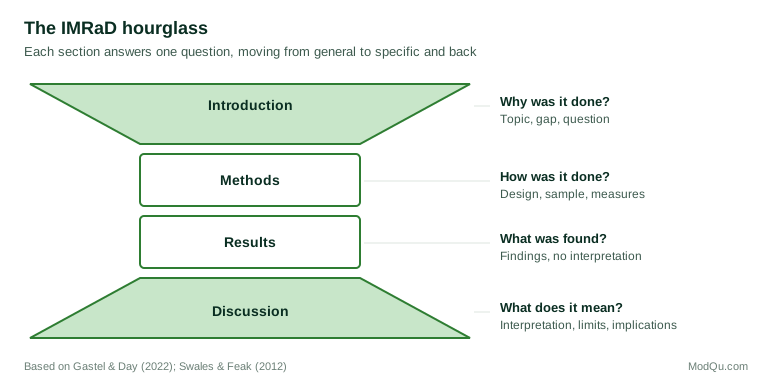
Each section answers a different question for the reader (Gastel & Day, 2022):
- Introduction: Why was the study done? It moves from the broad topic to the specific gap in knowledge and ends with the research question or hypothesis.
- Methods: How was it done? It gives enough detail for a competent reader to judge the study and, in principle, to repeat it.
- Results: What was found? It reports the findings in a logical order, without interpretation.
- Discussion: What does it mean? It interprets the results, relates them to earlier work, states limitations and moves back out to the wider implications.
The shape is often drawn as an hourglass: broad at the start of the introduction, narrow through the methods and results, and broad again at the end of the discussion.
Swales (1990) analysed how introductions do their work and described a common pattern he called "Create a Research Space". Writers first establish that the topic matters, then identify a gap or problem in previous research, and then show how the present study fills it. Swales and Feak (2012) give practical guidance on applying the same moves in student and professional writing.
Reporting guidelines build on IMRaD
In many fields, IMRaD is now supported by reporting guidelines that list what each section should contain for a given study design. CONSORT covers randomised trials (Schulz et al., 2010), STROBE covers observational studies (von Elm et al., 2007), and PRISMA covers systematic reviews (Page et al., 2021). In psychology and related fields, the Publication Manual includes Journal Article Reporting Standards for quantitative, qualitative and mixed methods research (American Psychological Association, 2020). These guidelines do not replace IMRaD; they make it more complete.
Variations and alternatives
IMRaD fits studies that test a question with data collected for that purpose. Other kinds of research often need a different structure.
Variations within empirical work. Lin and Evans (2012) examined empirical research articles across many disciplines and found considerable variation from the textbook pattern, including articles with a separate conclusion section and articles that combined results and discussion. A combined "Results and Discussion" section is common when each finding needs interpretation before the next can be understood. Some journals place methods at the end of the article, after the discussion, to bring the findings forward.
Qualitative research. Qualitative articles often keep the broad IMRaD outline but present findings as themes, each illustrated with quotations and interpreted as it is presented. Reporting guidelines such as COREQ (Tong et al., 2007) and SRQR (O'Brien et al., 2014) ask authors to describe the researchers' position, the sampling approach and how the analysis was done, which often requires a fuller methods section than in quantitative work.
Reviews. Systematic reviews follow IMRaD closely, with the search and selection process in the methods. Narrative and theoretical reviews are usually organised by topic or argument rather than by IMRaD sections.
Humanities and theoretical articles. Articles in history, philosophy, law and much of theory are usually structured as an argument: a thesis, a sequence of supporting sections and a conclusion. Headings follow the argument rather than a fixed template.
Short formats. Letters, brief reports and research notes often compress IMRaD into a few paragraphs, sometimes without headings, while keeping the same order of ideas.
Choosing a structure
The first guide is the target journal's instructions for authors, which often specify the structure. Beyond that, the useful question is what the reader needs to know, and in what order, to understand and judge the work. IMRaD answers that question well for most empirical studies because it separates what was done from what was found and from what the authors think it means. When a different structure serves the reader better, the same principle applies: make clear what the question was, how it was answered, what was found and how far the conclusions reach.
References
American Psychological Association. (2020). Publication manual of the American Psychological Association (7th ed.). American Psychological Association.
Gastel, B., & Day, R. A. (2022). How to write and publish a scientific paper (9th ed.). Greenwood.
Lin, L., & Evans, S. (2012). Structural patterns in empirical research articles: A cross-disciplinary study. English for Specific Purposes, 31(3), 150–160.
O'Brien, B. C., Harris, I. B., Beckman, T. J., Reed, D. A., & Cook, D. A. (2014). Standards for reporting qualitative research: A synthesis of recommendations. Academic Medicine, 89(9), 1245–1251. https://doi.org/10.1097/ACM.0000000000000388
Page, M. J., McKenzie, J. E., Bossuyt, P. M., Boutron, I., Hoffmann, T. C., Mulrow, C. D., Shamseer, L., Tetzlaff, J. M., Akl, E. A., Brennan, S. E., Chou, R., Glanville, J., Grimshaw, J. M., Hróbjartsson, A., Lalu, M. M., Li, T., Loder, E. W., Mayo-Wilson, E., McDonald, S., … Moher, D. (2021). The PRISMA 2020 statement: An updated guideline for reporting systematic reviews. BMJ, 372, Article n71. https://doi.org/10.1136/bmj.n71
Schulz, K. F., Altman, D. G., & Moher, D. (2010). CONSORT 2010 statement: Updated guidelines for reporting parallel group randomised trials. BMJ, 340, Article c332. https://doi.org/10.1136/bmj.c332
Sollaci, L. B., & Pereira, M. G. (2004). The introduction, methods, results, and discussion (IMRAD) structure: A fifty-year survey. Journal of the Medical Library Association, 92(3), 364–367.
Swales, J. M. (1990). Genre analysis: English in academic and research settings. Cambridge University Press.
Swales, J. M., & Feak, C. B. (2012). Academic writing for graduate students: Essential tasks and skills (3rd ed.). University of Michigan Press.
Tong, A., Sainsbury, P., & Craig, J. (2007). Consolidated criteria for reporting qualitative research (COREQ): A 32-item checklist for interviews and focus groups. International Journal for Quality in Health Care, 19(6), 349–357. https://doi.org/10.1093/intqhc/mzm042
von Elm, E., Altman, D. G., Egger, M., Pocock, S. J., Gøtzsche, P. C., & Vandenbroucke, J. P. (2007). The Strengthening the Reporting of Observational Studies in Epidemiology (STROBE) statement: Guidelines for reporting observational studies. The Lancet, 370(9596), 1453–1457. https://doi.org/10.1016/S0140-6736(07)61602-X