
Research · Communicating research
Standards for Reporting Research to Enhance Knowledge Transparency
What research reporting guidelines are, why they were developed, the main standards such as CONSORT, PRISMA, STROBE and COREQ, what the evidence shows about their effect, and how the same principles apply to survey and commercial research.
A study can only be judged, used and built upon if readers know exactly what was done. That requires a report that describes who was studied, how they were selected, what was measured, how the data were analysed and what was found, including the results that did not support the researchers' expectations. When reports leave these details out, readers cannot tell whether the findings are trustworthy, other researchers cannot repeat the work, and practitioners cannot apply it. Reporting guidelines are structured checklists, developed by groups of researchers, statisticians and editors, that list the minimum information a report of a particular type of study should contain. This article explains why they were developed, describes the main guidelines, reviews the evidence on whether they work, and shows how the same principles apply outside academic publishing.
The problem of incomplete reporting
Poor reporting is a different problem from poor research. A well-conducted study can be reported so incompletely that readers cannot recognise its quality, and a weak study can be reported in a way that hides its weaknesses. Either way, readers lose the ability to judge the evidence.
The scale of the problem has been documented repeatedly in medicine, where it has been studied most. Glasziou et al. (2014) reviewed the evidence and concluded that a large share of research reports are incomplete or unusable: methods are described too briefly to be repeated, outcomes listed in the study plan are missing from the report, and many studies are never published at all. They argued that these failures waste much of the investment in research, because the results cannot be used even when the work itself was done well.
Some examples show how specific the gaps can be:
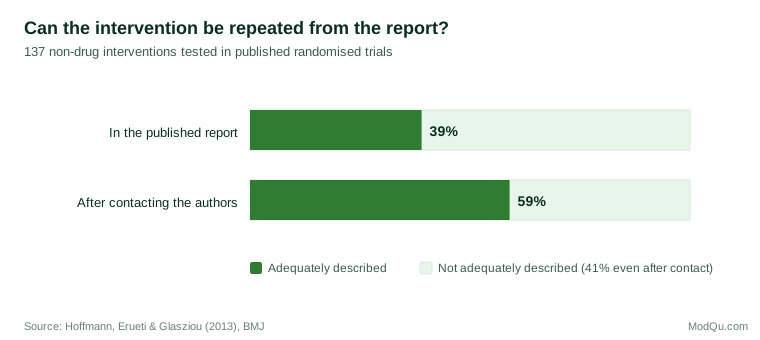
- Interventions that cannot be repeated. Hoffmann et al. (2013) examined 137 non-drug interventions, such as exercise programmes and educational sessions, tested in randomised trials published in leading general medical journals. Only 39% were described in enough detail to be replicated from the published report. After the researchers contacted the authors for more information, the figure rose to 59%. The rest remained unusable for anyone wishing to apply them.
- Outcomes that change. Chan et al. (2004) compared trial protocols with the published articles and found that many outcomes named in the protocols were reported incompletely or not at all, and that statistically significant outcomes were more likely to be fully reported than non-significant ones.
- Methods that matter but go unmentioned. Schulz et al. (1995) showed that trials which did not adequately conceal the allocation of participants to treatment groups, or did not report how they did so, produced larger estimates of treatment effects than trials with adequate concealment. Without a clear description of the method, readers cannot tell which kind of trial they are reading.
How reporting guidelines developed
The first widely adopted guideline was CONSORT (Consolidated Standards of Reporting Trials), published in 1996 by a group of trial methodologists and journal editors (Begg et al., 1996). It consisted of a checklist of items that every report of a randomised controlled trial should include, together with a flow diagram showing how many participants were assessed, randomised, treated, followed up and analysed. CONSORT was revised in 2001 and 2010 (Schulz et al., 2010), and a major update, CONSORT 2025, was published in 2025 (Hopewell et al., 2025).
CONSORT 2025 has 30 checklist items, up from 25 in the 2010 version. Its developers added items on data sharing, conflicts of interest, patient and public involvement, the assessment of harms, how missing data were handled and how the intervention was actually delivered, and grouped several items into a new section on open science (Hopewell et al., 2025). These changes reflect a wider shift: a report is now expected to show not only what was found but also where the protocol, analysis plan and data can be obtained.
CONSORT became the model for guidelines covering other study designs. Moher et al. (2010) set out a recommended process for developing them, including a review of the evidence on what tends to be poorly reported, a consensus exercise among experts, and an explanation document that gives the reasons for each item. Guidelines are collected by the EQUATOR Network (Enhancing the QUality and Transparency Of health Research), an international initiative that maintains a searchable library of reporting guidelines and promotes their use (Simera et al., 2010). The library now lists several hundred guidelines and extensions.
The main guidelines
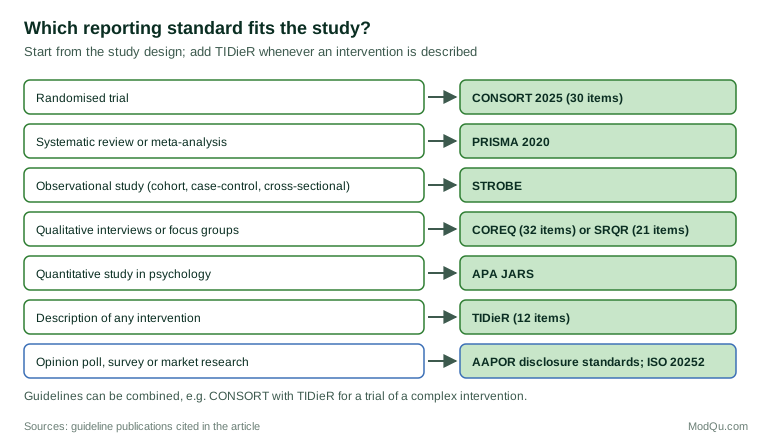
Each guideline is tailored to a type of study, because the information a reader needs differs between designs. The most widely used include:
- CONSORT for randomised trials, covering how participants were allocated, whether allocation was concealed, who was blinded, and how many participants were analysed in each group (Hopewell et al., 2025).
- TIDieR (Template for Intervention Description and Replication), a 12-item checklist for describing interventions: what was delivered, by whom, how, where, when, how much, and whether it was tailored or modified (Hoffmann et al., 2014). It was developed in response to the gaps that Hoffmann et al. (2013) documented.
- PRISMA (Preferred Reporting Items for Systematic reviews and Meta-Analyses), updated in 2020, for systematic reviews. It requires reviewers to report their search strategy, how studies were selected, how bias was assessed, and how many records were identified, screened and included (Page et al., 2021).
- STROBE (Strengthening the Reporting of Observational Studies in Epidemiology) for cohort, case-control and cross-sectional studies, which are common in public health and social research (von Elm et al., 2007).
- COREQ (Consolidated criteria for Reporting Qualitative research), a 32-item checklist for interviews and focus groups, covering the research team, the study design, and how the data were analysed and reported (Tong et al., 2007). The SRQR (Standards for Reporting Qualitative Research) offer a broader set of 21 items for qualitative studies of any kind (O'Brien et al., 2014).
- JARS (Journal Article Reporting Standards) of the American Psychological Association, which cover quantitative research across psychology and related fields, with modules for different designs (Appelbaum et al., 2018).
What the evidence shows
The most direct evidence comes from CONSORT. Turner et al. (2012) carried out a Cochrane systematic review of 50 evaluations covering 16,604 randomised trials. They compared the completeness of reporting in journals that endorsed CONSORT with journals that did not. Of 27 checklist items examined, 25 were better reported in the endorsing journals, although only five of the differences were statistically significant at the strict threshold the reviewers used. The authors concluded that endorsement was associated with more complete reporting, but that reporting remained far from adequate even in endorsing journals.
Two lessons follow. First, guidelines help: completeness improves where they are adopted. Second, endorsement is not the same as enforcement. A journal that lists CONSORT in its instructions to authors, but does not check submitted manuscripts against the checklist, gains less than one that requires a completed checklist and asks reviewers to use it. Glasziou et al. (2014) recommended that journals, funders and institutions take active steps, such as requiring checklists at submission and training reviewers and editors to use them.
What a transparent report contains
Although each guideline is specific to a design, they share a common core. A transparent report allows a reader to answer the following questions without contacting the authors:
- Who was studied and how were they found? Eligibility criteria, recruitment methods, setting and dates, and the number of people approached, eligible, included and retained.
- What was done to them, or measured about them? A description of any intervention detailed enough to repeat it, and exact definitions of every outcome and how it was measured.
- What was planned in advance? The registered protocol or analysis plan, where one exists, and any changes made after the study began, with reasons.
- How were the data analysed? The statistical methods, how missing data were handled, and which analyses were planned and which were exploratory.
- What was found? Results for every planned outcome, not only the favourable ones, with estimates of uncertainty such as confidence intervals.
- What are the limitations? Sources of bias and imprecision, and how far the results can be generalised.
- Who paid and who benefits? Funding sources and conflicts of interest.
- Where can the materials be found? Access to the data, code, questionnaires and protocols, or a statement of why they cannot be shared.
Survey and commercial research
The same principles apply to opinion polls, market research and organisational surveys, where readers are often clients, journalists or the public rather than other researchers. The American Association for Public Opinion Research (2021) sets out a Code of Professional Ethics and Practices that requires members to disclose, among other things, who sponsored and conducted a survey, the exact wording of the questions, the population studied, how the sample was drawn, the method and dates of data collection, the sample size, and how the results were weighted. Readers can then judge whether a published figure supports the claims made about it.
The international standard ISO 20252 (International Organization for Standardization, 2019) sets requirements for market, opinion and social research service providers, including documentation of the research design, fieldwork, data processing and reporting, so that a client can see how the results were produced.
In practice, a transparent survey or market research report should include a methods section that states:
- the target population and the sampling frame;
- how respondents were recruited, for example from a probability sample or an online panel;
- the fieldwork dates and mode of data collection;
- the number of completed responses and, where it can be calculated, the response rate;
- the full questionnaire or at least the exact wording of questions reported;
- how the data were weighted and cleaned, including any exclusions;
- the margin of error or other measure of uncertainty, and the limits of that measure for non-probability samples.
Reports that omit these details are common, and they leave readers unable to tell whether differences between groups or over time are real.
Limitations of reporting guidelines
Reporting guidelines describe what should be reported, not how the research should be done. A study can report every checklist item and still be poorly designed; a checklist will, however, make the weaknesses visible. Guidelines can also be applied mechanically, with authors ticking boxes and pointing to page numbers where the information is only partly given. Turner et al. (2012) found that many items remained poorly reported even in journals that endorsed CONSORT.
A second limitation is coverage. Most guidelines were developed in health research, and their uptake in business, education and other social science fields is uneven. Researchers in these fields can still use the closest relevant guideline, such as STROBE for an observational study or COREQ for an interview study, adapting items that do not apply.
A third is length. Complete reporting takes space, and journals and clients often want shorter reports. Online supplements, repositories and appendices allow the full detail to be made available without lengthening the main text.
Using guidelines in practice
Reporting guidelines are most useful when they are used from the start of a project rather than after the report is written. Practical steps include:
- Choose the guideline at the planning stage. The guideline shows what information will need to be recorded, such as the number of people approached and the reasons for exclusions, which is difficult to reconstruct later.
- Use the explanation documents. Most guidelines have an accompanying explanation and elaboration paper that gives the reasons for each item and examples of good reporting.
- Complete the checklist with the draft. Recording the page or section where each item is reported shows quickly which items are missing.
- Report deviations honestly. Where the study did not follow its plan, say what changed and why.
- Share the underlying materials. Protocols, questionnaires, code and, where possible, data allow readers to check and build on the work.
Summary
Reporting guidelines were developed because incomplete reports prevent readers from judging, repeating and using research. CONSORT, PRISMA, STROBE, COREQ, TIDieR and related standards set out the minimum information for each type of study, and evidence from CONSORT shows that their adoption is associated with more complete reporting, though gaps remain. The same principles apply to surveys and commercial research, where disclosure standards allow clients and the public to judge whether the findings support the claims made about them.
References
American Association for Public Opinion Research. (2021). AAPOR code of professional ethics and practices (Rev. ed.). AAPOR.
Appelbaum, M., Cooper, H., Kline, R. B., Mayo-Wilson, E., Nezu, A. M., & Rao, S. M. (2018). Journal article reporting standards for quantitative research in psychology: The APA Publications and Communications Board task force report. American Psychologist, 73(1), 3–25. https://doi.org/10.1037/amp0000191
Begg, C., Cho, M., Eastwood, S., Horton, R., Moher, D., Olkin, I., Pitkin, R., Rennie, D., Schulz, K. F., Simel, D., & Stroup, D. F. (1996). Improving the quality of reporting of randomized controlled trials: The CONSORT statement. JAMA, 276(8), 637–639. https://doi.org/10.1001/jama.1996.03540080059030
Chan, A.-W., Hróbjartsson, A., Haahr, M. T., Gøtzsche, P. C., & Altman, D. G. (2004). Empirical evidence for selective reporting of outcomes in randomized trials: Comparison of protocols to published articles. JAMA, 291(20), 2457–2465. https://doi.org/10.1001/jama.291.20.2457
Glasziou, P., Altman, D. G., Bossuyt, P., Boutron, I., Clarke, M., Julious, S., Michie, S., Moher, D., & Wager, E. (2014). Reducing waste from incomplete or unusable reports of biomedical research. The Lancet, 383(9913), 267–276. https://doi.org/10.1016/S0140-6736(13)62228-X
Hoffmann, T. C., Erueti, C., & Glasziou, P. P. (2013). Poor description of non-pharmacological interventions: Analysis of consecutive sample of randomised trials. BMJ, 347, Article f3755. https://doi.org/10.1136/bmj.f3755
Hoffmann, T. C., Glasziou, P. P., Boutron, I., Milne, R., Perera, R., Moher, D., Altman, D. G., Barbour, V., Macdonald, H., Johnston, M., Lamb, S. E., Dixon-Woods, M., McCulloch, P., Wyatt, J. C., Chan, A.-W., & Michie, S. (2014). Better reporting of interventions: Template for intervention description and replication (TIDieR) checklist and guide. BMJ, 348, Article g1687. https://doi.org/10.1136/bmj.g1687
Hopewell, S., Chan, A.-W., Collins, G. S., Hróbjartsson, A., Moher, D., Schulz, K. F., Tunn, R., Aggarwal, R., Berkwits, M., Berlin, J. A., Bhandari, N., Butcher, N. J., Campbell, M. K., Chidebe, R. C. W., Elbourne, D., Farmer, A., Fergusson, D. A., Golub, R. M., Goodman, S. N., . . . Boutron, I. (2025). CONSORT 2025 statement: Updated guideline for reporting randomised trials. BMJ, 389, Article e081123. https://doi.org/10.1136/bmj-2024-081123
International Organization for Standardization. (2019). Market, opinion and social research, including insights and data analytics: Vocabulary and service requirements (ISO Standard No. 20252:2019).
Moher, D., Schulz, K. F., Simera, I., & Altman, D. G. (2010). Guidance for developers of health research reporting guidelines. PLoS Medicine, 7(2), Article e1000217. https://doi.org/10.1371/journal.pmed.1000217
O'Brien, B. C., Harris, I. B., Beckman, T. J., Reed, D. A., & Cook, D. A. (2014). Standards for reporting qualitative research: A synthesis of recommendations. Academic Medicine, 89(9), 1245–1251. https://doi.org/10.1097/ACM.0000000000000388
Page, M. J., McKenzie, J. E., Bossuyt, P. M., Boutron, I., Hoffmann, T. C., Mulrow, C. D., Shamseer, L., Tetzlaff, J. M., Akl, E. A., Brennan, S. E., Chou, R., Glanville, J., Grimshaw, J. M., Hróbjartsson, A., Lalu, M. M., Li, T., Loder, E. W., Mayo-Wilson, E., McDonald, S., . . . Moher, D. (2021). The PRISMA 2020 statement: An updated guideline for reporting systematic reviews. BMJ, 372, Article n71. https://doi.org/10.1136/bmj.n71
Schulz, K. F., Altman, D. G., & Moher, D. (2010). CONSORT 2010 statement: Updated guidelines for reporting parallel group randomised trials. BMJ, 340, Article c332. https://doi.org/10.1136/bmj.c332
Schulz, K. F., Chalmers, I., Hayes, R. J., & Altman, D. G. (1995). Empirical evidence of bias: Dimensions of methodological quality associated with estimates of treatment effects in controlled trials. JAMA, 273(5), 408–412. https://doi.org/10.1001/jama.1995.03520290060030
Simera, I., Moher, D., Hirst, A., Hoey, J., Schulz, K. F., & Altman, D. G. (2010). Transparent and accurate reporting increases reliability, utility, and impact of your research: Reporting guidelines and the EQUATOR Network. BMC Medicine, 8, Article 24. https://doi.org/10.1186/1741-7015-8-24
Tong, A., Sainsbury, P., & Craig, J. (2007). Consolidated criteria for reporting qualitative research (COREQ): A 32-item checklist for interviews and focus groups. International Journal for Quality in Health Care, 19(6), 349–357. https://doi.org/10.1093/intqhc/mzm042
Turner, L., Shamseer, L., Altman, D. G., Schulz, K. F., & Moher, D. (2012). Does use of the CONSORT Statement impact the completeness of reporting of randomised controlled trials published in medical journals? A Cochrane review. Systematic Reviews, 1, Article 60. https://doi.org/10.1186/2046-4053-1-60
von Elm, E., Altman, D. G., Egger, M., Pocock, S. J., Gøtzsche, P. C., & Vandenbroucke, J. P. (2007). The Strengthening the Reporting of Observational Studies in Epidemiology (STROBE) statement: Guidelines for reporting observational studies. The Lancet, 370(9596), 1453–1457. https://doi.org/10.1016/S0140-6736(07)61602-X