
Research · Research integrity
Research Ethics in the Context of Dual-Use and Sensitive Knowledge
What dual-use research is, the ethical dilemma it creates, how the debate has developed since the 1970s, and the governance frameworks and review processes used to manage research whose results could be misused.
Most research is published on the assumption that knowledge is a public good: the more widely it is shared, the more it can be checked, built upon and used. A small share of research challenges that assumption. Dual-use research is legitimate research, done for beneficial purposes, whose methods, materials or results could also be misused to cause serious harm. This article explains the ethical issues it raises, how the debate has developed and how research systems now govern it.
The dual-use dilemma
Miller and Selgelid (2007) describe the dual-use dilemma as a conflict between two sets of obligations. Researchers have a duty to pursue and share knowledge that may prevent disease, improve safety or advance understanding. They and their institutions also have a duty not to provide others with the means to cause harm. The same study can serve both ends, and the researcher usually cannot control who reads the results.
The dilemma is sharpest in the life sciences, but it is not confined to them. Similar concerns have arisen in nuclear physics, chemistry, cryptography and, more recently, artificial intelligence. Tucker (2012) examines how such risks can be managed for emerging biological and chemical technologies. The ethical questions are similar in each case: how likely and how serious the potential misuse is, how much benefit the work offers, whether the benefit could be achieved in a safer way, and who should decide.
A short history of the debate
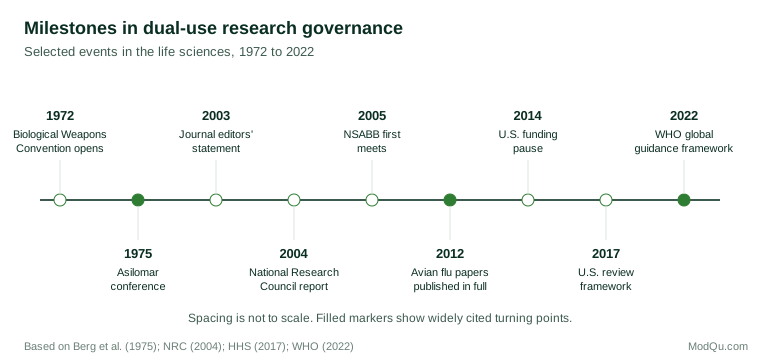
An early landmark was the 1975 Asilomar conference on recombinant DNA, at which scientists agreed to restrict certain experiments until the risks were better understood, and proposed a system of containment matched to the level of risk (Berg et al., 1975). Asilomar is often cited as an example of scientific self-regulation, though its concern was laboratory safety rather than deliberate misuse.
Concern about deliberate misuse grew after the anthrax letters sent in the United States in 2001. In 2003 a group of journal editors and authors issued a statement recognising that, on rare occasions, the potential harm of publishing some information could outweigh its benefit, and that editors might then need to modify or decline a paper (Journal Editors and Authors Group, 2003). In 2004 a U.S. National Research Council committee recommended that certain categories of experiment be reviewed before they were carried out and published, and proposed a national advisory board (National Research Council, 2004). The National Science Advisory Board for Biosecurity (NSABB) was set up soon afterwards and proposed a framework for overseeing such research (NSABB, 2007).
The most prominent controversy came in 2011–2012, when two research groups submitted papers on how avian influenza viruses might become transmissible between mammals. The NSABB first recommended withholding key details, then revised its view, and both papers were published in full in 2012. Researchers in the field also observed a voluntary pause on such work while the debate continued. Lipsitch and Galvani (2014) argued that the risks of some such experiments were not justified when safer methods could answer many of the same questions. In 2014 the U.S. government paused new funding for certain experiments of this kind, and in 2017 replaced the pause with a review framework for research involving enhanced pathogens with pandemic potential (U.S. Department of Health and Human Services, 2017).
How dual-use research is governed
Governance now works at several levels, which complement each other.
International law. The Biological Weapons Convention, opened for signature in 1972, and the Chemical Weapons Convention, opened in 1993, prohibit the development and use of these weapons. They set the outer boundary but do not say how ordinary research should be reviewed.
National policy. Some countries have specific oversight policies. In the United States, federal policies from 2012 and 2014 required funding agencies and research institutions to identify and review defined categories of dual-use research of concern, and these policies have since been revised. Other countries rely more on export controls, biosafety law and funder conditions.
Institutional review. Universities and research organisations may require projects that fall within defined categories to be reviewed by an institutional committee before work begins. Review typically asks whether the work fits a category of concern, what the risks and benefits are, and whether a risk mitigation plan is needed.
Funders and journals. Funders can review proposals for dual-use concerns, and journals have committed to developing processes to review submitted papers that raise such concerns (Journal Editors and Authors Group, 2003).
Researchers. Most guidance gives a central role to researchers' own awareness. The World Health Organization's global guidance framework (World Health Organization, 2022) emphasises education, a culture of responsibility and shared values alongside formal regulation, and is designed to be adapted to countries with different resources and legal systems.
Ethical arguments and disagreements
Several points remain contested. Some argue for a precautionary approach, in which research with a serious potential for catastrophic misuse should face a higher burden of justification (Kuhlau et al., 2011). Others note that restrictions have costs too: they can slow work on vaccines and treatments and hinder the checking of results. Selgelid (2009) argues that governance must weigh the benefits of openness against the risks of misuse, and that both too little and too much restriction carry costs.
There is also disagreement over who should decide. Self-governance by scientists draws on expert knowledge but may underweight risks to people outside the research community. Government oversight brings public accountability but may lack technical judgement or stretch across borders unevenly.
Practical implications for researchers
For most researchers, the practical obligations are modest but important: be aware of whether one's work could fall within a category of concern, raise questions early with an institutional biosafety or research ethics office, consider during design whether a safer method could answer the same question, and follow institutional and funder requirements on review and communication. Dual-use concerns are best addressed during planning, before the work has been done and the results exist.
References
Berg, P., Baltimore, D., Brenner, S., Roblin, R. O., & Singer, M. F. (1975). Summary statement of the Asilomar conference on recombinant DNA molecules. Proceedings of the National Academy of Sciences, 72(6), 1981–1984. https://doi.org/10.1073/pnas.72.6.1981
Journal Editors and Authors Group. (2003). Statement on scientific publication and security. Science, 299(5610), 1149.
Kuhlau, F., Höglund, A. T., Evers, K., & Eriksson, S. (2011). A precautionary principle for dual use research in the life sciences. Bioethics, 25(1), 1–8.
Lipsitch, M., & Galvani, A. P. (2014). Ethical alternatives to experiments with novel potential pandemic pathogens. PLOS Medicine, 11(5), Article e1001646. https://doi.org/10.1371/journal.pmed.1001646
Miller, S., & Selgelid, M. J. (2007). Ethical and philosophical consideration of the dual-use dilemma in the biological sciences. Science and Engineering Ethics, 13(4), 523–580.
National Research Council. (2004). Biotechnology research in an age of terrorism. The National Academies Press.
National Science Advisory Board for Biosecurity. (2007). Proposed framework for the oversight of dual use life sciences research: Strategies for minimizing the potential misuse of research information. National Institutes of Health.
Selgelid, M. J. (2009). Governance of dual-use research: An ethical dilemma. Bulletin of the World Health Organization, 87(9), 720–723.
Tucker, J. B. (Ed.). (2012). Innovation, dual use, and security: Managing the risks of emerging biological and chemical technologies. MIT Press.
U.S. Department of Health and Human Services. (2017). Framework for guiding funding decisions about proposed research involving enhanced potential pandemic pathogens. U.S. Department of Health and Human Services.
World Health Organization. (2022). Global guidance framework for the responsible use of the life sciences: Mitigating biorisks and governing dual-use research. World Health Organization.