
Research · Communicating research
Research Dissemination and Knowledge Translation
How research findings reach the people who can use them: the difference between dissemination and knowledge translation, the main frameworks, and what the evidence shows about which strategies work.
Publishing a study does not mean its findings will be used. Most journal articles are read by other researchers, and many are read by very few people at all. The people who could act on the findings, such as managers, clinicians, policymakers and the public, rarely read academic journals. Getting research to these audiences, and helping them apply it, requires deliberate effort.
Two terms describe this effort. Dissemination is the planned communication of research findings to specific audiences. Knowledge translation (KT) is a broader process that includes dissemination but also covers the synthesis of evidence, the exchange of knowledge between researchers and users, and the application of findings in practice. This article explains both, describes the main frameworks used to plan them, and summarises what the evidence shows about which strategies are effective.
Definitions
The term knowledge translation is most widely used in Canada, where the Canadian Institutes of Health Research (CIHR) adopted it as part of its mandate. CIHR defines KT as a dynamic and iterative process that includes synthesis, dissemination, exchange and ethically sound application of knowledge to improve health, provide more effective services and products, and strengthen the health care system (Straus et al., 2009). Other countries and fields use related terms, including knowledge transfer, knowledge exchange, knowledge mobilisation, research utilisation and implementation. Graham et al. (2006) identified many such terms in use by research funders and noted that they often overlap or are used inconsistently.
The differences matter in practice. Dissemination can be one-way: a researcher sends findings to an audience. Knowledge exchange implies a two-way relationship in which users also shape the research. Implementation refers to the work of putting findings into routine use, which is usually the responsibility of the organisation adopting them rather than the researcher.
The knowledge-to-action framework
The most widely cited KT framework is the knowledge-to-action (KTA) framework developed by Graham et al. (2006). It has two parts.
The knowledge creation funnel describes how knowledge is refined. Primary studies are the first generation of knowledge. Systematic reviews and other syntheses combine them into a second generation that is more reliable than any single study. Tools and products such as guidelines, decision aids and plain-language summaries are a third generation, designed to be directly usable. At each stage, the knowledge becomes more distilled and more useful to decision makers.
The action cycle describes the steps needed to apply knowledge in a particular setting: identifying a problem and selecting the relevant knowledge; adapting it to the local context; assessing barriers to its use; selecting, tailoring and implementing interventions; monitoring its use; evaluating outcomes; and sustaining its use over time.
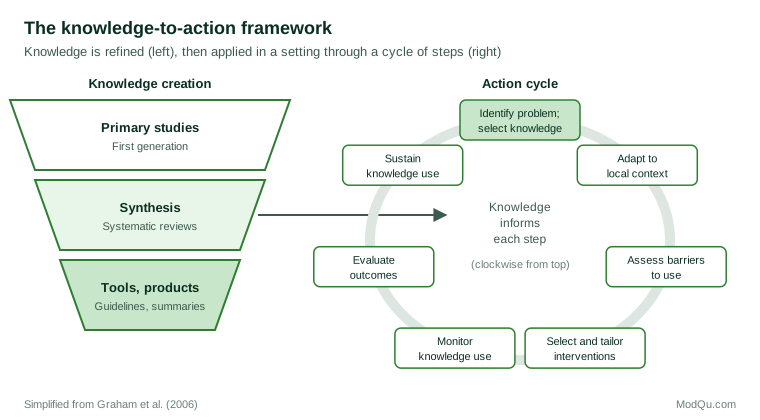
The framework makes two practical points. First, single studies are rarely the right unit for action; syntheses and tools built from a body of evidence are more reliable (Lavis et al., 2003). Second, the steps in the action cycle are mostly carried out by the people and organisations that use the knowledge, so researchers who want their work applied need to work with those users rather than simply sending them results.
Planning dissemination
Lavis et al. (2003) proposed an organising framework built on five questions that any research organisation should answer when planning knowledge transfer:
- What should be transferred? Usually the main messages from a body of research, not the details of a single study.
- To whom? Different audiences, such as the public, service providers, managers and policymakers, need different messages and formats.
- By whom? The messenger affects credibility. A trusted colleague, professional body or intermediary may be more persuasive than the research team.
- How? The channels and formats, from briefings and summaries to workshops and ongoing partnerships.
- With what effect? How success will be judged, for example by changes in awareness, attitudes, decisions or outcomes.
A dissemination plan answers these questions at the start of a project. In commercial research, the same logic applies: the plan identifies which teams will act on the findings, what each needs to know, who should present the results to them, in what form, and how the effect will be followed up.
Formats for different audiences
Busy decision makers need short, clear summaries. A common approach is the 1:3:25 format promoted by the Canadian Health Services Research Foundation: one page of main messages, a three-page executive summary, and a full report of about 25 pages. The main messages state what the findings mean for the reader, not only what was found.
Other formats include policy briefs, infographics, short videos, presentations, newsletters and professional conference talks. Brownson et al. (2018) reviewed approaches to disseminating public health research and emphasised that dissemination should be designed for the intended audience from the start, using formats and channels that the audience already uses, and drawing on methods from marketing and communication such as audience research and message testing.
Open access increases the number of people who can read a study. Piwowar et al. (2018) estimated that at least 28% of the scholarly literature was openly available, and that the share was higher for recently published articles. Davis (2011) conducted a randomised trial in which articles were made freely available or kept behind a subscription. Free access increased downloads but did not produce a detectable increase in citations within three years, suggesting that open access mainly widens readership beyond the researchers who already had access.
Social media can also widen reach. Eysenbach (2011) found that articles in one medical journal that were widely shared on Twitter in the days after publication were more likely to be highly cited later. The study was observational, so it shows an association rather than evidence that sharing causes citations.
What the evidence shows about effectiveness
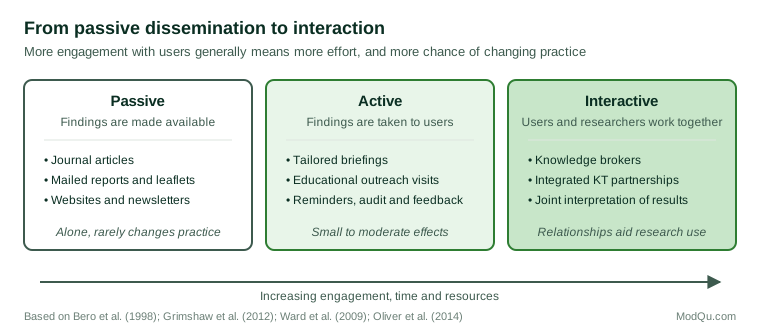
The most consistent finding in the KT literature is that passive dissemination on its own rarely changes practice. Bero et al. (1998) summarised systematic reviews of interventions to promote the use of research findings by health professionals. They found that passive approaches, such as mailing printed educational materials, generally had little or no effect. More active approaches, such as educational outreach visits, reminders, and interactive education, were more often effective, and combinations of interventions tended to work better than single interventions.
Later reviews have refined this picture. Grimshaw et al. (2012) concluded that most KT interventions produce small to moderate improvements, and that the choice of strategy should be based on an assessment of the specific barriers in a given setting. Audit and feedback, in which professionals receive summaries of their own performance compared with a standard, is one of the best-studied interventions. A Cochrane review of 140 trials found a median absolute improvement in compliance with desired practice of 4.3%, with wide variation between studies; feedback worked better when baseline performance was low, when it was given more than once, and when it included explicit targets and an action plan (Ivers et al., 2012).
Fit with the decision maker's needs is a recurring theme. Innvær et al. (2002) found that policymakers most often named personal contact, timeliness and relevance as the factors that helped them use research. Weiss (1979) observed that research is often used conceptually, gradually shaping how problems are understood, rather than applied directly to a single decision.
Context also affects whether knowledge is used. Greenhalgh et al. (2004) found that the spread of innovations in service organisations depends on the readiness of the adopting organisation as well as on the innovation itself. The Consolidated Framework for Implementation Research (Damschroder et al., 2009) groups the factors into five domains: the characteristics of the intervention, the outer setting (such as external policy and the needs of the people served), the inner setting (such as the culture and resources of the organisation), the characteristics of the individuals involved, and the process of implementation. Rogers (2003) showed that innovations spread faster when they have a clear relative advantage, are compatible with existing practice, are simple to understand, can be tried on a small scale and produce visible results. The same features help research findings to be adopted.
Interactive approaches: brokering and integrated KT
Because collaboration and good relationships between researchers and users are among the most frequently reported facilitators of research use (Oliver et al., 2014), many organisations now invest in interactive approaches.
Knowledge brokers are individuals or organisations that work between researchers and users. They find and interpret evidence, connect people, and help build the skills needed to use research. Ward et al. (2009) reviewed the literature on knowledge brokering and described three overlapping functions: knowledge management (finding and packaging information), linkage and exchange (bringing researchers and users together), and capacity building (developing users' ability to access and apply evidence).
Integrated knowledge translation involves users as partners throughout the research process, from defining the question to interpreting the findings. Users help ensure that the research is relevant and timely, and they are more likely to act on findings that they helped to produce. The approach contrasts with end-of-project KT, in which dissemination begins only after the research is complete.
Interactive approaches require time and resources from both sides, and they raise questions about independence. Researchers need to keep control of methods and reporting, even when users help shape the questions. A written agreement about roles, data access and publication rights helps prevent misunderstandings.
Writing for non-specialist readers
Summaries for users are a different kind of writing from journal articles. They lead with the main messages, use short sentences and everyday words, and explain technical terms or avoid them. They state results in absolute numbers where possible, say how certain the findings are, and explain what the reader might do differently. They also say what the research did not show, so that findings are not applied beyond the settings or groups that were studied. Testing a draft summary with a few members of the intended audience is a simple way to find passages that are unclear or easily misread.
Measuring dissemination and KT
Dissemination activity is easy to count: reports downloaded, briefings held, media mentions. These counts show reach, but they do not show use. Better measures follow the logic of the KTA framework and ask whether the target audience is aware of the findings, whether their understanding or decisions changed, and whether outcomes improved. Nutley et al. (2007) note that research use is often gradual and indirect, so evaluation should look for conceptual as well as direct use and should allow enough time for effects to appear.
A practical checklist
- Identify the users of the research and involve them early.
- Write a dissemination plan that answers what, to whom, by whom, how and with what effect.
- Base main messages on a body of evidence where possible, not on a single study.
- Produce summaries in formats suited to each audience, with clear statements of what the findings mean for them.
- Choose credible messengers and use channels the audience already uses.
- Combine passive dissemination with active or interactive strategies when the goal is a change in practice.
- Assess barriers in the setting where the findings will be applied, and tailor the strategy to them.
- Measure use and outcomes, not only reach.
Dissemination makes findings available. Knowledge translation makes them usable. Research that is planned with both in mind is much more likely to influence what people and organisations do.
References
Bero, L. A., Grilli, R., Grimshaw, J. M., Harvey, E., Oxman, A. D., & Thomson, M. A. (1998). Closing the gap between research and practice: An overview of systematic reviews of interventions to promote the implementation of research findings. BMJ, 317(7156), 465–468. https://doi.org/10.1136/bmj.317.7156.465
Brownson, R. C., Eyler, A. A., Harris, J. K., Moore, J. B., & Tabak, R. G. (2018). Getting the word out: New approaches for disseminating public health science. Journal of Public Health Management and Practice, 24(2), 102–111. https://doi.org/10.1097/PHH.0000000000000673
Damschroder, L. J., Aron, D. C., Keith, R. E., Kirsh, S. R., Alexander, J. A., & Lowery, J. C. (2009). Fostering implementation of health services research findings into practice: A consolidated framework for advancing implementation science. Implementation Science, 4, Article 50. https://doi.org/10.1186/1748-5908-4-50
Davis, P. M. (2011). Open access, readership, citations: A randomized controlled trial of scientific journal publishing. The FASEB Journal, 25(7), 2129–2134. https://doi.org/10.1096/fj.11-183988
Eysenbach, G. (2011). Can tweets predict citations? Metrics of social impact based on Twitter and correlation with traditional metrics of scientific impact. Journal of Medical Internet Research, 13(4), Article e123. https://doi.org/10.2196/jmir.2012
Graham, I. D., Logan, J., Harrison, M. B., Straus, S. E., Tetroe, J., Caswell, W., & Robinson, N. (2006). Lost in knowledge translation: Time for a map? Journal of Continuing Education in the Health Professions, 26(1), 13–24. https://doi.org/10.1002/chp.47
Greenhalgh, T., Robert, G., Macfarlane, F., Bate, P., & Kyriakidou, O. (2004). Diffusion of innovations in service organizations: Systematic review and recommendations. The Milbank Quarterly, 82(4), 581–629. https://doi.org/10.1111/j.0887-378X.2004.00325.x
Grimshaw, J. M., Eccles, M. P., Lavis, J. N., Hill, S. J., & Squires, J. E. (2012). Knowledge translation of research findings. Implementation Science, 7, Article 50. https://doi.org/10.1186/1748-5908-7-50
Innvær, S., Vist, G., Trommald, M., & Oxman, A. (2002). Health policy-makers' perceptions of their use of evidence: A systematic review. Journal of Health Services Research & Policy, 7(4), 239–244. https://doi.org/10.1258/135581902320432778
Ivers, N., Jamtvedt, G., Flottorp, S., Young, J. M., Odgaard-Jensen, J., French, S. D., O'Brien, M. A., Johansen, M., Grimshaw, J., & Oxman, A. D. (2012). Audit and feedback: Effects on professional practice and healthcare outcomes. Cochrane Database of Systematic Reviews, (6), Article CD000259. https://doi.org/10.1002/14651858.CD000259.pub3
Lavis, J. N., Robertson, D., Woodside, J. M., McLeod, C. B., & Abelson, J. (2003). How can research organizations more effectively transfer research knowledge to decision makers? The Milbank Quarterly, 81(2), 221–248. https://doi.org/10.1111/1468-0009.t01-1-00052
Nutley, S. M., Walter, I., & Davies, H. T. O. (2007). Using evidence: How research can inform public services. Policy Press.
Oliver, K., Innvar, S., Lorenc, T., Woodman, J., & Thomas, J. (2014). A systematic review of barriers to and facilitators of the use of evidence by policymakers. BMC Health Services Research, 14, Article 2. https://doi.org/10.1186/1472-6963-14-2
Piwowar, H., Priem, J., Larivière, V., Alperin, J. P., Matthias, L., Norlander, B., Farley, A., West, J., & Haustein, S. (2018). The state of OA: A large-scale analysis of the prevalence and impact of Open Access articles. PeerJ, 6, Article e4375. https://doi.org/10.7717/peerj.4375
Rogers, E. M. (2003). Diffusion of innovations (5th ed.). Free Press.
Straus, S. E., Tetroe, J., & Graham, I. (2009). Defining knowledge translation. CMAJ, 181(3–4), 165–168. https://doi.org/10.1503/cmaj.081229
Ward, V., House, A., & Hamer, S. (2009). Knowledge brokering: The missing link in the evidence to action chain? Evidence & Policy, 5(3), 267–279. https://doi.org/10.1332/174426409X463811
Weiss, C. H. (1979). The many meanings of research utilization. Public Administration Review, 39(5), 426–431. https://doi.org/10.2307/3109916