
Research · Communicating research
From Research Question to Knowledge Contribution: Articulating Originality and Significance
How researchers move from a research question to a clear claim of contribution, what originality and significance mean to examiners, reviewers and funders, and practical ways to state both in a thesis, paper or proposal.
Every piece of research is judged, sooner or later, on what it adds. A doctoral examiner asks whether the thesis makes a contribution to knowledge. A journal reviewer asks what is new. A funder asks why the work matters and to whom. These questions are about two qualities: originality, meaning what the work adds that was not known or available before, and significance, meaning why that addition matters. Researchers often do good work and then describe its contribution poorly, or claim more than the evidence supports. This article explains how the research question shapes the contribution, what assessors mean by originality and significance, and how to state both clearly.
What assessors look for
The requirement to contribute to knowledge is close to universal in doctoral assessment. Clarke and Lunt (2014) interviewed doctoral examiners and found that most, whatever their discipline, regarded originality or a contribution to knowledge as essential for a pass. The same examiners interpreted the criterion through the norms of their own field, and expected other qualities as well, such as competent use of methods and a coherent argument. Lovitts (2007), working with faculty across many disciplines in the United States, similarly found that the qualities of an excellent dissertation were understood in practice but rarely written down for students.
Research assessment systems state the criteria more formally. The United Kingdom's Research Excellence Framework assessed outputs in 2021 on three criteria: originality, understood as the extent to which an output makes an important and innovative contribution to understanding and knowledge; significance, understood as the extent to which the work has influenced, or has the capacity to influence, knowledge, scholarly thought, or policy and practice; and rigour, understood as intellectual coherence and integrity and the use of robust and appropriate concepts and methods (REF 2021, 2019). The three criteria are assessed together. Original work that lacks rigour is not credible, and rigorous work that adds nothing new is of limited value.
Originality takes many forms
Originality does not have to mean a new discovery. Guetzkow et al. (2004) interviewed members of multidisciplinary fellowship panels in the humanities and social sciences and found that panellists recognised several kinds of originality: an original approach, an original topic, work in an understudied area, original theory, original method, original data and original results. An original approach was the form mentioned most often, and original results were mentioned least. Humanists and historians tended to value originality of approach and of data, while social scientists more often mentioned originality of method.
This range is useful for researchers. A study can be original because it:
- applies an established method to a population, place or period that has not been studied;
- uses new or newly available data, such as an archive, an administrative dataset or a purpose-built survey;
- introduces or adapts a method that answers an old question more convincingly;
- combines ideas from two fields that have not been connected before;
- tests an accepted explanation and finds that it does not hold in some conditions;
- develops a concept or theory that explains findings that were previously treated separately.
Combining existing knowledge in new ways is a common source of important work. Uzzi et al. (2013) analysed about 17.9 million research papers and found that the papers most likely to be highly cited were mostly grounded in conventional combinations of prior work while also including an unusual combination. Novelty and familiarity worked together.
From question to contribution
The contribution of a study is set largely by its research question. A question that has already been answered convincingly cannot produce an original contribution however well the study is carried out. A question that cannot be answered with the available data and methods cannot produce a credible one. The work of articulating a contribution therefore begins before data collection, when the question is chosen and framed.
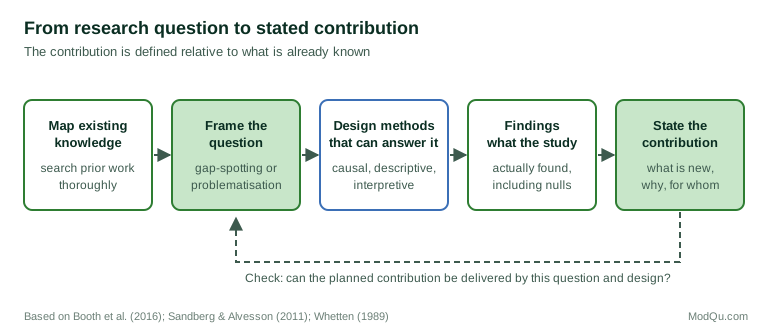
Map what is already known. A contribution is defined relative to existing knowledge, so a claim of originality depends on a thorough search of prior work. Weak searching is common. Robinson and Goodman (2011) examined reports of randomised trials included in 227 meta-analyses and found that the reports cited fewer than a quarter of the relevant earlier trials that had been available to them. A researcher who has not found the earlier studies cannot say accurately what a new study adds, and may repeat work that has already been done.
Frame the question. Sandberg and Alvesson (2011) studied how management researchers construct research questions. The most common approach was gap-spotting: identifying something that the literature has overlooked, left incomplete or not yet applied. Gap-spotting is useful, but it tends to produce incremental additions to existing lines of work. Alvesson and Sandberg (2011) proposed problematisation as an alternative: identifying and challenging the assumptions that underlie existing research, so that the study asks whether the established way of thinking about a topic is correct. Davis (1971) made a related observation about theories that readers find interesting: they typically deny an assumption that the audience held, rather than confirm it.
Design methods that can answer the question. The contribution can only be as strong as the evidence. A causal claim needs a design that supports causal inference; a claim about a population needs a sample that represents it. If the available methods cannot support the intended contribution, it is better to narrow the question than to overstate the result.
State the contribution after the findings. Findings do not always match the original expectation. The stated contribution should describe what the study actually found, including unexpected and null results, rather than the contribution that was planned.
Significance: why it matters and to whom
Significance is a separate question from originality. A finding can be new and of little consequence. Significance asks what difference the contribution makes, either to understanding or to practice.
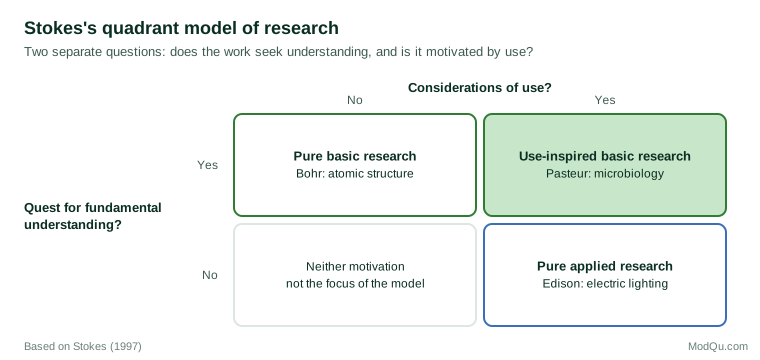
Stokes (1997) offered a widely used way of thinking about this. He argued that research can be classified by two separate questions: whether it seeks fundamental understanding, and whether it is motivated by considerations of use. Research driven only by understanding, such as Niels Bohr's work on atomic structure, sits in one quadrant. Research driven only by use, such as Thomas Edison's development of electric lighting, sits in another. Research that pursues both at once, such as Louis Pasteur's work on microbiology, sits in what Stokes called Pasteur's quadrant. The framework shows that significance can come from either source, and that the two are not opposites.
A clear statement of significance names the audience. A contribution may matter to researchers in a specific field because it resolves a disagreement, corrects an error or opens a new line of inquiry. It may matter to practitioners because it changes how a problem is diagnosed or treated. It may matter to policy makers because it shows whether a programme works. Chalmers et al. (2014) argue that research priorities should be set with the people who will use the results, because research that does not address their questions is a form of waste. Chalmers and Glasziou (2009) had earlier estimated that avoidable problems in how research is chosen, designed, published and reported together waste about 85% of investment in biomedical research.
Writing the contribution statement
Contribution statements usually appear in three places: the introduction, where the researcher explains what the study will add; the discussion, where the researcher shows what it did add; and the abstract, where both are condensed. Swales (1990) described a common structure for research introductions in three moves: establishing the territory, establishing a niche in it, and occupying that niche. The second move, showing that something is missing or wrong in current knowledge, is where originality is argued. The third, announcing what the present study does, is where the contribution is stated.
Booth et al. (2016) suggest a practical sequence for framing a project: name the topic, state the question, and then explain why answering it matters, in the form: I am studying a topic, because I want to find out a specific thing, in order to help my reader understand a larger issue. The final step states the significance.
A strong contribution statement is specific. Compare the following:
- Weak: "This study contributes to the literature on remote work."
- Stronger: "Earlier studies of remote work and productivity relied on self-reported measures from office-based firms. Using three years of task-level records from 40 call centres, this study shows that the productivity effect of remote work depends on the complexity of the task, which explains why earlier studies reached opposite conclusions."
The second version, an invented example for illustration, states what was known, what is new (the data and the finding), and why it matters (it resolves a disagreement in prior research). Whetten (1989) proposed that a theoretical contribution should address what factors are involved, how they are related, why the relationship holds, and under what conditions; the stronger statement does this in compressed form.
Corley and Gioia (2011) reviewed what management journals regard as a theoretical contribution and identified two dimensions: originality, ranging from incremental to revelatory insight, and utility, ranging from scientific usefulness to practical usefulness. A contribution statement should be honest about where on each dimension the work falls. Incremental contributions are valuable and form most of the knowledge in any field; presenting them as revolutionary damages credibility.
Common problems
Claiming to be the first. Statements such as "this is the first study to examine" are easily disproved by one earlier paper. Merton (1957) documented how often disputes over priority arise in science, including among researchers who had worked independently. A safer and more informative claim describes what the study adds relative to named earlier work.
Confusing a gap with a contribution. That something has not been studied is not, by itself, a reason to study it. The statement needs to explain why filling the gap would change understanding or practice.
Burying the contribution. Examiners and reviewers should not have to infer the contribution. It should be stated plainly near the start and again in the conclusions, in consistent terms.
Overstating significance. A study of one organisation does not establish a general law, and a correlation does not establish a cause. The claimed significance should match the strength and scope of the evidence.
A note on risk
Highly original work carries more risk of a slow or uncertain reception. Wang et al. (2017) measured novelty in scientific papers by whether they combined journals in their references in ways never seen before. Novel papers were less likely to be highly cited in the first few years, but more likely to become among the most highly cited papers in the long run, and they tended to be published in journals with lower impact factors than expected. Researchers making a highly original claim should therefore explain its basis especially carefully, showing how it connects to established knowledge as well as how it departs from it.
Summary
A knowledge contribution is built from the research question onward. Originality can lie in the topic, data, method, approach, theory or results, and assessors in different fields value these differently. Significance explains why the contribution matters and to whom. A good contribution statement names what was known, what the study adds and why that addition matters, in specific terms that the evidence can support.
References
Alvesson, M., & Sandberg, J. (2011). Generating research questions through problematization. Academy of Management Review, 36(2), 247–271. https://doi.org/10.5465/amr.2009.0188
Booth, W. C., Colomb, G. G., Williams, J. M., Bizup, J., & FitzGerald, W. T. (2016). The craft of research (4th ed.). University of Chicago Press.
Chalmers, I., Bracken, M. B., Djulbegovic, B., Garattini, S., Grant, J., Gülmezoglu, A. M., Howells, D. W., Ioannidis, J. P. A., & Oliver, S. (2014). How to increase value and reduce waste when research priorities are set. The Lancet, 383(9912), 156–165. https://doi.org/10.1016/S0140-6736(13)62229-1
Chalmers, I., & Glasziou, P. (2009). Avoidable waste in the production and reporting of research evidence. The Lancet, 374(9683), 86–89. https://doi.org/10.1016/S0140-6736(09)60329-9
Clarke, G., & Lunt, I. (2014). The concept of 'originality' in the Ph.D.: How is it interpreted by examiners? Assessment & Evaluation in Higher Education, 39(7), 803–820. https://doi.org/10.1080/02602938.2013.870970
Corley, K. G., & Gioia, D. A. (2011). Building theory about theory building: What constitutes a theoretical contribution? Academy of Management Review, 36(1), 12–32. https://doi.org/10.5465/amr.2009.0486
Davis, M. S. (1971). That's interesting! Towards a phenomenology of sociology and a sociology of phenomenology. Philosophy of the Social Sciences, 1(2), 309–344.
Guetzkow, J., Lamont, M., & Mallard, G. (2004). What is originality in the humanities and the social sciences? American Sociological Review, 69(2), 190–212. https://doi.org/10.1177/000312240406900203
Lovitts, B. E. (2007). Making the implicit explicit: Creating performance expectations for the dissertation. Stylus.
Merton, R. K. (1957). Priorities in scientific discovery: A chapter in the sociology of science. American Sociological Review, 22(6), 635–659. https://doi.org/10.2307/2089193
REF 2021. (2019). Panel criteria and working methods (REF 2019/02). Research England.
Robinson, K. A., & Goodman, S. N. (2011). A systematic examination of the citation of prior research in reports of randomized, controlled trials. Annals of Internal Medicine, 154(1), 50–55. https://doi.org/10.7326/0003-4819-154-1-201101040-00007
Sandberg, J., & Alvesson, M. (2011). Ways of constructing research questions: Gap-spotting or problematization? Organization, 18(1), 23–44. https://doi.org/10.1177/1350508410372151
Stokes, D. E. (1997). Pasteur's quadrant: Basic science and technological innovation. Brookings Institution Press.
Swales, J. M. (1990). Genre analysis: English in academic and research settings. Cambridge University Press.
Uzzi, B., Mukherjee, S., Stringer, M., & Jones, B. (2013). Atypical combinations and scientific impact. Science, 342(6157), 468–472. https://doi.org/10.1126/science.1240474
Wang, J., Veugelers, R., & Stephan, P. (2017). Bias against novelty in science: A cautionary tale for users of bibliometric indicators. Research Policy, 46(8), 1416–1436. https://doi.org/10.1016/j.respol.2017.06.006
Whetten, D. A. (1989). What constitutes a theoretical contribution? Academy of Management Review, 14(4), 490–495. https://doi.org/10.2307/258554