
Research · Communicating research
From Findings to Recommendations: Closing the Research-Action Gap
Why research findings so often fail to change decisions, how to turn findings into clear and defensible recommendations, and what the evidence says about getting research used.
Research is commissioned to inform decisions, yet a large share of it changes nothing. Reports are read, filed and forgotten, and decisions are made on other grounds. In health care, the time it takes for research evidence to reach routine practice has often been estimated at 17 years (Balas & Boren, 2000), although Morris et al. (2011) show that such estimates vary widely depending on how the start and end points are defined. In business, the same gap appears when a customer study produces a long deck of charts but no change to the product, the price or the service.
This article covers the last step of the research process: moving from what the data show to what the reader should do. It explains why findings fail to become action, how to build a recommendation that follows from the evidence, how to state its strength and uncertainty, and how to work with decision makers so that the recommendation is used.
Why findings do not become action
The research-action gap has been studied most closely in public policy and health care. Two systematic reviews of policymakers' use of evidence reached similar conclusions. Innvær et al. (2002) found that the factors policymakers most often named as helping them use research were personal contact with researchers, timely research and research that was relevant to their decisions. The absence of these was the most common barrier. Twelve years later, Oliver et al. (2014) reviewed 145 studies and found the same pattern: the most frequently reported barriers were poor access to good-quality, relevant research and research that arrived too late, while the most frequently reported facilitators were collaboration and relationships between researchers and decision makers.
These findings point to problems of fit rather than problems of quality. Research may be rigorous and still fail because it answers a question the decision maker did not ask, arrives after the decision has been made, or is written so that the implications are left for the reader to work out. Political and organisational factors also matter. Cairney (2016) points out that policy is made in complex systems with many actors, limited attention and competing values, so evidence is only one input among several.
What it means for research to be "used"
Use is not a single event. Weiss (1979) described several distinct ways in which research enters decision making. In the problem-solving model, a decision maker faces a specific problem and research supplies the answer. In the enlightenment model, research gradually changes how people think about an issue, without any single study being decisive. In the political and tactical models, research is used to support a position already taken, or to show that something is being done.
A common simplification distinguishes three types of use (Nutley et al., 2007). Instrumental use is the direct application of findings to a decision. Conceptual use changes understanding, the framing of a problem or the options considered. Symbolic use applies research to justify or legitimise a decision made on other grounds.
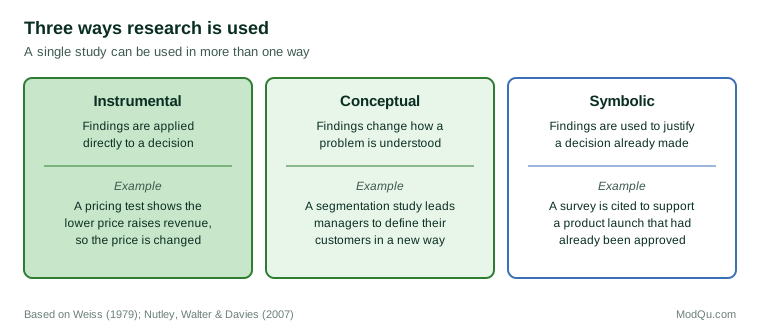
The distinction is useful when setting expectations. A recommendation report is designed for instrumental use, but conceptual use is common and valuable: a study that changes how a management team defines its customers may influence many later decisions. Symbolic use is not always harmful, but a researcher should recognise when it is the reason a study was commissioned.
From finding to recommendation
A finding is a statement about the data. A recommendation is a statement about what someone should do. Between the two lie two further steps that are often skipped.
- Finding: what the evidence shows, stated with its precision. "34% of customers who cancelled in the last year named slow support as the main reason."
- Insight: why it matters, usually by comparison or explanation. "This is the most common reason given, ahead of price, and it has risen since the last survey."
- Implication: what follows for the organisation. "Reducing support response times is likely to reduce cancellations more than a price cut would."
- Recommendation: a specific action, with an owner and a time frame. "The support team should pilot a four-hour response target for premium accounts next quarter and measure the effect on renewals."
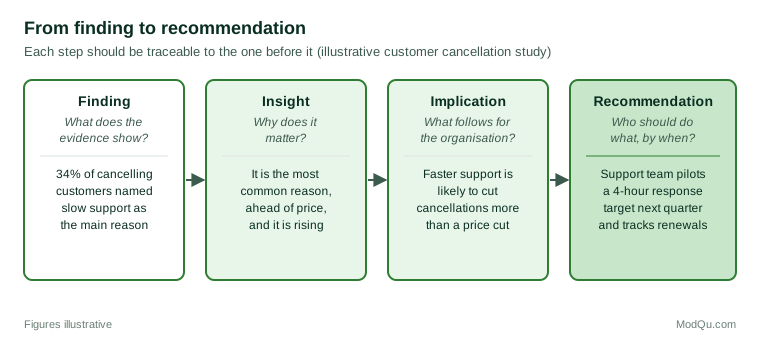
Each step should be traceable to the one before it. Readers should be able to see which findings support each recommendation, and a recommendation that cannot be traced back to evidence in the report should be identified as a judgement or removed. This also means avoiding the opposite error: listing findings and leaving the reader to infer the action. Decision makers rarely have time to make that inference, and different readers will make it differently.
Structure helps. Minto (2009) recommends that business documents start with the main conclusion and then present the supporting arguments, grouped and ordered logically, rather than building up to the conclusion at the end. For a research report, this usually means opening with the recommendations and the key findings behind them, then providing the detail.
Writing recommendations that can be acted on
A useful recommendation answers several practical questions:
- What exactly should be done? "Improve customer support" is an aim; "introduce a four-hour response target for premium accounts" is an action.
- Who is responsible? A recommendation with no owner is easy to agree with and easy to ignore.
- When should it happen, and in what order relative to other recommendations?
- What will it cost, and what resources does it need?
- How will success be measured, so that the organisation can tell whether the action worked?
- How strong is the evidence, and what are the main risks or uncertainties?
Fewer recommendations are usually better. A report with 30 recommendations of equal weight forces the reader to set priorities that the researcher is better placed to set. Ranking recommendations, or separating a small number of priority actions from secondary ones, makes the report easier to act on.
Context also matters. An intervention that worked in one setting may not work in another. Pawson and Tilley (1997) argue that evaluation should ask what works, for whom and in what circumstances, rather than simply whether something works. A recommendation should state the conditions under which the evidence applies, for example the customer segment, market or time period studied.
Stating the strength of a recommendation
Health care guideline developers have the most developed methods for linking evidence to recommendations. The GRADE approach separates two judgements: the certainty of the evidence, and the strength of the recommendation (Guyatt et al., 2008). Evidence can be rated as high, moderate, low or very low certainty. Recommendations are rated as strong or conditional (sometimes called weak).
A strong recommendation means that the guideline panel is confident the desirable effects of an action outweigh the undesirable effects, so that most informed people would choose it. A conditional recommendation means the balance is closer or less certain, so that different people, given the same information, might reasonably choose differently (Andrews et al., 2013). High-certainty evidence does not automatically produce a strong recommendation: an effective treatment may be costly, hard to deliver or unacceptable to many patients.
The GRADE Evidence to Decision frameworks make these other considerations explicit. Alonso-Coello et al. (2016) list criteria including the priority of the problem, the size of desirable and undesirable effects, the certainty of the evidence, how people value the outcomes, resource use, equity, acceptability and feasibility. A panel records its judgement on each criterion, together with the evidence behind it, before reaching a recommendation.
The same discipline works outside health care. A recommendation in a market research report can be labelled as strong ("the evidence clearly supports this and the cost is low") or conditional ("worth piloting, because the evidence is promising but limited to one region"). Recording the reasons makes it easier for decision makers to weigh the recommendation against other priorities and to revisit it if circumstances change.
Communicating uncertainty
Researchers often worry that stating uncertainty will undermine their recommendations. Van der Bles et al. (2019) reviewed the evidence on communicating uncertainty about facts and numbers, and found that it can be described at several levels, from a full probability distribution to a simple verbal statement that an estimate is uncertain. Spiegelhalter et al. (2011) show how visual formats such as ranges, fan charts and icon arrays can make uncertainty easier to understand.
The form in which numbers are presented also affects decisions. Gigerenzer et al. (2007) show that relative risks ("a 50% reduction") are often misunderstood and can exaggerate the size of an effect, while absolute risks ("from 2 in 1,000 to 1 in 1,000") and natural frequencies are understood more accurately. Framing also matters: Tversky and Kahneman (1981) showed that people make different choices between logically equivalent options depending on whether outcomes are described as gains or losses. A responsible report presents key numbers in more than one form where framing could change the decision, and avoids choosing the frame that most favours the preferred recommendation.
Working with decision makers
The evidence on research use consistently points to relationships. Lavis et al. (2003) argue that research organisations should plan knowledge transfer around five questions: what should be transferred, to whom, by whom, how, and with what effect. They note that the message should usually be based on a body of research rather than a single study, and that the audience determines the form of the message.
In practice, this means involving decision makers before the research begins, not after it ends. Agreeing the decisions the research is meant to inform, the options under consideration and the deadline helps ensure that the findings arrive in time and answer the right question. Sharing emerging findings during the project gives decision makers time to raise practical objections and avoids surprises in the final report.
Implementation is the final stage. Greenhalgh et al. (2004), in a review of the spread of innovations in service organisations, found that adoption depends not only on the features of the innovation but also on the readiness of the organisation, the people involved and the wider environment. A recommendation that requires new skills, budget or changes to other teams' work needs a plan for those changes, not just a statement that the action should be taken.
A checklist for the final report
- Open with the recommendations and the main findings behind them.
- Link each recommendation to specific evidence in the report.
- Make each recommendation specific, with an owner, timing, cost and measure of success.
- Rank recommendations or separate priority actions from secondary ones.
- State the strength of each recommendation and the certainty of the evidence behind it.
- Describe the context in which the evidence applies.
- Present key numbers in absolute terms and state their uncertainty.
- Agree the follow-up: who will act, and how the results will be reviewed.
Closing the research-action gap is mainly a matter of design. Research that is planned with its users, written to support a specific decision and honest about its limits has a much better chance of being used than research that is delivered at the end of a project and left to speak for itself.
References
Alonso-Coello, P., Schünemann, H. J., Moberg, J., Brignardello-Petersen, R., Akl, E. A., Davoli, M., Treweek, S., Mustafa, R. A., Rada, G., Rosenbaum, S., Morelli, A., Guyatt, G. H., Oxman, A. D., & GRADE Working Group. (2016). GRADE Evidence to Decision (EtD) frameworks: A systematic and transparent approach to making well informed healthcare choices. 1: Introduction. BMJ, 353, Article i2016. https://doi.org/10.1136/bmj.i2016
Andrews, J., Guyatt, G., Oxman, A. D., Alderson, P., Dahm, P., Falck-Ytter, Y., Nasser, M., Meerpohl, J., Post, P. N., Kunz, R., Brozek, J., Vist, G., Rind, D., Akl, E. A., & Schünemann, H. J. (2013). GRADE guidelines: 14. Going from evidence to recommendations: The significance and presentation of recommendations. Journal of Clinical Epidemiology, 66(7), 719–725. https://doi.org/10.1016/j.jclinepi.2012.03.013
Balas, E. A., & Boren, S. A. (2000). Managing clinical knowledge for health care improvement. Yearbook of Medical Informatics, 2000, 65–70.
Cairney, P. (2016). The politics of evidence-based policy making. Palgrave Macmillan.
Gigerenzer, G., Gaissmaier, W., Kurz-Milcke, E., Schwartz, L. M., & Woloshin, S. (2007). Helping doctors and patients make sense of health statistics. Psychological Science in the Public Interest, 8(2), 53–96. https://doi.org/10.1111/j.1539-6053.2008.00033.x
Greenhalgh, T., Robert, G., Macfarlane, F., Bate, P., & Kyriakidou, O. (2004). Diffusion of innovations in service organizations: Systematic review and recommendations. The Milbank Quarterly, 82(4), 581–629. https://doi.org/10.1111/j.0887-378X.2004.00325.x
Guyatt, G. H., Oxman, A. D., Vist, G. E., Kunz, R., Falck-Ytter, Y., Alonso-Coello, P., & Schünemann, H. J. (2008). GRADE: An emerging consensus on rating quality of evidence and strength of recommendations. BMJ, 336(7650), 924–926. https://doi.org/10.1136/bmj.39489.470347.AD
Innvær, S., Vist, G., Trommald, M., & Oxman, A. (2002). Health policy-makers' perceptions of their use of evidence: A systematic review. Journal of Health Services Research & Policy, 7(4), 239–244. https://doi.org/10.1258/135581902320432778
Lavis, J. N., Robertson, D., Woodside, J. M., McLeod, C. B., & Abelson, J. (2003). How can research organizations more effectively transfer research knowledge to decision makers? The Milbank Quarterly, 81(2), 221–248. https://doi.org/10.1111/1468-0009.t01-1-00052
Minto, B. (2009). The pyramid principle: Logic in writing and thinking (3rd ed.). Pearson Education.
Morris, Z. S., Wooding, S., & Grant, J. (2011). The answer is 17 years, what is the question: Understanding time lags in translational research. Journal of the Royal Society of Medicine, 104(12), 510–520. https://doi.org/10.1258/jrsm.2011.110180
Nutley, S. M., Walter, I., & Davies, H. T. O. (2007). Using evidence: How research can inform public services. Policy Press.
Oliver, K., Innvar, S., Lorenc, T., Woodman, J., & Thomas, J. (2014). A systematic review of barriers to and facilitators of the use of evidence by policymakers. BMC Health Services Research, 14, Article 2. https://doi.org/10.1186/1472-6963-14-2
Pawson, R., & Tilley, N. (1997). Realistic evaluation. Sage.
Spiegelhalter, D., Pearson, M., & Short, I. (2011). Visualizing uncertainty about the future. Science, 333(6048), 1393–1400. https://doi.org/10.1126/science.1191181
Tversky, A., & Kahneman, D. (1981). The framing of decisions and the psychology of choice. Science, 211(4481), 453–458. https://doi.org/10.1126/science.7455683
van der Bles, A. M., van der Linden, S., Freeman, A. L. J., Mitchell, J., Galvao, A. B., Zaval, L., & Spiegelhalter, D. J. (2019). Communicating uncertainty about facts, numbers and science. Royal Society Open Science, 6(5), Article 181870. https://doi.org/10.1098/rsos.181870
Weiss, C. H. (1979). The many meanings of research utilization. Public Administration Review, 39(5), 426–431. https://doi.org/10.2307/3109916