
Research · Research design
Design Science Research Approaches to Artifact-Centered Knowledge Creation
What design science research is, how it creates knowledge by building and evaluating artefacts, the six-activity process model, how artefacts are evaluated, what counts as a contribution, and how the approach applies to applied and commercial research.
Most research describes or explains the world as it is. Design science research sets out to change it. Its aim is to create an artefact, such as a method, a model, a tool or a system, that solves a practical problem, and to learn something general from building and testing it. The approach has its roots in Herbert Simon's argument that the "sciences of the artificial" deserve their own methods, because they study things that are made to serve a purpose rather than things that occur naturally (Simon, 1996). This article explains how design science research works, how its artefacts are evaluated and what kind of knowledge it produces.
Natural science and design science
March and Smith (1995) drew a clear line between the two traditions. Natural science asks what is true: it produces theories that describe and explain. Design science asks what is effective: it produces artefacts that serve human purposes, and judges them by whether they work. They identified four types of design output: constructs (the vocabulary of a problem), models (representations of how things relate), methods (sets of steps for performing a task) and instantiations (working implementations). Each can be built and then evaluated.
The two traditions depend on each other. A design draws on existing theory to explain why it should work, and testing the design can confirm, refine or challenge that theory. Walls et al. (1992) argued that a design can embody a theory of its own, an information system design theory, which states the requirements a class of systems must meet and the features that will meet them.
The core guidelines
Hevner et al. (2004) set out seven guidelines that became the reference point for the field, particularly in information systems research:
- The research must produce a viable artefact.
- The artefact must address an important and relevant problem.
- Its utility, quality and efficacy must be rigorously demonstrated through evaluation.
- The research must make a clear contribution, in the artefact itself, in the design knowledge or in methods.
- It must apply rigorous methods in both building and evaluating the artefact.
- Design is a search process: the researcher uses available means to reach a satisfactory solution, not necessarily an optimal one.
- The results must be communicated to both technical and management audiences.
The sixth guideline reflects the idea of satisficing (Simon, 1996). In most real problems the space of possible designs is too large to search fully, so the researcher seeks a solution that is good enough and explains why.
A process model
Guidelines say what good design research looks like; they do not say how to do it. Peffers et al. (2007) proposed a process with six activities, shown below.
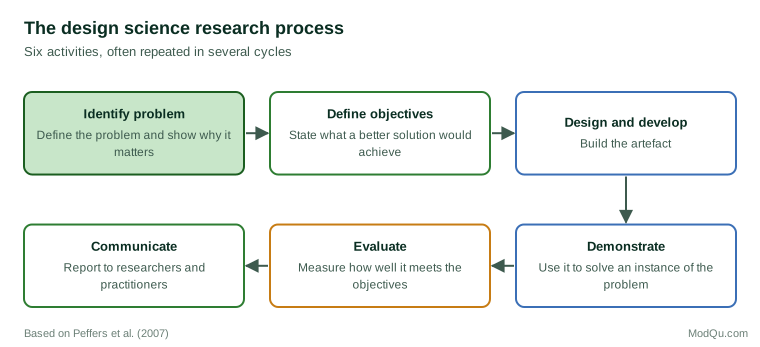
The process need not start at the beginning. A project may start from a problem, from a clear objective set by a client, from an existing artefact that needs improving, or from an observed solution that needs to be explained and generalised (Peffers et al., 2007). Evaluation results feed back into the design, and several cycles are normal.
Evaluating artefacts
Evaluation separates design science research from ordinary product development. The researcher must show, with evidence, that the artefact does what it claims. Venable et al. (2016) proposed a framework for choosing an evaluation strategy along two dimensions. The first is the purpose of evaluation: formative evaluation during development, to improve the design, or summative evaluation at the end, to judge it. The second is the setting: artificial evaluation, such as simulations, laboratory experiments and expert reviews, or naturalistic evaluation with real users solving real problems in real organisations.
Artificial evaluation is cheaper, faster and better controlled, but less convincing about real-world use. Naturalistic evaluation is the stronger test, but costlier and riskier. Venable et al. (2016) recommended moving from artificial and formative evaluation early in a project towards naturalistic and summative evaluation later, with the order adjusted to the main risks of the design.
What counts as a contribution
A working artefact alone is not a research contribution. Gregor and Hevner (2013) distinguished three levels of design knowledge: a specific, situated artefact; more general design principles or methods; and a full design theory. They also classified contributions by how new the problem and the solution are. Improvement applies a new solution to a known problem, exaptation extends a known solution to a new problem, and invention offers a new solution to a new problem. Applying a known solution to a known problem is routine design, not research.
Gregor and Jones (2007) set out the components of a complete design theory, including its purpose and scope, its constructs, its principles of form and function, its testable propositions and its justificatory knowledge. Baskerville et al. (2018) argued that projects should strike a balance between the artefact and the theory, and that useful contributions can sit at any point between the two.
An illustrative example
Suppose a research team is asked to help a subscription business detect customers who are likely to cancel. The example is hypothetical. In design science terms, the problem is late detection: the business learns of dissatisfaction only when a customer leaves. The objective is a short survey-based early-warning index that flags customers at risk at least two months before cancellation, with no more than five questions.
The team draws on existing research about satisfaction and loyalty as justificatory knowledge, builds a draft index, and evaluates it first in an artificial setting by testing it against historical survey and cancellation records. That formative evaluation shows that two questions add nothing, so they are replaced. The revised index is then evaluated naturalistically: account managers use it for six months, and the team compares cancellation among flagged customers who were contacted with those who were not. The contribution is the index itself and a stated design principle, for example that questions about recent problems predict cancellation better than general satisfaction questions in this setting, which other teams can test elsewhere.
Beyond information systems
The approach has spread to management and organisational research. van Aken (2004) argued that management research should produce field-tested technological rules of the form "to achieve outcome Y in situation S, use intervention X". Romme (2003) proposed design as a third mode of organisational research alongside science and the humanities. Action design research combines design science with action research, building and evaluating the artefact inside the organisation that will use it, so that the organisation shapes the design as it develops (Sein et al., 2011).
For applied and commercial research, the approach offers a disciplined way to create tools such as survey instruments, segmentation models and dashboards. The problem is stated, the objectives are made explicit, the artefact is built, and its value is shown with evidence rather than assumed. The result is a useful tool and a reusable lesson about why it works.
References
Baskerville, R., Baiyere, A., Gregor, S., Hevner, A., & Rossi, M. (2018). Design science research contributions: Finding a balance between artifact and theory. Journal of the Association for Information Systems, 19(5), 358–376. https://doi.org/10.17705/1jais.00495
Gregor, S., & Hevner, A. R. (2013). Positioning and presenting design science research for maximum impact. MIS Quarterly, 37(2), 337–355. https://doi.org/10.25300/MISQ/2013/37.2.01
Gregor, S., & Jones, D. (2007). The anatomy of a design theory. Journal of the Association for Information Systems, 8(5), 312–335. https://doi.org/10.17705/1jais.00129
Hevner, A. R., March, S. T., Park, J., & Ram, S. (2004). Design science in information systems research. MIS Quarterly, 28(1), 75–106. https://doi.org/10.2307/25148625
March, S. T., & Smith, G. F. (1995). Design and natural science research on information technology. Decision Support Systems, 15(4), 251–266. https://doi.org/10.1016/0167-9236(94)00041-2
Peffers, K., Tuunanen, T., Rothenberger, M. A., & Chatterjee, S. (2007). A design science research methodology for information systems research. Journal of Management Information Systems, 24(3), 45–77. https://doi.org/10.2753/MIS0742-1222240302
Romme, A. G. L. (2003). Making a difference: Organization as design. Organization Science, 14(5), 558–573. https://doi.org/10.1287/orsc.14.5.558.16769
Sein, M. K., Henfridsson, O., Purao, S., Rossi, M., & Lindgren, R. (2011). Action design research. MIS Quarterly, 35(1), 37–56. https://doi.org/10.2307/23043488
Simon, H. A. (1996). The sciences of the artificial (3rd ed.). MIT Press.
van Aken, J. E. (2004). Management research based on the paradigm of the design sciences: The quest for field-tested and grounded technological rules. Journal of Management Studies, 41(2), 219–246. https://doi.org/10.1111/j.1467-6486.2004.00430.x
Venable, J., Pries-Heje, J., & Baskerville, R. (2016). FEDS: A framework for evaluation in design science research. European Journal of Information Systems, 25(1), 77–89. https://doi.org/10.1057/ejis.2014.36
Walls, J. G., Widmeyer, G. R., & El Sawy, O. A. (1992). Building an information system design theory for vigilant EIS. Information Systems Research, 3(1), 36–59. https://doi.org/10.1287/isre.3.1.36