
Research · Research integrity
Collaborative Writing and Authorship Practices in Team-Based Knowledge Production
How research teams write together and share credit, covering the rise of team science, authorship criteria, contributor roles, author order, honorary and ghost authorship, hyperauthorship, disputes and practical agreements for collaborative writing.
Most new knowledge is now produced by teams. A single study may involve statisticians, field researchers, specialists in several disciplines, software developers and partners outside universities. Writing up such work raises practical and ethical questions that a single author never faces. Who did enough to be named as an author? In what order should names appear? Who is responsible if something is wrong? How should a dozen people write one coherent paper? This article examines how authorship works in team-based research, where it goes wrong and how teams can manage it well.
The rise of teams
Wuchty et al. (2007) analysed millions of research papers and patents over five decades and found that teams increasingly dominated knowledge production in almost every field, including the social sciences and, to a lesser extent, the arts and humanities. Team-authored papers were also more likely to be highly cited. Larivière et al. (2015) traced collaboration back to 1900 and found that the average number of authors per paper had grown steadily, and that papers with more authors tended to receive more citations.
Katz and Martin (1997) pointed out that collaboration is hard to define and that co-authorship is only a partial indicator of it: some collaborators are not listed as authors, and some authors contributed little. Sonnenwald (2007) reviewed research on scientific collaboration and described how teams form, how they coordinate work across distances and disciplines, and the tensions that arise over credit and control. Stokols et al. (2008) described an emerging science of team science that studies how research teams can be organised to work effectively.
Fanelli and Larivière (2016) showed one consequence of growing teams. The number of papers per researcher has risen sharply, but when each paper's credit is divided among its authors, individual productivity has changed little over a century. Researchers publish more papers largely because they share them with more co-authors.
What authorship means
Authorship confers both credit and responsibility. Wager (2009) summarised why it matters: authorship brings recognition and reward, through hiring, promotion and funding, and it assigns responsibility for the integrity of the work. The two should go together. A person who takes credit should be able to answer for what was published.
The most widely used criteria come from the International Committee of Medical Journal Editors (2024). An author should meet all four of the following:
- Substantial contributions to the conception or design of the work, or to the acquisition, analysis or interpretation of data.
- Drafting the work or revising it critically for important intellectual content.
- Final approval of the version to be published.
- Agreement to be accountable for all aspects of the work, ensuring that questions about its accuracy or integrity are appropriately investigated and resolved.
People who contributed but do not meet all four criteria, such as those who provided funding, general supervision, technical help or writing assistance, should be acknowledged rather than listed as authors. Many fields outside medicine use similar principles, although Marušić et al. (2011) found in a systematic review that understanding and practice of authorship varied widely between disciplines and that problems were common across all of them.
Why conventions differ between fields
Authorship norms reflect how work is organised in each field. In laboratory sciences, research is typically done by teams in a laboratory led by a principal investigator, so long author lists and a senior last author are normal. In the humanities, single-authored books and articles remain common, and a long author list would be unusual. In economics and mathematics, alphabetical order is often used because contributions are hard to rank and co-authors are treated as equals. In the social sciences, practice falls in between and varies by method: large survey projects may have many authors, while ethnographies are often written by one person.
These differences matter when researchers from different fields work together, because each may assume their own field's norms. A sociologist and an epidemiologist writing together may hold different views about who should be listed and in what order. They also matter for evaluation: hiring and promotion committees that compare candidates across fields need to understand what an author list means in each.
Students and junior researchers
Junior team members are especially vulnerable in authorship decisions. Doctoral students and research assistants often do much of the data collection and analysis, but have less power to insist on credit. Senior researchers may assume authorship by default, even when their contribution was limited to general supervision or securing funding, which on its own does not meet the usual criteria (International Committee of Medical Journal Editors, 2024).
Good practice is to discuss authorship with students and junior colleagues at the start of a project, to explain the conventions of the field, and to make sure that people who did substantial work are offered the chance to meet all the authorship criteria, for example by being invited to help draft and revise the paper. Where a student's thesis forms the basis of a paper, many institutions expect the student to be first author.
From authorship to contributorship
Rennie et al. (1997) argued that the traditional idea of authorship had failed in large collaborations, because a list of names says nothing about who did what. They proposed replacing it with contributorship: listing each person's specific contributions, with one or more named guarantors taking responsibility for the whole.
This idea has been put into practice through the Contributor Roles Taxonomy (CRediT), a standard set of fourteen roles that describe the contributions typically made to research outputs (Allen et al., 2014; Brand et al., 2015). Many publishers now ask authors to state their roles using this taxonomy.
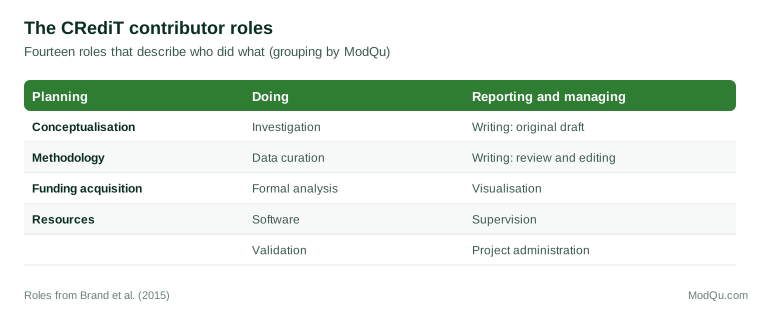
Contributor statements make credit more precise and reveal patterns that author lists hide. Macaluso et al. (2016) analysed contribution statements in a large set of journal articles and found that women were more likely than men to be credited with performing experiments, while men were more likely to be credited with conceiving studies, analysing data and contributing resources. West et al. (2013) found that women were under-represented as authors in the most prestigious author positions, first and last, across many fields.
Author order
When there are several authors, their order signals credit, but the conventions differ.
Tscharntke et al. (2007) described four approaches. In sequence-determines-credit, contribution declines with position. In equal contribution, authors are listed alphabetically or with a note that they contributed equally. In first-last-author emphasis, common in the life sciences, the first author did most of the work and the last author led the team or laboratory. In percent-contribution-indicated, each author's share is stated. Because readers cannot always tell which convention is in use, they recommended that authors state it.
Some fields list authors alphabetically by default. Waltman (2012) found that alphabetical ordering was common in mathematics, economics and high-energy physics, but rare elsewhere and declining overall. In such fields, the first-listed author is not necessarily the main contributor.
Hyperauthorship
In some fields, author lists have grown to hundreds or thousands of names. Cronin (2001) called this hyperauthorship and asked whether it represented a breakdown of the meaning of authorship or a structural change in how research is done. In particle physics, large collaborations list every member as an author on every paper. Castelvecchi (2015) reported on a physics paper with more than 5,000 authors, in which the list of names took up most of its pages. In such cases, authorship signals membership of a collaboration rather than individual responsibility for a paper, and collaborations rely on internal review procedures to ensure quality.
Responsibility in large teams
As teams grow, no single author can check every part of a paper. A statistician cannot verify laboratory procedures, and a field researcher may not be able to assess a complex model. The fourth criterion of the International Committee of Medical Journal Editors (2024) addresses this by asking each author to be able to identify which co-authors are responsible for which parts of the work, and to have confidence in their integrity, as well as being accountable for their own contribution. Contributor statements make these responsibilities visible. Named guarantors, as Rennie et al. (1997) proposed, take responsibility for the integrity of the work as a whole.
Experience with misconduct shows why this matters. When fabricated data have been found in team papers, co-authors have often said they had no way of knowing. Shared responsibility works only if teams build in checks, such as having more than one person examine raw data and analyses, rather than relying on trust alone.
When authorship goes wrong
Honorary authorship
Honorary or gift authorship means listing people who did not meet authorship criteria, often senior colleagues, heads of department or people whose names may help publication. Flanagin et al. (1998) surveyed authors of articles in leading medical journals and found that a substantial share of articles had honorary authors. Wislar et al. (2011) repeated the survey more than a decade later and found that honorary and ghost authorship remained common.
Ghost authorship
Ghost authorship means omitting people who made substantial contributions, typically professional writers or employees of a sponsor. It hides conflicts of interest and the true origin of the work. Gøtzsche et al. (2007) compared protocols of industry-initiated trials with the resulting publications and found evidence of ghost authorship in most of them, often involving statisticians or company employees who were not named.
Inflated author lists
A related problem is the growth of author lists beyond what contributions justify. Where hiring and promotion reward the number of papers, researchers have an incentive to add one another to papers as a favour, or to form groups that routinely list all members. Such practices inflate publication counts and make it harder to identify who actually did the work. Contributor statements and fractional counting of credit, in which each author receives a share of a paper rather than full credit, reduce the incentive (Fanelli & Larivière, 2016).
Disputes
Disagreements about who should be an author, or in what order, are common in collaborative work and can damage relationships and careers. They often arise because expectations were never discussed, because contributions changed during the project, or because of differences in power between senior and junior team members. Albert and Wager (2003) advised new researchers to discuss authorship early, to record agreements, and to seek help from a senior colleague or institutional adviser when disputes cannot be resolved directly.
Writing as a team
Beyond credit, teams must produce a coherent text. Common approaches include:
- A lead writer, who drafts the paper and integrates comments from others. This produces the most consistent text, but places a heavy load on one person.
- Section ownership, where different people draft the sections they know best, with one person editing the whole for consistency.
- Simultaneous editing in shared online documents, which speeds up work but needs clear rules on who decides between conflicting edits.
Whatever the approach, teams benefit from agreeing an outline before drafting, keeping a single master version, setting deadlines for comments and making one person responsible for the final text and for submission.
Several practical habits make team writing smoother. Agreeing the main message of the paper in a sentence or two before anyone drafts prevents sections from pulling in different directions. A shared style sheet, covering terms, abbreviations, referencing style and how results are reported, saves time at the editing stage. Reference management software with a shared library avoids duplicate and inconsistent citations. Comments should be specific and constructive, and co-authors should distinguish essential changes from preferences. Finally, every author should read the complete final version, not only their own section, before approving it, since approval of the whole is part of the authorship criteria.
Authorship and AI tools
The growing use of generative AI tools in writing has added a new question. Journals and publication ethics bodies agree that AI tools cannot be authors, because they cannot take responsibility for the work or agree to be accountable for it (Thorp, 2023). Where such tools are used in drafting or editing, their use should be disclosed, and the human authors remain responsible for every statement in the text.
An authorship agreement
The figure below sets out a simple process for agreeing authorship in a team.
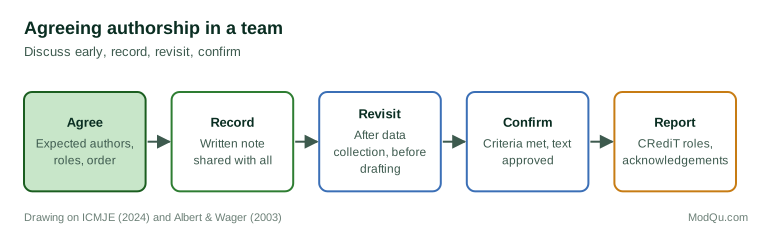
At the start of a project, the team agrees who is expected to be an author, what each person will contribute and what order is likely, based on the conventions of the field. The agreement is recorded and revisited at key stages, such as after data collection and before drafting, because contributions often change. Before submission, every author confirms that they meet the criteria, approves the final text and agrees to be accountable for it. Contributions are reported using a standard taxonomy such as CRediT, and people who helped but are not authors are acknowledged.
Authorship in business and applied research
Authorship questions also arise in commercial research, consultancy and reports by public bodies and charities. Reports are often published under an organisation's name, with individual contributors credited inside or not at all. The same principles still help: be clear who is responsible for the content, credit significant contributions honestly, disclose who funded and who wrote the work, and do not present a report as independent if a sponsor shaped it. Clients and readers are better able to trust a report when they know who stands behind it.
Conclusion
Team-based research has transformed authorship. Long author lists, shared writing and diverse contributions make the traditional idea of a single responsible author hard to apply. Criteria such as those of the International Committee of Medical Journal Editors, contributor taxonomies such as CRediT and explicit conventions on author order help teams assign credit fairly and keep responsibility clear. Honorary and ghost authorship remain common, and disputes are frequent where expectations are unspoken. The most effective safeguard is simple: agree authorship early, record it, revisit it as the work develops, and make sure that everyone named can stand behind what is published.
References
Albert, T., & Wager, E. (2003). How to handle authorship disputes: A guide for new researchers. In The COPE report 2003 (pp. 32–34). Committee on Publication Ethics.
Allen, L., Scott, J., Brand, A., Hlava, M., & Altman, M. (2014). Publishing: Credit where credit is due. Nature, 508(7496), 312–313. https://doi.org/10.1038/508312a
Brand, A., Allen, L., Altman, M., Hlava, M., & Scott, J. (2015). Beyond authorship: Attribution, contribution, collaboration, and credit. Learned Publishing, 28(2), 151–155. https://doi.org/10.1087/20150211
Castelvecchi, D. (2015). Physics paper sets record with more than 5,000 authors. Nature. https://doi.org/10.1038/nature.2015.17567
Cronin, B. (2001). Hyperauthorship: A postmodern perversion or evidence of a structural shift in scholarly communication practices? Journal of the American Society for Information Science and Technology, 52(7), 558–569. https://doi.org/10.1002/asi.1097
Fanelli, D., & Larivière, V. (2016). Researchers' individual publication rate has not increased in a century. PLoS ONE, 11(3), Article e0149504. https://doi.org/10.1371/journal.pone.0149504
Flanagin, A., Carey, L. A., Fontanarosa, P. B., Phillips, S. G., Pace, B. P., Lundberg, G. D., & Rennie, D. (1998). Prevalence of articles with honorary authors and ghost authors in peer-reviewed medical journals. JAMA, 280(3), 222–224. https://doi.org/10.1001/jama.280.3.222
Gøtzsche, P. C., Hróbjartsson, A., Johansen, H. K., Haahr, M. T., Altman, D. G., & Chan, A.-W. (2007). Ghost authorship in industry-initiated randomised trials. PLoS Medicine, 4(1), Article e19. https://doi.org/10.1371/journal.pmed.0040019
International Committee of Medical Journal Editors. (2024). Recommendations for the conduct, reporting, editing, and publication of scholarly work in medical journals. ICMJE.
Katz, J. S., & Martin, B. R. (1997). What is research collaboration? Research Policy, 26(1), 1–18. https://doi.org/10.1016/S0048-7333(96)00917-1
Larivière, V., Gingras, Y., Sugimoto, C. R., & Tsou, A. (2015). Team size matters: Collaboration and scientific impact since 1900. Journal of the Association for Information Science and Technology, 66(7), 1323–1332. https://doi.org/10.1002/asi.23266
Macaluso, B., Larivière, V., Sugimoto, T., & Sugimoto, C. R. (2016). Is science built on the shoulders of women? A study of gender differences in contributorship. Academic Medicine, 91(8), 1136–1142. https://doi.org/10.1097/ACM.0000000000001261
Marušić, A., Bošnjak, L., & Jerončić, A. (2011). A systematic review of research on the meaning, ethics and practices of authorship across scholarly disciplines. PLoS ONE, 6(9), Article e23477. https://doi.org/10.1371/journal.pone.0023477
Rennie, D., Yank, V., & Emanuel, L. (1997). When authorship fails: A proposal to make contributors accountable. JAMA, 278(7), 579–585. https://doi.org/10.1001/jama.1997.03550070071041
Sonnenwald, D. H. (2007). Scientific collaboration. Annual Review of Information Science and Technology, 41(1), 643–681. https://doi.org/10.1002/aris.2007.1440410121
Stokols, D., Hall, K. L., Taylor, B. K., & Moser, R. P. (2008). The science of team science: Overview of the field and introduction to the supplement. American Journal of Preventive Medicine, 35(2, Suppl.), S77–S89. https://doi.org/10.1016/j.amepre.2008.05.002
Thorp, H. H. (2023). ChatGPT is fun, but not an author. Science, 379(6630), 313. https://doi.org/10.1126/science.adg7879
Tscharntke, T., Hochberg, M. E., Rand, T. A., Resh, V. H., & Krauss, J. (2007). Author sequence and credit for contributions in multiauthored publications. PLoS Biology, 5(1), Article e18. https://doi.org/10.1371/journal.pbio.0050018
Wager, E. (2009). Recognition, reward and responsibility: Why the authorship of scientific papers matters. Maturitas, 62(2), 109–112. https://doi.org/10.1016/j.maturitas.2008.12.001
Waltman, L. (2012). An empirical analysis of the use of alphabetical authorship in scientific publishing. Journal of Informetrics, 6(4), 700–711. https://doi.org/10.1016/j.joi.2012.07.008
West, J. D., Jacquet, J., King, M. M., Correll, S. J., & Bergstrom, C. T. (2013). The role of gender in scholarly authorship. PLoS ONE, 8(7), Article e66212. https://doi.org/10.1371/journal.pone.0066212
Wislar, J. S., Flanagin, A., Fontanarosa, P. B., & DeAngelis, C. D. (2011). Honorary and ghost authorship in high impact biomedical journals: A cross sectional survey. BMJ, 343, Article d6128. https://doi.org/10.1136/bmj.d6128
Wuchty, S., Jones, B. F., & Uzzi, B. (2007). The increasing dominance of teams in production of knowledge. Science, 316(5827), 1036–1039. https://doi.org/10.1126/science.1136099