
Investigation · Method and the future
The Investigative Report: Structure, Standards and Findings
The report is the part of an investigation that decision-makers actually read. This article explains how to structure an investigative report, the standards it should meet, how to state findings and uncertainty, and common mistakes.
An investigation is only as useful as its report. Managers, boards, regulators, courts and the people investigated usually do not see the interviews or documents themselves; they see the report. A clear report allows a fair decision to be made and defended. A poor one can undermine a sound investigation, by hiding the evidence behind a conclusion, overstating certainty or leaving out what was not examined. This article sets out a standard structure, the qualities a report should have, and how to express findings.
A standard structure
Most investigative reports follow a similar order, whether they concern a workplace complaint, a fraud or a safety incident.
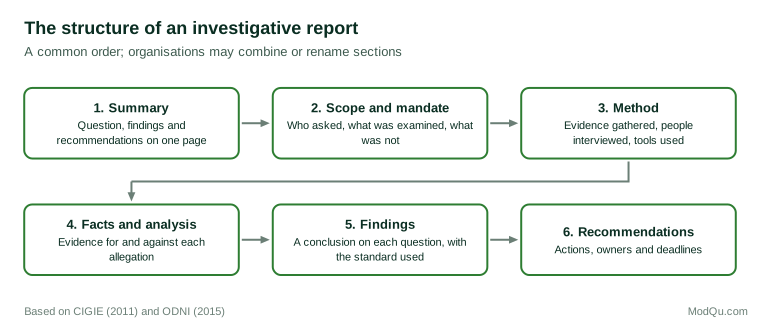
The summary states the question, the findings and the main recommendations, because many readers will read nothing else. The scope records who commissioned the investigation, the allegations or questions examined and any limits, such as documents that could not be obtained or people who declined to be interviewed. The method lists the evidence gathered and how. The facts and analysis section sets out the evidence on each question, including evidence that points the other way, and explains how conflicts were resolved. The findings answer each question against a stated standard, such as the balance of probabilities. Recommendations follow from the findings and say who should do what. Appendices hold chronologies, document lists and interview records.
Standards a report should meet
Professional standards for investigations stress that reports should be accurate, complete, objective, timely and supported by sufficient evidence (Council of the Inspectors General on Integrity and Efficiency [CIGIE], 2011). Standards for intelligence analysis add that judgements should be clearly separated from the information they are based on, that the quality of sources should be described, that uncertainty should be expressed, and that alternative explanations should be considered (Office of the Director of National Intelligence [ODNI], 2015). Heuer and Pherson (2015) describe structured techniques, such as analysis of competing hypotheses, whose results can be summarised in the report to show how alternatives were tested. For digital evidence, ISO/IEC 27043 sets out principles for documenting investigation processes so that they can be reviewed (International Organization for Standardization [ISO], 2015).
Reports that may be used in litigation must also meet procedural rules. In England and Wales, expert reports must state the expert's instructions, the material relied on and the range of opinion, and include a statement of truth (Civil Procedure Rules, 1998, Part 35). In United States federal courts, expert reports must contain a complete statement of the opinions and the basis and reasons for them (Fed. R. Civ. P. 26(a)(2)(B)).
Stating findings and uncertainty
Each finding should answer a specific question, name the standard of proof and point to the evidence. Toulmin (1958) described an argument as a claim supported by evidence and a warrant that links them, together with any qualifications; a good finding has the same parts. For example: "On the balance of probabilities, the employee approved the payments knowing the supplier was not genuine. This is based on the employee's emails of 3 and 9 May and the bank records in Appendix C. The employee's account that the approvals were automatic is not supported by the system logs."
Words of probability need care. Kent (1964) showed that readers interpret terms such as "probable" or "possible" very differently, and recommended linking them to defined ranges. A report that uses such terms should say what they mean.
Fairness and review before release
Before a report is finalised, the people it criticises should usually be told the substance of the proposed findings and given a chance to respond, and their response should be considered and recorded. This is a requirement of fairness in many workplaces and public inquiries, and it often corrects factual errors. A second investigator or a manager who was not involved should review the draft to check that every finding is supported, that the evidence against each finding has been addressed, and that the tone is neutral. The report should also be marked with its confidentiality level and distributed only to those who need it, because it will usually contain personal information about witnesses and the people investigated. Finally, the investigator should keep the working file, including notes, evidence lists and drafts, so that the report can be defended if it is challenged later.
Common mistakes
- Conclusions without the evidence that supports them.
- Leaving out evidence that favours the person investigated.
- Findings on matters outside the mandate.
- Opinion or emotive language in place of facts.
- Recommendations that do not follow from any finding.
- Jargon that decision-makers cannot follow. Plain language makes reports easier to act on, and in the United States federal agencies are required to use it in public documents (Plain Writing Act of 2010).
Conclusion
A good investigative report states the question, scope and method, sets out the evidence on both sides, gives a finding on each question against a stated standard, and makes recommendations that follow from the findings. It separates fact from judgement and is honest about uncertainty. Written this way, a report allows decision-makers to act fairly and allows others to check that they did.
References
Civil Procedure Rules 1998, SI 1998/3132, Part 35 (UK).
Council of the Inspectors General on Integrity and Efficiency. (2011). Quality standards for investigations.
Fed. R. Civ. P. 26.
Heuer, R. J., Jr., & Pherson, R. H. (2015). Structured analytic techniques for intelligence analysis (2nd ed.). CQ Press.
International Organization for Standardization. (2015). Information technology — Security techniques — Incident investigation principles and processes (ISO/IEC 27043:2015).
Kent, S. (1964). Words of estimative probability. Studies in Intelligence, 8(4), 49–65.
Office of the Director of National Intelligence. (2015). Intelligence Community Directive 203: Analytic standards.
Plain Writing Act of 2010, Pub. L. No. 111-274, 124 Stat. 2861.
Toulmin, S. E. (1958). The uses of argument. Cambridge University Press.