
Investigation · Method and the future
Resource Constraints and Triage Decisions in High-Volume Investigation Environments
Most investigative bodies receive far more cases than they can investigate fully, so they must decide which to pursue, how far and in what order. This article explains how triage works, the research on solvability and harm, the risks of bias and inconsistency in triage decisions, and how to make prioritisation transparent, fair and effective.
No police force, regulator, fraud team or complaints unit can investigate every matter it receives as thoroughly as it would like. Reports of crime, complaints, alerts and tips arrive in volumes that far exceed the hours available. Digital evidence adds to the load, with devices waiting months for examination. In these conditions, the most consequential decisions an investigative body makes are often not about how to investigate, but about what to investigate at all. Triage is the process of making those decisions: screening incoming matters, deciding which to pursue, at what level of effort and in what order. This article explains how triage works, what research says about predicting which cases can be solved and which matter most, and how to make triage fair and effective.
The scale of the problem
Research on criminal investigation has long shown that most cases are not solved and that investigative effort makes a difference in only some of them. The RAND study of criminal investigation found that the most important factor in whether a case was solved was the information available at the outset, from victims and witnesses, and that for many cases additional investigative work added little (Greenwood et al., 1977). In digital forensics, Quick and Choo (2014) documented backlogs of seized devices caused by the rapid growth in data volumes, and Garfinkel (2010) predicted that examiners would increasingly need to triage rather than examine everything. Regulators face similar pressures: Sparrow (2000) argued that regulators cannot respond to every complaint and should organise their work around identifying and solving the most important problems, and a government review in the United Kingdom recommended that regulators target inspection and enforcement on the basis of risk (Hampton, 2005).
Solvability
One approach to triage asks which cases are likely to be solved if investigated. Studies of burglary in the United States led to "solvability factors": features of a case, such as a named suspect, a witness, a description of the offender, physical evidence or a vehicle registration, that predict whether investigation will lead to an arrest. Eck (1979, 1983) found that a small number of such factors could identify the cases most likely to benefit from follow-up, and that cases without them were rarely solved however much effort was spent. In England, Coupe and Griffiths (1996) found that the outcome of residential burglary investigations depended heavily on information obtained at the scene and in the first stages of investigation. Later work has applied solvability models to other crimes, such as metal theft (Robb et al., 2015).
Solvability models allow resources to go where they are most likely to produce results. But they carry a risk: cases that are hard to solve may also be serious, and screening them out can leave victims without any response. Solvability alone is not a sufficient basis for triage.
Harm
A second approach asks which cases matter most. Sherman (2013) argued that policing should target resources on the basis of evidence about where harm is concentrated, test what works and track results. Sherman et al. (2016) proposed the Cambridge Crime Harm Index, which weights offences by the length of the sentence recommended for them in sentencing guidelines, so that one serious offence counts for more than many minor ones. Harm-based prioritisation directs effort to the cases with the greatest consequences for victims and the public, including those with complex evidence. Intelligence-led policing similarly uses analysis to identify the most harmful offenders and problems (Ratcliffe, 2016).
Combining solvability and harm
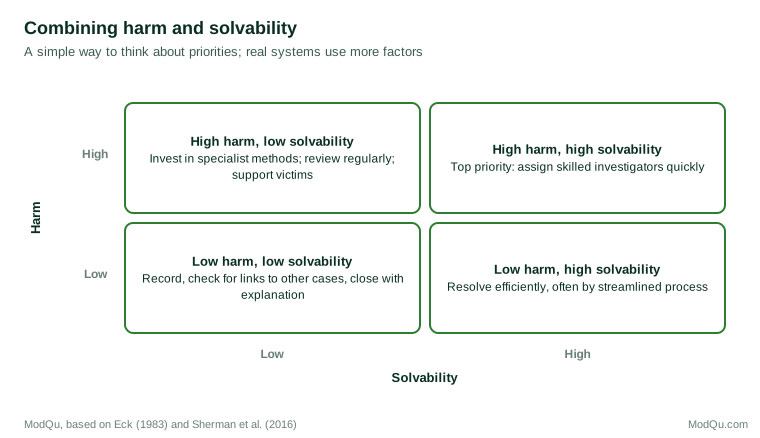
Most triage systems combine several factors: the seriousness of the matter, the vulnerability of the people affected, the risk of further harm, the availability of evidence and leads, whether the case links to others, the public interest and the resources required. Braga et al. (2011) argued that investigative resources should be directed not only at solving individual cases but at controlling crime more broadly, for example by focusing on repeat offenders and linked cases. A case that is minor on its own may be important if it connects to a series.
Risks in triage
Triage decisions are made quickly, often by junior staff, on limited information, and they can go wrong in several ways.
Inconsistency. Without clear criteria, similar cases may be treated differently depending on who screens them, the time of day or the current workload. Danziger et al. (2011), studying parole decisions by judges, found that favourable rulings became less likely as a session went on and rose again after breaks, suggesting that extraneous factors such as fatigue can affect consequential decisions.
Discretion and bias. Lipsky (1980) described how front-line public servants, facing more demands than they can meet, develop routines and shortcuts to ration their attention, and how these can systematically disadvantage some groups. Triage criteria that rely on whether a victim is articulate, persistent or well connected can reproduce inequalities.
Missed patterns. Screening each case alone can miss links between cases. A series of minor complaints about the same person or business may indicate a serious problem.
Silent attrition. Cases screened out may never be reviewed, and the people who reported them may not be told.
Triage within an investigation
Triage applies not only to deciding which cases to open but to deciding what to do within a case. A single investigation may involve dozens of seized devices, thousands of documents and hundreds of possible witnesses. Digital forensic units increasingly use a staged approach: a quick preview of each device to decide whether it is relevant, a targeted extraction of the most likely sources of evidence, and a full examination only where the case requires it (Quick & Choo, 2014). Document review uses ranking to put the most likely relevant material in front of reviewers first. Witness enquiries are prioritised by how close each person was to the events and how much their evidence could change the picture.
The same risks apply as in case triage. A preview may miss hidden or deleted material, and a ranking model may push important but unusual documents to the bottom. Investigators should record the criteria used at each stage, sample what was set aside, and be prepared to explain why a fuller examination was not carried out.
Responding to cases that are not pursued
Screening a case out does not end the organisation's responsibility to the person who reported it. People who report crimes, complaints or misconduct and hear nothing often conclude that they were not believed, and are less likely to report again. Simple steps help: acknowledging every report, explaining in plain terms that it has been recorded and assessed, saying whether further action is planned, and telling the person what to do if they obtain new information or if the problem continues. Recorded reports that are not investigated still have value, because they can be linked to later reports and may reveal a pattern that justifies investigation.
Making triage fair and effective
Experience and research point to several practices:
- Use explicit criteria. Write down the factors that determine priority and how they are weighed, and apply them consistently.
- Combine harm and solvability. Do not screen out serious cases simply because they are hard.
- Look for links. Check each new matter against existing records before closing it.
- Allow escalation. Let staff escalate cases that do not fit the criteria but seem important.
- Review decisions. Audit samples of screened-out cases to check that criteria are working and applied consistently.
- Communicate. Tell people what will happen to their report and why, including when it will not be investigated further.
- Use technology carefully. Automated scoring and machine learning can help rank large volumes, as in technology-assisted document review (Cormack & Grossman, 2014), but models must be validated and monitored for bias.
- Measure outcomes. Track what happens to cases at each priority level and adjust criteria accordingly.
Some legal regimes limit triage. In the European Union, organisations must follow up whistleblowing reports diligently and give feedback within a set period (Directive (EU) 2019/1937, 2019), so reports cannot simply be ignored, although the depth of follow-up can be proportionate.
A short example
The following hypothetical case illustrates triage in practice. A survey company's quality team receives about 400 alerts a month about possibly fraudulent respondents, far more than its two investigators can examine. It introduces a scoring system that combines the potential harm, measured by the value of incentives claimed and whether a client's data were affected, with solvability, measured by the number of independent indicators such as shared devices, implausible completion times and duplicate payment details. High-scoring alerts go to investigators within two days; low-scoring alerts are checked automatically for links to known fraud networks and otherwise closed, with the respondent's account flagged for monitoring. Each month, a reviewer samples 20 closed alerts. In the second month, the sample reveals that several low-value alerts share a payment account, exposing a network the scoring system had missed. The team adds a link check to the scoring rules, and the monthly audit becomes a permanent part of the process.
Conclusion
High-volume investigative environments force choices about which matters to pursue. Research on solvability shows that early information largely determines whether cases can be solved, while harm-based approaches direct effort to the cases that matter most. Effective triage combines both, looks for links between cases, applies explicit criteria consistently, allows escalation, audits its decisions and tells people what will happen to their reports. Done well, triage allows limited resources to produce the most knowledge and the greatest protection; done badly, it silently abandons serious cases and the people who reported them.
References
Braga, A. A., Flynn, E. A., Kelling, G. L., & Cole, C. M. (2011). Moving the work of criminal investigators towards crime control (New Perspectives in Policing). Harvard Kennedy School and National Institute of Justice.
Cormack, G. V., & Grossman, M. R. (2014). Evaluation of machine-learning protocols for technology-assisted review in electronic discovery. In Proceedings of the 37th International ACM SIGIR Conference on Research and Development in Information Retrieval (pp. 153–162). ACM. https://doi.org/10.1145/2600428.2609601
Coupe, T., & Griffiths, M. (1996). Solving residential burglary (Crime Detection and Prevention Series Paper 77). Home Office.
Danziger, S., Levav, J., & Avnaim-Pesso, L. (2011). Extraneous factors in judicial decisions. Proceedings of the National Academy of Sciences, 108(17), 6889–6892. https://doi.org/10.1073/pnas.1018033108
Directive (EU) 2019/1937 of the European Parliament and of the Council of 23 October 2019 on the protection of persons who report breaches of Union law. (2019). Official Journal of the European Union, L 305, 17–56.
Eck, J. E. (1979). Managing case assignments: The burglary investigation decision model replication. Police Executive Research Forum.
Eck, J. E. (1983). Solving crimes: The investigation of burglary and robbery. Police Executive Research Forum.
Garfinkel, S. L. (2010). Digital forensics research: The next 10 years. Digital Investigation, 7(Suppl.), S64–S73. https://doi.org/10.1016/j.diin.2010.05.009
Greenwood, P. W., Chaiken, J. M., & Petersilia, J. (1977). The criminal investigation process. D. C. Heath.
Hampton, P. (2005). Reducing administrative burdens: Effective inspection and enforcement. HM Treasury.
Lipsky, M. (1980). Street-level bureaucracy: Dilemmas of the individual in public services. Russell Sage Foundation.
Quick, D., & Choo, K.-K. R. (2014). Impacts of increasing volume of digital forensic data: A survey and future research challenges. Digital Investigation, 11(4), 273–294. https://doi.org/10.1016/j.diin.2014.09.002
Ratcliffe, J. H. (2016). Intelligence-led policing (2nd ed.). Routledge.
Robb, P., Coupe, T., & Ariel, B. (2015). 'Solvability' and detection of metal theft on railway property. European Journal on Criminal Policy and Research, 21(4), 463–484. https://doi.org/10.1007/s10610-014-9264-x
Sherman, L. W., Neyroud, P. W., & Neyroud, E. (2016). The Cambridge Crime Harm Index: Measuring total harm from crime based on sentencing guidelines. Policing: A Journal of Policy and Practice, 10(3), 171–183. https://doi.org/10.1093/police/paw003
Sherman, L. W. (2013). The rise of evidence-based policing: Targeting, testing, and tracking. Crime and Justice, 42(1), 377–451. https://doi.org/10.1086/670819
Sparrow, M. K. (2000). The regulatory craft: Controlling risks, solving problems, and managing compliance. Brookings Institution Press.