
Investigation · Business and corporate investigation
Reputation Due Diligence: Investigating What the Public Record Shows
Before a business partners with, invests in or hires someone, it often asks what the public record says about them. This article explains how reputation due diligence is done, which sources it draws on, how reliable those sources are, and how to report adverse findings fairly.
When a company considers a new business partner, an investor weighs a deal, or a board appoints a senior executive, one of the questions asked is: what is known about these people? Have they been involved in litigation, fraud, corruption or regulatory breaches? Are they connected to politically exposed persons or sanctioned individuals? Have journalists or courts reported anything that would embarrass the organisation if it came to light later? Reputation due diligence is the investigation that answers these questions from the public record.
The work matters because reputational harm can be costly. Karpoff et al. (2008), studying firms targeted by enforcement actions for financial misrepresentation, found that the loss of value from damage to reputation was many times larger than the legal penalties imposed. Fombrun and Shanley (1990) showed that reputation reflects how stakeholders interpret a wide range of signals about a firm, which means that an association with a disreputable partner can affect how a company is seen. Due diligence aims to identify such risks before they are taken on.
This article describes the sources used in reputation due diligence, the reliability of each, the methods for combining them, and the legal and ethical limits on the work.
What the public record contains
The public record is broader than it may seem. It includes official registers, court and regulatory records, the press and the large body of material published online, much of which is now described as open-source information (Glassman & Kang, 2012).
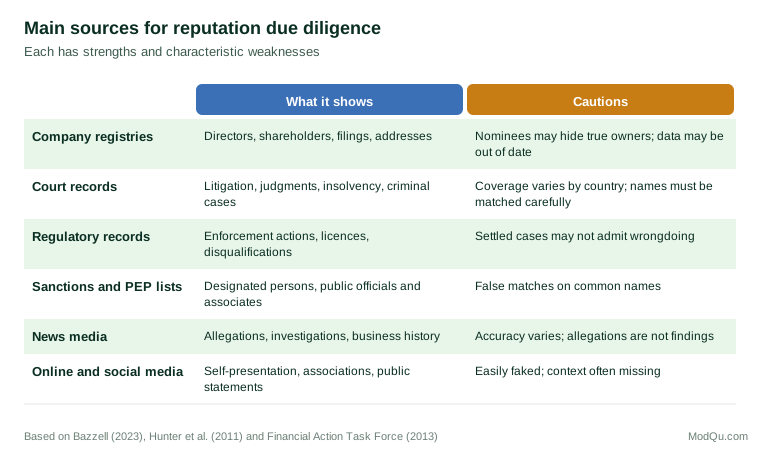
Company registries show who formed a company, who its directors and shareholders are, and what it has filed. They are the starting point for understanding a business and its connections. Their weakness is that they show legal ownership, which may be held by nominees or other companies, rather than the people who ultimately own and control the business. Leaked records such as the Panama Papers showed how widely layers of offshore companies have been used to hide ownership (Obermayer & Obermaier, 2016), and international standards now require countries to ensure that information on beneficial ownership is available to authorities (Financial Action Task Force [FATF], 2023).
Court records reveal litigation, insolvency, judgments and criminal proceedings. They are among the most reliable sources, because they record what a court decided. But access varies greatly between countries and courts, and records are often searchable only by name, so investigators must confirm that a record relates to the right person.
Regulatory records show enforcement actions, licences, professional disciplinary findings and disqualifications. Many enforcement actions are settled without an admission of wrongdoing, which should be reflected in how they are reported.
Sanctions lists and politically exposed person databases identify individuals subject to sanctions and people who hold or have held prominent public positions, along with their family members and close associates. Politically exposed persons are not wrongdoers, but they present a higher risk of corruption, and dealings with them call for closer scrutiny (FATF, 2013).
News media often provide the richest information, including allegations that never reached a court. They are also the least consistent in reliability. A detailed investigative report in a reputable publication, based on documents and named sources, deserves more weight than an anonymous blog post repeating a rumour.
Online and social media sources show how people present themselves, whom they associate with and what they have said in public. They can reveal undisclosed business interests or connections, but they are easily manipulated, and material can be fabricated, edited or presented out of context (Wardle & Derakhshan, 2017).
Method
Define the question
A due diligence inquiry should begin with a clear statement of what the client needs to know and why. A review of a potential joint venture partner in a high-risk country calls for a different scope from a check on a new non-executive director. The scope should state who is to be researched, including related companies and key individuals, which countries and time periods are covered, and what kinds of issue are relevant.
Search systematically
Searches should be recorded so that another investigator could repeat them: which sources were searched, which names and variants were used, and what was found. Names must be searched in their different forms, including transliterations from other alphabets, maiden names and former company names. Bazzell (2023) describes techniques for searching open sources systematically, and the Berkeley Protocol sets out principles for conducting and documenting online investigations in a way that preserves the integrity of evidence (Human Rights Center, University of California, Berkeley, School of Law, & Office of the United Nations High Commissioner for Human Rights, 2022).
Confirm identity
The most common error in reputation research is attributing information to the wrong person. Common names produce many matches, and the person who appears in a court record or news report may be someone else. Each finding should be linked to the subject by identifiers such as date of birth, address, company roles or photographs before it is relied on. Commercial databases of personal records can contain errors, outdated entries and mismatched records (Lageson, 2020), so they should be checked against primary sources where possible.
Assess reliability
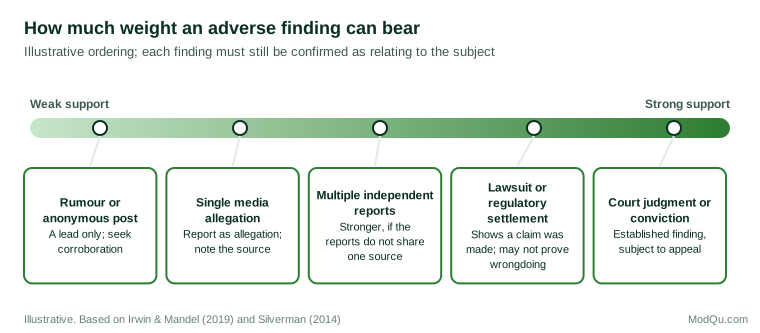
Each finding should be assessed for the reliability of its source and the credibility of the information itself. A useful practice is to distinguish clearly between established facts, such as a criminal conviction or a regulatory fine, and allegations, such as claims made in a lawsuit or reported in the press. Irwin and Mandel (2019) note that analysts often conflate source reliability with information credibility when grading intelligence, and the same risk applies here: a reputable newspaper can report an allegation accurately without the allegation being true.
Corroborate
Important findings should be corroborated by independent sources. Several media reports that all repeat the same original story count as one source, not several. Verification practices developed in journalism, such as tracing a claim to its original source and checking dates, locations and documents, apply directly to due diligence (Kovach & Rosenstiel, 2014; Silverman, 2014). Hunter et al. (2011) recommend treating each factual claim as a hypothesis to be confirmed with documents, which is equally good advice for investigators.
Guard against bias
Reputation research is vulnerable to the same biases as any other investigation. An investigator who finds one damaging story early may read later material in its light and give less attention to information that points the other way. People tend to seek and interpret evidence in ways that confirm what they already believe (Nickerson, 1998). A useful safeguard is to write down, before the research is complete, what innocent explanations could account for an adverse finding, and to check them. Heuer (1999) recommends listing competing hypotheses and asking which evidence would distinguish between them. In due diligence, the competing hypotheses might be that a lawsuit reflects real misconduct, that it was a commercial dispute of a kind common in the industry, or that it was brought by a competitor for tactical reasons.
A short example
The following hypothetical case illustrates the method. An investment firm is considering buying a stake in a logistics company and asks for due diligence on the company and its founder. Registry searches show that the founder has been a director of eleven companies, three of which went into insolvency. Court records show a judgment against one of those companies for unpaid debts, and a news article from eight years ago reports that the founder was questioned by police in connection with a customs fraud investigation.
The investigator confirms through dates of birth and addresses that the records relate to the founder. Further searches show that the insolvencies occurred during a sector-wide downturn and that the founder was not disqualified as a director. The customs investigation ended with charges against two other people; a later article reports that the founder was a witness and was never charged. The report sets out these findings, distinguishes established facts from the earlier allegation, and notes that court records in one of the countries where the company operates could not be searched. The investment firm proceeds, with additional warranties covering customs compliance.
Reporting findings
The report should answer the client's questions directly, summarise the main findings and their significance, and set out the evidence for each. It should state what was searched and what could not be searched, since gaps in coverage are themselves important: an absence of adverse records in a country with poor court access means much less than an absence in a country with comprehensive online records.
Language matters. Allegations should be reported as allegations, with their source, and the subject's response should be included where it is publicly available. Findings should be stated with appropriate confidence, avoiding both overstatement and vague hedging. Reports that describe people as "linked to" crime or corruption without explaining the nature of the link can mislead the client and be unfair to the subject.
Legal and ethical limits
Reputation due diligence involves collecting and processing personal data, and it is regulated accordingly. In the European Union and the United Kingdom, the General Data Protection Regulation requires that personal data be processed lawfully, fairly and for specified purposes, and limited to what is necessary (Regulation (EU) 2016/679, 2016). In Google Spain SL v Agencia Española de Protección de Datos (2014), the Court of Justice of the European Union held that individuals can ask search engines to remove links to information about them that is inadequate, irrelevant or no longer relevant, which means that some information may be harder to find through search engines even though it remains in the original source.
Investigators should use lawful methods. Reputation due diligence is research into public information and should not involve pretexting, hacking, or obtaining private records such as bank or telephone data without lawful authority. Reports should be shared only with those who need them, and stored securely. Because reports may include damaging information about people who do not know they are being researched, investigators have a particular responsibility to be accurate and fair.
Conclusion
Reputation due diligence turns the public record into knowledge that supports decisions about partners, investments and appointments. Its value depends on searching systematically, confirming that each finding relates to the right person, distinguishing allegations from established facts, corroborating important findings and reporting what is and is not known. Done carefully, it allows organisations to see risks before they become problems, while treating the people being researched fairly.
References
Bazzell, M. (2023). OSINT techniques: Resources for uncovering online information (10th ed.). IntelTechniques.
Financial Action Task Force. (2013). FATF guidance: Politically exposed persons (Recommendations 12 and 22).
Financial Action Task Force. (2023). Guidance on beneficial ownership of legal persons.
Fombrun, C., & Shanley, M. (1990). What's in a name? Reputation building and corporate strategy. Academy of Management Journal, 33(2), 233–258. https://doi.org/10.5465/256324
Glassman, M., & Kang, M. J. (2012). Intelligence in the internet age: The emergence and evolution of open source intelligence (OSINT). Computers in Human Behavior, 28(2), 673–682. https://doi.org/10.1016/j.chb.2011.11.014
Google Spain SL v Agencia Española de Protección de Datos (C-131/12) EU:C:2014:317.
Heuer, R. J., Jr. (1999). Psychology of intelligence analysis. Center for the Study of Intelligence, Central Intelligence Agency.
Human Rights Center, University of California, Berkeley, School of Law, & Office of the United Nations High Commissioner for Human Rights. (2022). Berkeley protocol on digital open source investigations: A practical guide on the effective use of digital open source information in investigating violations of international criminal, human rights and humanitarian law. United Nations.
Hunter, M. L., Hanson, N., Sabbagh, R., Sengers, L., Sullivan, D., & Svith, F. T. (2011). Story-based inquiry: A manual for investigative journalists. UNESCO.
Irwin, D., & Mandel, D. R. (2019). Improving information evaluation for intelligence production. Intelligence and National Security, 34(4), 503–525. https://doi.org/10.1080/02684527.2019.1569343
Karpoff, J. M., Lee, D. S., & Martin, G. S. (2008). The cost to firms of cooking the books. Journal of Financial and Quantitative Analysis, 43(3), 581–611. https://doi.org/10.1017/S0022109000004221
Kovach, B., & Rosenstiel, T. (2014). The elements of journalism: What newspeople should know and the public should expect (3rd ed.). Three Rivers Press.
Lageson, S. E. (2020). Digital punishment: Privacy, stigma, and the harms of data-driven criminal justice. Oxford University Press.
Nickerson, R. S. (1998). Confirmation bias: A ubiquitous phenomenon in many guises. Review of General Psychology, 2(2), 175–220. https://doi.org/10.1037/1089-2680.2.2.175
Obermayer, B., & Obermaier, F. (2016). The Panama papers: Breaking the story of how the rich and powerful hide their money. Oneworld.
Regulation (EU) 2016/679 of the European Parliament and of the Council of 27 April 2016 on the protection of natural persons with regard to the processing of personal data and on the free movement of such data (General Data Protection Regulation). (2016). Official Journal of the European Union, L 119, 1–88.
Silverman, C. (Ed.). (2014). Verification handbook: A definitive guide to verifying digital content for emergency coverage. European Journalism Centre.
Wardle, C., & Derakhshan, H. (2017). Information disorder: Toward an interdisciplinary framework for research and policymaking (Council of Europe Report DGI(2017)09). Council of Europe.