
Investigation · Scientific and technical investigation
Psychological and Behavioral Analysis Contributions to Investigative Knowledge
Psychology contributes to investigations through offender profiling, case linkage, geographic profiling, interviewing, deception research, threat assessment and psychological autopsy. This article reviews what each method can and cannot do, the evidence for its accuracy, and how investigators should use behavioural advice.
Investigations are about human behaviour: what people did, why, and what they are likely to do next. It is natural for investigators to turn to psychology for help. Popular culture has made the "profiler" a familiar figure, able to deduce an offender's age, job and childhood from a crime scene. The reality is more modest and more useful. Psychology contributes to investigations in several distinct ways, some well supported by evidence and others much less so. This article reviews the main contributions, the research on their accuracy, and how investigators can use behavioural advice without being misled by it.
Offender profiling
Offender profiling infers characteristics of an unknown offender from the way a crime was committed. Early work at the FBI's Behavioral Science Unit developed a method based on interviews with convicted offenders and experience of cases, which classified crimes, for example as "organised" or "disorganised", and linked those types to offender characteristics (Douglas et al., 1986).
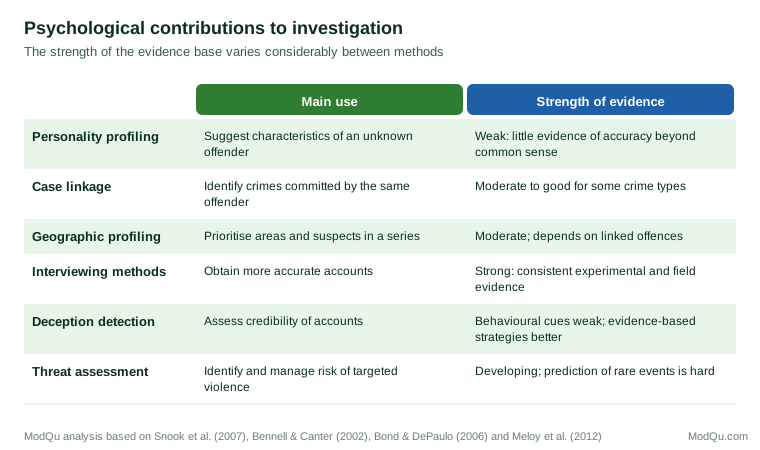
Research has been critical of this approach. Alison et al. (2002) argued that it rests on assumptions from trait psychology that behaviour is consistent across situations and that particular crime scene actions reliably reveal stable personality characteristics, assumptions that are poorly supported. Snook et al. (2007), in a review and meta-analysis, found little evidence that professional profilers predicted offender characteristics more accurately than comparison groups, and noted that much of the profiling literature relied on anecdote and common sense rather than empirical testing. A survey of forensic psychologists and psychiatrists found widespread doubts about the scientific validity of profiling, even among those who considered it useful in some cases (Torres et al., 2006).
Investigative psychology, developed by Canter (2004), takes a more empirical approach, using statistical analysis of solved cases to identify relationships between offence behaviours and offender characteristics. Its claims are more limited and more testable.
Studies of how investigators use profiles show mixed results. A Home Office survey of officers who had received profiling advice found that it rarely led directly to the identification of an offender, although officers often found it helpful in other ways, such as offering a fresh perspective or supporting interview strategy (Copson, 1995).
Profiling also carries risks. In the investigation of the murder of Rachel Nickell in London in 1992, police mounted an undercover operation, guided by a psychological profile, to obtain incriminating statements from a suspect, Colin Stagg. The trial judge excluded the evidence obtained and criticised the operation, and the prosecution collapsed (R v Stagg, 1994). Another man was later convicted of the murder. Alison et al. (2003) showed that many profile statements are vague or unsupported, and recommended that profiles be assessed by examining the evidence and reasoning behind each claim.
Case linkage
Case linkage asks whether two or more crimes were committed by the same offender, based on similarities in behaviour. It relies on two assumptions: that offenders behave consistently across their crimes, and that different offenders behave distinctively. Woodhams and Toye (2007) tested these assumptions with serial commercial robberies and found support for both, with some behaviours more consistent and distinctive than others. Bennell and Canter (2002) showed that linking commercial burglaries was most accurate when based on the distance between offence locations, rather than on details of how the offences were committed.
Case linkage has a clearer empirical basis than personality profiling, because its predictions can be tested directly on solved series. It is useful for combining evidence from several crimes, prioritising suspects and allocating resources.
Geographic profiling
Geographic profiling estimates where a serial offender is likely to live or be based from the locations of their crimes. It draws on research showing that offenders tend to commit crimes relatively close to home, but not too close, and that the likelihood of offending declines with distance. Rossmo (2000) developed a method that produces a probability surface used to prioritise suspects and areas for searches. Its value depends on there being several linked offences, and on the offender behaving like most offenders.
Interviewing and deception
Psychology has had its greatest practical impact on interviewing. Research on memory and on false confessions has led many jurisdictions to move from accusatory interrogation to information-gathering methods. Kassin et al. (2010) identified risk factors for false confessions and recommended reforms such as recording interviews in full and limiting the length of interrogations.
Research on deception has shown that people, including professionals, are poor at detecting lies from behaviour. Bond and DePaulo (2006), in a meta-analysis of more than 200 studies, found that people correctly classified truths and lies only about 54 per cent of the time, little better than chance. Vrij (2008) reviewed evidence that common beliefs about cues to deceit, such as gaze aversion and fidgeting, are largely mistaken. The polygraph has also been found to lack a sound scientific basis for detecting deception in screening contexts (National Research Council, 2003).
More promising approaches focus on the content of what people say and on how they respond to evidence. Hartwig et al. (2006) found that interviewers trained to withhold evidence and then reveal it strategically were much better at detecting deception, because liars' accounts were more likely to contradict the evidence.
Threat assessment
Threat assessment aims to identify and manage people who may pose a risk of targeted violence. Fein and Vossekuil (1999), from studies of attacks on public figures, argued that attackers rarely issue direct threats but often display other warning behaviours, and that assessment should focus on whether a person is on a pathway towards violence rather than whether they fit a profile. Meloy et al. (2012) proposed a typology of warning behaviours, such as fixation, identification with previous attackers and leakage of intent to third parties. These approaches support investigation and intervention, although predicting rare violent events remains difficult.
Psychological autopsy
When the cause of a death is uncertain, for example whether it was suicide, accident or homicide, investigators may use a psychological autopsy: a structured reconstruction of the person's mental state and circumstances before death, based on records and interviews with family and associates. Isometsä (2001) reviewed research using the method and found that it has provided consistent evidence on risk factors for suicide, although its use in individual cases relies on retrospective accounts that may be biased.
Ethical limits
Behavioural analysis raises ethical questions. Profiles and threat assessments can attach suspicion to people because of characteristics such as age, background or mental health rather than their conduct, and once recorded, such labels can follow a person long after an investigation ends. Psychologists advising investigations should stay within their competence, state the limits of their methods, and avoid offering diagnoses of people they have not assessed. Investigators should ensure that behavioural advice never substitutes for evidence of what a person actually did.
A short example
The following hypothetical case shows behavioural analysis used well. A retailer suffers a series of eight thefts from stockrooms in different stores over four months. The investigation team asks an analyst to assess whether the thefts are linked. Using records of solved cases, the analyst finds that the thefts share a narrow time window shortly before closing, the same method of entry and the same types of goods, and that these features are uncommon in other thefts across the company. The analyst concludes that the thefts are probably linked, and maps the stores to show that they cluster around two delivery routes. The team treats this as a reason to prioritise checks rather than as evidence against anyone. Delivery schedules and access records then identify one driver who was present at all eight stores at the relevant times, and stock found in the driver's possession confirms the link. Throughout, the analyst's report states its assumptions and the base rates used, and the team's conclusion rests on the access records and recovered stock, not on the behavioural analysis.
Using behavioural advice well
Investigators can gain from psychology without being misled by it. They should ask advisers to explain the evidence and reasoning behind each claim, prefer methods with empirical support and known error rates, treat behavioural advice as a way to prioritise and generate hypotheses rather than as evidence of guilt, avoid narrowing the investigation to people who fit a profile, and record how advice was used. Courts may test the reliability of expert behavioural evidence; in the United States, the Daubert v. Merrell Dow Pharmaceuticals, Inc. (1993) standard asks whether methods have been tested and have known error rates.
Conclusion
Psychology contributes to investigative knowledge in several ways. Its strongest contributions are in interviewing, where research has improved the quality of accounts and reduced false confessions, and in empirically tested methods such as case linkage and geographic profiling. Personality-based offender profiling has weak empirical support and carries risks when it narrows investigations. Behavioural cues to deception are unreliable, but evidence-based interviewing strategies can help. Investigators who use psychology as a source of tested methods and hypotheses, rather than as a substitute for evidence, gain the most from it.
References
Alison, L., Bennell, C., Mokros, A., & Ormerod, D. (2002). The personality paradox in offender profiling: A theoretical review of the processes involved in deriving background characteristics from crime scene actions. Psychology, Public Policy, and Law, 8(1), 115–135. https://doi.org/10.1037/1076-8971.8.1.115
Alison, L., Smith, M. D., Eastman, O., & Rainbow, L. (2003). Toulmin's philosophy of argument and its relevance to offender profiling. Psychology, Crime & Law, 9(2), 173–183. https://doi.org/10.1080/1068316031000116265
Bennell, C., & Canter, D. V. (2002). Linking commercial burglaries by modus operandi: Tests using regression and ROC analysis. Science & Justice, 42(3), 153–164. https://doi.org/10.1016/S1355-0306(02)71820-0
Bond, C. F., Jr., & DePaulo, B. M. (2006). Accuracy of deception judgments. Personality and Social Psychology Review, 10(3), 214–234. https://doi.org/10.1207/s15327957pspr1003_2
Canter, D. (2004). Offender profiling and investigative psychology. Journal of Investigative Psychology and Offender Profiling, 1(1), 1–15. https://doi.org/10.1002/jip.7
Copson, G. (1995). Coals to Newcastle? Part 1: A study of offender profiling (Police Research Group Special Interest Series Paper 7). Home Office.
Daubert v. Merrell Dow Pharmaceuticals, Inc., 509 U.S. 579 (1993).
Douglas, J. E., Ressler, R. K., Burgess, A. W., & Hartman, C. R. (1986). Criminal profiling from crime scene analysis. Behavioral Sciences & the Law, 4(4), 401–421. https://doi.org/10.1002/bsl.2370040405
Fein, R. A., & Vossekuil, B. (1999). Assassination in the United States: An operational study of recent assassins, attackers, and near-lethal approachers. Journal of Forensic Sciences, 44(2), 321–333. https://doi.org/10.1520/JFS14457J
Hartwig, M., Granhag, P. A., Strömwall, L. A., & Kronkvist, O. (2006). Strategic use of evidence during police interviews: When training to detect deception works. Law and Human Behavior, 30(5), 603–619. https://doi.org/10.1007/s10979-006-9053-9
Isometsä, E. T. (2001). Psychological autopsy studies: A review. European Psychiatry, 16(7), 379–385. https://doi.org/10.1016/S0924-9338(01)00594-6
Kassin, S. M., Drizin, S. A., Grisso, T., Gudjonsson, G. H., Leo, R. A., & Redlich, A. D. (2010). Police-induced confessions: Risk factors and recommendations. Law and Human Behavior, 34(1), 3–38. https://doi.org/10.1007/s10979-009-9188-6
Meloy, J. R., Hoffmann, J., Guldimann, A., & James, D. (2012). The role of warning behaviors in threat assessment: An exploration and suggested typology. Behavioral Sciences & the Law, 30(3), 256–279. https://doi.org/10.1002/bsl.999
National Research Council. (2003). The polygraph and lie detection. National Academies Press. https://doi.org/10.17226/10420
Rossmo, D. K. (2000). Geographic profiling. CRC Press.
R v Stagg (1994), Central Criminal Court, 14 September 1994 (unreported).
Snook, B., Eastwood, J., Gendreau, P., Goggin, C., & Cullen, R. M. (2007). Taking stock of criminal profiling: A narrative review and meta-analysis. Criminal Justice and Behavior, 34(4), 437–453. https://doi.org/10.1177/0093854806296925
Torres, A. N., Boccaccini, M. T., & Miller, H. A. (2006). Perceptions of the validity and utility of criminal profiling among forensic psychologists and psychiatrists. Professional Psychology: Research and Practice, 37(1), 51–58. https://doi.org/10.1037/0735-7028.37.1.51
Vrij, A. (2008). Detecting lies and deceit: Pitfalls and opportunities (2nd ed.). Wiley.
Woodhams, J., & Toye, K. (2007). An empirical test of the assumptions of case linkage and offender profiling with serial commercial robberies. Psychology, Public Policy, and Law, 13(1), 59–85. https://doi.org/10.1037/1076-8971.13.1.59