
Investigation · Method and the future
Investigation Versus Research: Overlaps and Differences
Investigation and research both gather evidence to answer questions, but they differ in purpose, scope, standards and what happens to the findings. This article compares the two and explains what each can learn from the other.
Investigators and researchers both ask questions, gather evidence, test explanations and report conclusions. A fraud examiner reconstructing a series of payments and a social scientist studying patterns of fraud use many of the same skills. Yet the two activities differ in important ways, and confusing them can cause problems: an investigation run like an open-ended study may never reach a decision, and research run like an investigation may target individuals in ways that research ethics do not allow. This article compares the two.
What they share
Both investigation and research are disciplined ways of finding out what is true. Both start from a question, form hypotheses, gather evidence systematically, look for evidence that would disprove an explanation as well as support it, and record their methods so that others can check them. Popper (1959) argued that scientific claims gain strength by surviving serious attempts to refute them, and the same principle protects investigations against confirmation bias. Both also depend on honest reporting: a researcher who hides inconvenient data and an investigator who ignores evidence pointing away from a suspect commit the same basic error.
How they differ
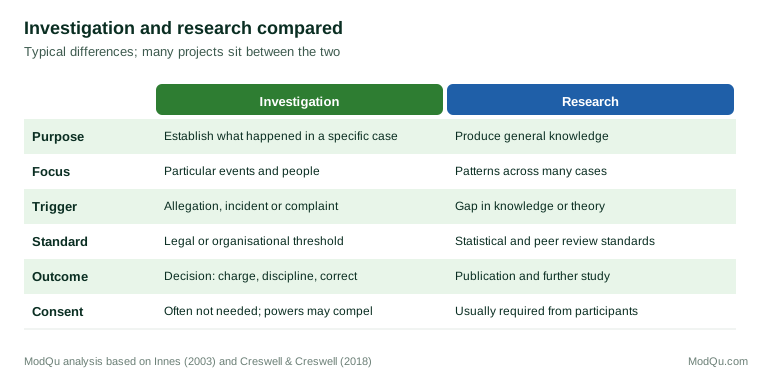
Purpose and focus. An investigation seeks to establish what happened in a particular case and who was responsible. Research seeks knowledge that applies beyond any one case. Innes (2003), in a study of homicide detectives, describes investigation as the construction of an account of a specific event that is good enough to support a decision. Research design texts, by contrast, emphasise sampling, measurement and generalisation (Creswell & Creswell, 2018).
Standards of proof. An investigation is judged against the standard its decision requires, such as the balance of probabilities in a disciplinary case. Research is judged by its methods and by peer review, and its conclusions remain provisional. Ioannidis (2005) showed that many published research findings are likely to be false because of small studies, flexible analyses and bias, which is why research relies on replication.
Ethics and consent. Research with people generally requires informed consent and independent ethical review, following principles such as respect for persons, beneficence and justice (National Commission for the Protection of Human Subjects of Biomedical and Behavioral Research, 1979). Investigations often proceed without the consent of the person being investigated and may use legal powers to compel documents or answers. They are instead constrained by law, due process and proportionality.
Time and closure. Investigations must reach a decision, often within a deadline. Research can say that more work is needed.
What each can learn from the other
Investigators can borrow research habits: writing down hypotheses before collecting evidence, considering alternative explanations, recording methods so that the work can be repeated, and being honest about uncertainty. Stelfox (2009) argues that investigations improve when they follow explicit principles of this kind rather than relying on instinct.
Researchers can learn from investigators' attention to the provenance and reliability of each source, careful documentation of evidence handling, and willingness to reach a definite conclusion when the evidence supports one.
Mistakes that come from confusing them
Treating an investigation as research can lead to drift. An inquiry into one complaint widens into a general review of a department, the original question is never answered, and the person complained about waits months for a decision. Treating research as an investigation causes the opposite problem. A study of staff attitudes that is later used to identify and discipline individual respondents breaks the promises made to participants and damages trust in all future surveys. A third mistake is to present investigation findings as if they were general truths, for example by concluding from one fraud case that a whole group of employees is untrustworthy. Each activity has its own scope, and keeping to it protects both the people involved and the credibility of the findings.
When they meet
Some work combines both. A survey company that finds suspicious responses may investigate a specific panel member while also researching patterns of fraud across its panels. In such cases, it helps to be clear which activity is being done at each moment, because the rules on consent, data use and standards of proof differ.
Conclusion
Investigation and research share a commitment to evidence, testing and honest reporting. They differ in purpose, focus, standards, ethics and the need for closure. Knowing which one is being done, and borrowing the strengths of the other, makes both more reliable.
References
Creswell, J. W., & Creswell, J. D. (2018). Research design: Qualitative, quantitative, and mixed methods approaches (5th ed.). SAGE.
Innes, M. (2003). Investigating murder: Detective work and the police response to criminal homicide. Oxford University Press.
Ioannidis, J. P. A. (2005). Why most published research findings are false. PLoS Medicine, 2(8), Article e124. https://doi.org/10.1371/journal.pmed.0020124
National Commission for the Protection of Human Subjects of Biomedical and Behavioral Research. (1979). The Belmont report: Ethical principles and guidelines for the protection of human subjects of research. U.S. Department of Health, Education, and Welfare.
Popper, K. R. (1959). The logic of scientific discovery. Hutchinson.
Stelfox, P. (2009). Criminal investigation: An introduction to principles and practice. Willan.