
Investigation · Business and corporate investigation
Financial Auditing as an Investigative Generator of Economic Knowledge
An audit is an investigation that produces knowledge others can rely on. This article explains how financial auditing gathers and weighs evidence, why markets and governments depend on what it produces, and where its knowledge runs out.
Every year, auditors examine the accounts of millions of companies, public bodies and charities. Their reports are short, often a page or two, and most readers never look past the opinion paragraph. Yet the work behind those reports is one of the largest systematic investigations carried out anywhere in the economy. Auditors gather evidence, test claims made by management, weigh the reliability of sources and reach a conclusion that others can rely on. The result is a form of knowledge: a reasoned, evidence-based judgment that the financial statements present a fair picture, or a warning that they do not.
This article looks at auditing as an investigative activity. It explains why audits exist, how auditors gather and weigh evidence, what kinds of knowledge audits produce for investors, regulators and the wider economy, and the limits of that knowledge.
Why audits exist
The modern theory of the firm explains the demand for audit. When the people who manage a business are not the people who own or finance it, managers have information that owners lack and interests that may differ from theirs. Jensen and Meckling (1976) described the costs this creates as agency costs, and identified monitoring as one way to reduce them. Watts and Zimmerman (1983) showed that audits were used voluntarily long before they were required by law, because owners and lenders wanted independent assurance about what managers reported. Auditing, in this view, exists because information provided by an interested party is worth more when someone independent has checked it.
Healy and Palepu (2001) review evidence that credible financial reporting reduces the information gap between managers and investors, which lowers the cost of capital and helps markets allocate resources. Since Ball and Brown (1968) showed that share prices respond to the information in reported earnings, research has consistently found that accounting numbers carry information that markets use. Audit is part of what makes those numbers credible.
The audit as an investigation
An audit shares the structure of other investigations. It begins with a set of claims, in this case the assertions that management makes in the financial statements: that assets exist, that transactions occurred, that amounts are complete and correctly valued, and that disclosures are adequate. The auditor's task is to gather enough appropriate evidence to reach a conclusion about whether these claims are true in all material respects (International Auditing and Assurance Standards Board [IAASB], 2009a).
Planning around risk
Auditors cannot examine everything, so they plan around risk. They study the business, its industry and its controls, identify the areas where material misstatement is most likely, and direct more effort to those areas. This is the same reasoning that investigators use when deciding where to look first: concentrate effort where the evidence is most likely to change the conclusion.
Weighing evidence
Auditing standards set out principles for judging the reliability of evidence that would be familiar to any investigator. Evidence obtained from independent external sources is generally more reliable than evidence generated inside the organisation; evidence obtained directly by the auditor is more reliable than evidence obtained indirectly; documentary evidence is more reliable than oral statements; and original documents are more reliable than copies (IAASB, 2009c).
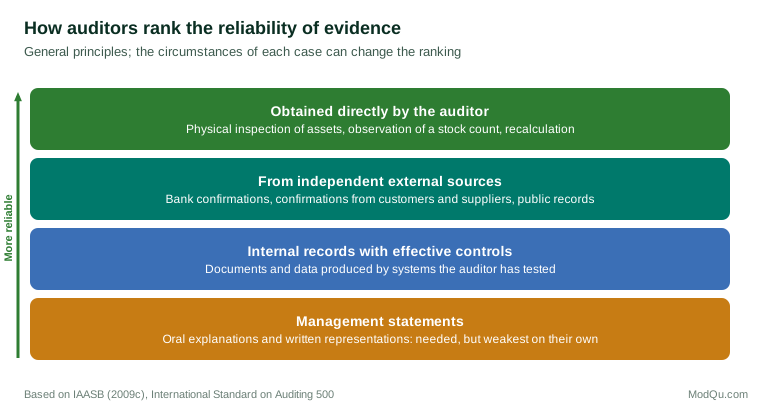
The emphasis on independent evidence reflects the core problem of audit: much of the information comes from the people whose reporting is being tested. A bank confirmation sent directly to the auditor is harder to falsify than a bank statement supplied by the client. Management's explanations are necessary, but they must be corroborated.
Professional scepticism
Standards require auditors to maintain professional scepticism, an attitude that includes a questioning mind and a critical assessment of evidence (IAASB, 2009a). Nelson (2009) reviewed research showing that scepticism is affected by the auditor's knowledge, incentives and personal traits, and by the pressures of time and client relationships. Hurtt (2010) developed a scale to measure sceptical traits and found that they vary considerably between individuals. Scepticism is, in effect, the auditor's protection against confirmation bias: the habit of asking what evidence would show the account to be wrong, not only what evidence supports it.
Fraud
Auditors are required to consider the risk that the statements are misstated because of fraud, to discuss how fraud could occur, and to respond to identified risks (IAASB, 2009b). They are not, however, required to find every fraud, and standards acknowledge that fraud involving collusion and forgery may go undetected. This is one of the most important limits on the knowledge an audit produces, and one that users of financial statements often misunderstand.
An example of audit reasoning
A simple case shows how these principles work together. A manufacturer reports a sharp rise in sales in the last month of its financial year, and receivables have grown much faster than sales over the year. The auditor treats revenue recognised near the year end as a significant risk, because it is a common area for misstatement and because the pattern fits a known warning sign. Rather than relying on sales invoices produced by the company, the auditor sends confirmation requests directly to a sample of customers with large year-end balances, examines shipping documents for sales recorded in the last weeks of the year, and reviews credit notes and returns in the first weeks of the new year.
The results are mixed. Most customers confirm their balances, but two do not reply, and the shipping records show that several large orders were dispatched only after the year end. Credit notes issued in January reverse part of December's sales. Management explains that the goods were held at customers' request and that the credit notes reflect routine pricing adjustments. The auditor tests these explanations against the contracts and correspondence, finds that the sales terms did not allow revenue to be recognised before delivery, and asks management to correct the accounts. If management refuses and the amount is material, the audit opinion will be modified. At each step, the auditor has preferred independent evidence to the company's own records, and has tested management's explanation rather than accepting it.
What knowledge audits produce
Knowledge for investors and lenders
The most direct product of an audit is assurance that the financial statements can be relied on. Investors use this information to value companies, lenders to decide whether to extend credit, and suppliers and customers to judge whether a business is sound. DeFond and Zhang (2014), reviewing archival research on auditing, conclude that higher-quality audits are associated with more credible earnings and with market responses that reflect that credibility.
Knowledge for the organisation
Audits also produce knowledge for the organisations audited. Auditors report weaknesses in internal control to management and those charged with governance, and in the United States the Sarbanes-Oxley Act of 2002 requires auditors of larger listed companies to report on the effectiveness of internal control over financial reporting. These findings can reveal problems in processes, systems and oversight that management had not recognised.
Knowledge for government and the public
Public sector audit extends the investigative function to government. Supreme audit institutions examine whether public money has been spent lawfully and whether programmes deliver value, and international standards set out the principles for this work (International Organization of Supreme Audit Institutions [INTOSAI], 2019). Performance audits by bodies such as the United States Government Accountability Office produce detailed evidence about how government programmes work, under standards that require sufficient, appropriate evidence for every finding (U.S. Government Accountability Office [GAO], 2018).
Knowledge about audit itself
The supply of audits has also been studied as an economic market. Simunic (1980) modelled the pricing of audit services and found that fees reflect the size and complexity of the client and the risk involved. DeAngelo (1981) argued that larger audit firms have more to lose from a damaged reputation and therefore stronger incentives to provide high-quality audits. Francis (2004), reviewing what was known about audit quality, concluded that outright audit failures are relatively rare but that quality varies in ways that matter to users.
The limits of audit knowledge
Audit failures show where the knowledge runs out. When large companies have collapsed shortly after receiving clean audit opinions, public inquiries have asked what the audit actually established. A parliamentary inquiry into the collapse of the construction and services company Carillion in 2018 was sharply critical of the company's auditors and of the regulatory system (House of Commons Business, Energy and Industrial Strategy and Work and Pensions Committees, 2018). Reviews that followed in the United Kingdom recommended replacing the audit regulator (Kingman, 2018) and broadening the scope of audit so that it addresses questions users care about, such as resilience and the risk of fraud, more directly (Brydon, 2019).
These reviews identified an "expectation gap" between what users believe an audit provides and what it is designed to provide. An audit gives reasonable, not absolute, assurance; it works on samples; it relies partly on information from management; and it addresses the financial statements, not the wisdom of the business model or the competence of its leaders. Power (1997) argued more broadly that the spread of audit across society has sometimes created "rituals of verification" in which the appearance of checking substitutes for real understanding. The investigative value of an audit depends on whether it genuinely tests claims or merely confirms that procedures were followed.
Lessons for other investigators
Auditing offers several lessons for investigators in other fields. It shows the value of stating precisely which claims are being tested. It provides a practical ranking of evidence by source and independence. It treats scepticism as a professional duty rather than a personal disposition. And it makes clear, in its standards and its opinion, what level of assurance has been reached and what has not been examined. Each of these practices makes the knowledge an investigation produces more reliable and more honest about its limits.
References
Ball, R., & Brown, P. (1968). An empirical evaluation of accounting income numbers. Journal of Accounting Research, 6(2), 159–178. https://doi.org/10.2307/2490232
Brydon, D. (2019). Assess, assure and inform: Improving audit quality and effectiveness. Report of the independent review into the quality and effectiveness of audit.
DeAngelo, L. E. (1981). Auditor size and audit quality. Journal of Accounting and Economics, 3(3), 183–199. https://doi.org/10.1016/0165-4101(81)90002-1
DeFond, M., & Zhang, J. (2014). A review of archival auditing research. Journal of Accounting and Economics, 58(2–3), 275–326. https://doi.org/10.1016/j.jacceco.2014.09.002
Francis, J. R. (2004). What do we know about audit quality? The British Accounting Review, 36(4), 345–368. https://doi.org/10.1016/j.bar.2004.09.003
Healy, P. M., & Palepu, K. G. (2001). Information asymmetry, corporate disclosure, and the capital markets: A review of the empirical disclosure literature. Journal of Accounting and Economics, 31(1–3), 405–440. https://doi.org/10.1016/S0165-4101(01)00018-0
House of Commons Business, Energy and Industrial Strategy and Work and Pensions Committees. (2018). Carillion (HC 769).
Hurtt, R. K. (2010). Development of a scale to measure professional skepticism. Auditing: A Journal of Practice & Theory, 29(1), 149–171. https://doi.org/10.2308/aud.2010.29.1.149
International Auditing and Assurance Standards Board. (2009a). International Standard on Auditing 200: Overall objectives of the independent auditor and the conduct of an audit in accordance with International Standards on Auditing. International Federation of Accountants.
International Auditing and Assurance Standards Board. (2009b). International Standard on Auditing 240: The auditor's responsibilities relating to fraud in an audit of financial statements. International Federation of Accountants.
International Auditing and Assurance Standards Board. (2009c). International Standard on Auditing 500: Audit evidence. International Federation of Accountants.
International Organization of Supreme Audit Institutions. (2019). ISSAI 100: Fundamental principles of public-sector auditing.
Jensen, M. C., & Meckling, W. H. (1976). Theory of the firm: Managerial behavior, agency costs and ownership structure. Journal of Financial Economics, 3(4), 305–360. https://doi.org/10.1016/0304-405X(76)90026-X
Kingman, J. (2018). Independent review of the Financial Reporting Council.
Nelson, M. W. (2009). A model and literature review of professional skepticism in auditing. Auditing: A Journal of Practice & Theory, 28(2), 1–34. https://doi.org/10.2308/aud.2009.28.2.1
Power, M. (1997). The audit society: Rituals of verification. Oxford University Press.
Sarbanes-Oxley Act of 2002, Pub. L. No. 107-204, 116 Stat. 745.
Simunic, D. A. (1980). The pricing of audit services: Theory and evidence. Journal of Accounting Research, 18(1), 161–190. https://doi.org/10.2307/2490397
U.S. Government Accountability Office. (2018). Government auditing standards: 2018 revision (GAO-18-568G).
Watts, R. L., & Zimmerman, J. L. (1983). Agency problems, auditing, and the theory of the firm: Some evidence. The Journal of Law and Economics, 26(3), 613–633. https://doi.org/10.1086/467051