
Intelligence · Concepts and history
Sherman Kent and the Founding of Intelligence Analysis as a Discipline
Sherman Kent, a Yale historian, did more than anyone to turn intelligence analysis into a profession with its own methods, standards and literature. This article covers Kent's career, main ideas and legacy, the debates the ideas provoked, and what the legacy means for analysts today.
Every profession has its founders: people who define its purpose, set its standards and give it a vocabulary. For intelligence analysis in the English-speaking world, the most important of these is Sherman Kent. A historian by training, Kent spent most of a long career at the Central Intelligence Agency, leading the office responsible for national intelligence estimates for fifteen years. Kent wrote the first serious book on strategic intelligence, founded the profession's main journal and argued, long before it was fashionable, that analysts should express uncertainty in numbers. The American intelligence community's school for analysts bears Kent's name. This article explains who Kent was, what Kent argued and why Kent's ideas still matter, including to analysts working far from government.
From Yale to the OSS
Kent was born in 1903 and trained as a historian at Yale University, teaching European history there in the 1930s. The scholarly work was in French history, and Kent also wrote a practical guide for students on historical research and writing. That experience of weighing documentary evidence, assessing sources and constructing careful arguments would shape everything Kent later wrote about intelligence.
When the United States entered the Second World War, many academics joined the new Office of Strategic Services (OSS). Kent joined its Research and Analysis Branch, which brought together historians, economists, geographers and political scientists to produce studies for military planners and policymakers. Katz (1989) describes how the branch developed methods for turning scattered open and secret information into assessments of foreign economies, transport systems and political conditions. Winks (1987) shows how Yale in particular supplied many of the scholars who staffed American wartime intelligence, and how the experience left a lasting mark on both the universities and the agencies that followed. Kent rose to head the branch's Europe–Africa division.
Strategic Intelligence for American World Policy
After the war Kent taught at the National War College and then returned to Yale, where Kent wrote Strategic Intelligence for American World Policy (Kent, 1949). The book set out, for the first time in a systematic way, what intelligence for national policy should be and how it should be produced.
Kent's starting point was a three-part definition. Intelligence, Kent wrote, is knowledge: the knowledge that leaders must have about other states to protect national interests. It is organisation: the institutions that produce that knowledge. And it is activity: the work of research, analysis and reporting. Kent divided the knowledge itself into three time frames. Basic descriptive intelligence describes the relatively stable features of a foreign state, such as its geography, economy and political institutions. Current reportorial intelligence keeps that description up to date by tracking events. Speculative–evaluative intelligence, the most demanding kind, estimates what a foreign state is likely to do in the future and why.
Kent argued that strategic intelligence should be produced in the manner of good scholarship. Analysts should state the problem clearly, collect all relevant evidence, evaluate it critically, consider alternative hypotheses, reach conclusions that the evidence supports, and present them so that others could check the reasoning. Kent was well aware that intelligence lacked the leisure of academic research, but Kent thought the same intellectual standards should apply.
Kent also took a firm position on the relationship between intelligence and policy. Analysts, Kent argued, should be close enough to policymakers to understand their needs, but not so close that they lose their objectivity or become advocates for particular policies. Too much distance makes intelligence irrelevant; too little makes it a servant of preferences.
The Kent–Kendall debate
Kent's book drew a sharp review from Willmoore Kendall, a political scientist who had also served in wartime intelligence. Kendall (1949) argued that Kent's model was too narrow. In Kendall's view, Kent treated intelligence as a research service that described the outside world for policymakers to act on, as though the world were a fixed object to be studied. Kendall wanted intelligence to help policymakers understand how American action could shape events, and Kent thought analysts should engage more directly with the policy process and the political debate surrounding it.
Davis (1992) describes this exchange as a defining debate for the profession. Kent's model of the detached, scholarly analyst became dominant in American practice, but Kendall's concerns about relevance and engagement never disappeared. They resurface whenever critics argue that intelligence products are accurate but unused, or that analysts should work alongside decision-makers rather than delivering finished reports to them.
The Office of National Estimates
In 1950, after the failure to anticipate Chinese intervention in the Korean War exposed weaknesses in American estimative intelligence, the Central Intelligence Agency created an Office of National Estimates. Kent joined it as deputy to the historian William Langer and became its director in 1952, a post Kent held until 1967. The office and its Board of National Estimates produced National Intelligence Estimates: coordinated assessments, agreed among the intelligence agencies, of issues such as Soviet military power, the stability of foreign governments and the likely course of conflicts. Steury (1994) collects Kent's essays from this period, many written for internal audiences and declassified later, which show Kent working out in practice how estimates should be drafted, coordinated and defended.
Kent placed great weight on the estimative process itself: careful drafting by analysts, challenge by colleagues from other agencies, review by a board of senior figures, and frank recording of dissent. Kent believed the process made estimates better than any single analyst could and gave policymakers a judgement they could trust.
A famous miss: Cuba, 1962
The estimates were not always right. In September 1962 a Special National Intelligence Estimate concluded that the Soviet Union was unlikely to place offensive nuclear missiles in Cuba, on the grounds that doing so would be inconsistent with past Soviet behaviour and too risky. Weeks later, reconnaissance photographs showed the missiles being installed. Knorr (1964), analysing the episode, argued that the estimators had reasoned plausibly from Soviet precedent but had underweighted the possibility that Soviet leaders would take a gamble they had never taken before. Allison (1969) later showed how different analytic models of government decision-making could produce very different explanations of Soviet behaviour in the crisis.
Kent defended the estimate in an essay for internal readers, arguing that the reasoning was sound given the evidence available and that the Soviet decision was itself a miscalculation (Steury, 1994). The case nonetheless became a classic illustration of the risk of judging an adversary by what one would consider rational, a theme that Heuer (1999) later developed in work on the psychology of analysis. Jervis (2010) returns to similar problems in Kent's study of later intelligence failures.
Estimating when you do not know
Kent's essays from the years at the Office of National Estimates return repeatedly to the nature of estimating itself. Kent insisted that an estimate is not a prediction dressed up as fact. It is a reasoned judgement about matters that cannot be known with certainty, usually because they depend on decisions that foreign leaders have not yet made or on information that is hidden. In one of Kent's best-known formulations, Kent observed that estimating is what you do when you do not know (Steury, 1994). The estimator's job is therefore to narrow the range of plausible outcomes, show which are more likely and why, and identify what evidence would change the judgement.
This view had practical consequences. Kent wanted estimates to separate what was known from what was inferred, and inferences from guesses. Analysts were to say explicitly when the evidence was thin, rather than to cover gaps with confident prose. Estimates were also to address the questions policymakers would actually face, even when the honest answer was uncertain, rather than retreat into description because description was safer.
Kent was equally concerned about the influence of estimates. In Kent's view an estimate that no one read, or that policymakers dismissed, had failed regardless of its accuracy. This is why Kent cared about clarity of writing, about timing estimates to arrive before decisions, and about the credibility that came from a record of honest judgements, including honest admissions of error. These concerns anticipate later research on how intelligence is used, which finds that the relationship between analyst and decision-maker matters at least as much as the quality of the analysis itself.
For a business analyst the lesson translates directly. A market forecast, a competitor assessment or a risk estimate is valuable not because it is certain but because it makes the uncertainty explicit and usable. Separating evidence, inference and assumption, and stating how confident one is, allows decision-makers to judge how much weight to give the analysis and what to watch for next.
Words of estimative probability
Kent's most enduring practical contribution concerns language. Kent had noticed that estimates used words such as "probable", "likely" and "serious possibility" without any agreement on what they meant. In one well-known case, an estimate had stated that an attack on Yugoslavia was a "serious possibility". When Kent asked colleagues who had agreed the text what odds they had in mind, their answers ranged from roughly 20% to 80%. The same words had meant very different things to the people who signed them, and presumably to the policymakers who read them.
In an essay titled "Words of Estimative Probability", Kent (1964) proposed that analysts link each probability expression to a range of numerical odds. Kent's table assigned, for example, "almost certain" to about 93% (give or take about 6%), "probable" to about 75% (give or take about 12%), "chances about even" to about 50%, "probably not" to about 30% and "almost certainly not" to about 7%.
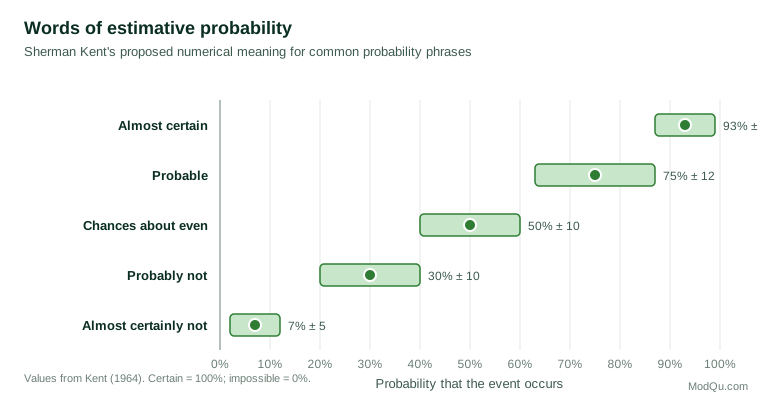
Kent described the resistance to the proposal in vivid terms. Some colleagues, labelled the "mathematicians", welcomed numbers; others, the "poets", felt that probability could not be quantified in political judgements and that numbers would convey false precision. Kent's proposal was not adopted at the time.
The problem Kent identified has since been confirmed by research. Mosteller and Youtz (1990), reviewing studies of how people interpret probability words, found wide variation in the numbers assigned to the same expression. Friedman and Zeckhauser (2012) argue that intelligence assessments routinely fail to convey uncertainty clearly and that this weakens their usefulness. Dhami and Mandel (2021) review evidence that numeric probabilities communicate more accurately than words and that analysts can provide them reliably. Barnes (2016), describing a Canadian intelligence unit that adopted numeric probabilities, reports that analysts adapted to the practice and that their forecasts proved well calibrated. Many agencies now publish standard tables linking probability words to numerical ranges, a direct descendant of Kent's proposal.
Building a literature
Kent believed that intelligence could become a true profession only if practitioners wrote down and debated what they learned. In "The Need for an Intelligence Literature", Kent argued that intelligence lacked the body of writing on method and theory that every mature discipline possesses, and that without it each generation would have to relearn the same lessons (Kent, 1955). The essay appeared in the first issue of Studies in Intelligence, the agency's professional journal, which Kent helped found and which continues to publish today.
Davis (2002) summarises the principles that Kent's colleagues and successors drew from Kent's work: a commitment to substantive expertise, rigorous standards of evidence, objectivity, clarity of expression, explicit treatment of uncertainty, and service to the policymaker without capture by policy.
Kent's legacy and its critics
Kent's influence is visible throughout modern intelligence practice. Lowenthal (2022) describes the National Intelligence Estimate process Kent shaped as the model for formal, coordinated assessment. Andrew (2018) places Kent among the figures who made American intelligence analysis distinctive. The Central Intelligence Agency named its school for analysts after Kent in 2000.
Kent's model also has critics. Johnston (2005), studying analytic practice decades later, found that the scholarly ideal Kent described was often squeezed out by the pressure of current reporting, and that analysts received little training in the methods Kent took for granted. Marrin (2012) argues that intelligence analysis still lacks the systematic evidence base about what works that Kent hoped a professional literature would supply. Others revive Kendall's critique, arguing that the detached-scholar model makes intelligence less useful to decision-makers than it could be.
What Kent offers analysts today
For analysts in business and public bodies, Kent's legacy can be summarised in five habits:
- Know which question you are answering. Distinguish basic description, current reporting and estimates of the future, because each needs different methods and evidence.
- Apply scholarly standards under time pressure. State the problem, weigh the evidence, consider alternatives and show the reasoning, even in a short product.
- Say what the words mean. Link probability expressions to numbers, or use numbers directly, so that readers understand the uncertainty as intended.
- Use challenge as a quality check. Coordinated review, in which colleagues from different perspectives test a draft, improves judgements and records dissent.
- Write things down. Record methods, lessons and mistakes so that the next analyst does not start from scratch.
Kent's career shows that intelligence analysis is not merely a by-product of collection but a discipline in its own right, with standards that can be taught and improved. That idea, more than any single estimate, is Kent's lasting contribution.
References
Allison, G. T. (1969). Conceptual models and the Cuban missile crisis. American Political Science Review, 63(3), 689–718. https://doi.org/10.2307/1954423
Andrew, C. (2018). The secret world: A history of intelligence. Yale University Press.
Barnes, A. (2016). Making intelligence analysis more intelligent: Using numeric probabilities. Intelligence and National Security, 31(3), 327–344. https://doi.org/10.1080/02684527.2014.994955
Davis, J. (1992). The Kent-Kendall debate of 1949. Studies in Intelligence, 35(2), 91–103.
Davis, J. (2002). Sherman Kent and the profession of intelligence analysis (Occasional Papers, Vol. 1, No. 5). Sherman Kent Center for Intelligence Analysis.
Dhami, M. K., & Mandel, D. R. (2021). Words or numbers? Communicating probability in intelligence analysis. American Psychologist, 76(3), 549–560. https://doi.org/10.1037/amp0000637
Friedman, J. A., & Zeckhauser, R. (2012). Assessing uncertainty in intelligence. Intelligence and National Security, 27(6), 824–847. https://doi.org/10.1080/02684527.2012.708275
Heuer, R. J., Jr. (1999). Psychology of intelligence analysis. Center for the Study of Intelligence, Central Intelligence Agency.
Jervis, R. (2010). Why intelligence fails: Lessons from the Iranian Revolution and the Iraq War. Cornell University Press.
Johnston, R. (2005). Analytic culture in the US intelligence community: An ethnographic study. Center for the Study of Intelligence, Central Intelligence Agency.
Katz, B. M. (1989). Foreign intelligence: Research and analysis in the Office of Strategic Services, 1942–1945. Harvard University Press.
Kendall, W. (1949). The function of intelligence. World Politics, 1(4), 542–552. https://doi.org/10.2307/2008837
Kent, S. (1949). Strategic intelligence for American world policy. Princeton University Press.
Kent, S. (1955). The need for an intelligence literature. Studies in Intelligence, 1(1), 1–11.
Kent, S. (1964). Words of estimative probability. Studies in Intelligence, 8(4), 49–65.
Knorr, K. (1964). Failures in national intelligence estimates: The case of the Cuban missiles. World Politics, 16(3), 455–467. https://doi.org/10.2307/2009582
Lowenthal, M. M. (2022). Intelligence: From secrets to policy (9th ed.). CQ Press.
Marrin, S. (2012). Improving intelligence analysis: Bridging the gap between scholarship and practice. Routledge.
Mosteller, F., & Youtz, C. (1990). Quantifying probabilistic expressions. Statistical Science, 5(1), 2–12. https://doi.org/10.1214/ss/1177012242
Steury, D. P. (Ed.). (1994). Sherman Kent and the Board of National Estimates: Collected essays. Center for the Study of Intelligence, Central Intelligence Agency.
Winks, R. W. (1987). Cloak and gown: Scholars in the secret war, 1939–1961. William Morrow.