
Insights · Insight quality and pitfalls
The Danger of Anecdote-Driven Insight
Why single vivid stories so often outweigh systematic evidence in organisations, what research on availability, vividness and narrative persuasion shows, how anecdotes distort priorities, and how to use stories responsibly alongside data.
A senior manager hears from a friend that the company's customer service was rude. A board member reads one furious review. A salesperson describes a lost deal in vivid detail. Within days, the story has reshaped priorities, and a project is under way to fix a problem that may affect very few customers. Meanwhile, a systematic survey showing a different and larger problem sits unread.
Anecdote-driven insight is the tendency to let individual stories, rather than systematic evidence, determine what organisations believe about their customers, markets and performance. Stories are powerful and often useful, but when they substitute for evidence rather than illustrate it, they can lead organisations seriously astray. This article explains why anecdotes are so persuasive, how they distort judgement, and how to use them well.
Why anecdotes are persuasive
Research on judgement offers several explanations for the power of anecdotes.
Availability. Tversky and Kahneman (1973) showed that people judge how frequent or likely something is by how easily examples come to mind, a shortcut they called the availability heuristic. Tversky and Kahneman (1974) described how this and other heuristics, though often useful, lead to predictable errors. Events that are vivid, recent or personally experienced come to mind more easily and are therefore judged more common than they are. Lichtenstein et al. (1978) asked people to estimate the frequency of different causes of death and found that dramatic, well-publicised causes were overestimated while common, quiet causes were underestimated.
Vividness. Nisbett and Ross (1980) argued that vivid, concrete, personal information has a disproportionate influence on judgement compared with abstract, statistical information, even when the statistical information is more informative. Borgida and Nisbett (1977) found that students choosing courses were more influenced by brief face-to-face comments from a few students than by a statistical summary of evaluations from many students. Taylor and Thompson (1982) later reviewed the evidence and found that the "vividness effect" was less consistent in laboratory experiments than often assumed, but that concrete case information was nonetheless frequently weighted more heavily than base rates.
Neglect of sample quality. Hamill et al. (1980) showed participants a vivid description of a single welfare recipient and found that it changed their attitudes about welfare recipients in general, even when they were told explicitly that the case was highly atypical. People generalised from a single case without adjusting for how unrepresentative it was.
Identifiable individuals. Jenni and Loewenstein (1997) examined the "identified victim effect", the tendency to respond more strongly to identified individuals than to statistical groups. Small et al. (2007) found that people gave more to help an identified child than to a cause described with statistics, and that adding statistics to the story of the child reduced giving rather than increasing it.
Narrative transportation. Green and Brock (2000) found that people who became absorbed in a story, or "transported" into it, were more likely to adopt beliefs consistent with the story and less likely to notice its flaws. A good story bypasses the scrutiny that a statistic would receive.
How strong is the effect?
Meta-analyses suggest that the relative power of stories and statistics depends on the situation. Allen and Preiss (1997) combined studies comparing narrative and statistical evidence and found that statistical evidence was, on average, somewhat more persuasive. Shen et al. (2015) found that narratives had a small but reliable persuasive effect in health communication. Freling et al. (2020) conducted a meta-analysis specifically of the "anecdotal bias", the tendency to rely on anecdotes over statistical evidence in decisions, and found that anecdotes were more influential than statistics in some conditions, particularly when the topic was emotionally engaging and when the decision involved personal risk, and less influential in others.
The evidence therefore does not say that stories always beat statistics. It says that stories have a disproportionate influence in exactly the situations where emotions run high and decisions feel personal, which describes many business decisions about customers and reputation.
Studies in medicine show the practical stakes. Ubel et al. (2001) found that including patient testimonials in decision aids changed people's treatment choices, depending on which testimonials were included, even when statistical information was also provided. Fagerlin et al. (2005) found that anecdotes influenced hypothetical treatment choices, and that presenting statistics visually reduced but did not eliminate their influence.
How anecdotes distort organisational insight
In organisations, anecdotes travel in particular ways, which creates systematic distortions.
Who tells the story. Stories reach decision makers through particular channels: senior managers' personal experiences, complaints escalated to the chief executive, salespeople's accounts of lost deals, and media coverage. These channels favour certain kinds of story. Complaints that reach senior managers are usually from the most persistent or well-connected customers, not from typical ones.
Survivorship and success stories. Denrell (2003) showed that when people learn from visible cases, they tend to see only the survivors, since failures disappear. Managers who study successful companies or products, without studying the failures that followed the same strategies, can draw exactly the wrong lessons. Rosenzweig (2007) argued that many popular business books draw conclusions from stories of successful firms that are distorted by the "halo effect": once a firm is known to be successful, everything about it, its culture, its leadership, its strategy, is described in glowing terms, so that the stories explain success after the fact rather than predicting it.
Preference for soft information. Mintzberg (1973) observed that managers rely heavily on verbal, informal information, such as conversations, gossip and anecdotes, rather than on formal reports. This is not irrational, since such information is current and rich, but it makes managers especially exposed to anecdotes that happen to reach them.
Confirmation. Anecdotes are easy to find for almost any belief. Gilovich (1991) described how people use selected examples to support beliefs that are not supported by systematic evidence, and how stories that confirm what people already think are more readily remembered and repeated.
Base rates and the single case
At the heart of anecdotal reasoning is the neglect of base rates, the background frequency of an event in the relevant population. Bar-Hillel (1980) reviewed research on the base-rate fallacy and found that people tend to ignore base rates when they are given specific, individuating information about a case, unless the base rate is made causally relevant or the specific information is clearly uninformative. A story about one customer is individuating information of exactly this kind. It crowds out the question of how many customers are like that one.
In business, the base-rate question has several forms. Out of how many customers did this complaint arise? How many customers had the same experience without complaining? How many deals were lost for the reason the salesperson describes, compared with other reasons? How often did the strategy that worked for this famous company fail for others? Asking these questions routinely, whenever a story is used to support a decision, brings the relevant base rate back into view.
A useful discipline is to express a story in terms of its likely frequency before discussing what to do about it. "A customer was kept on hold for forty minutes" becomes "our data show that about 3% of calls wait more than thirty minutes, around 4,000 calls a month". The second statement may be just as alarming, or much less so, but it supports a proportionate response.
Anecdotes inside insight teams
Insight teams are not immune. Researchers who conduct interviews remember the most articulate and emotional participants best, and these participants' words tend to dominate reports and presentations. An analyst who has spent an hour with a frustrated customer may weight that conversation more heavily than a survey of thousands. Presentations built around a few powerful video clips can leave audiences with an impression that the underlying analysis does not support.
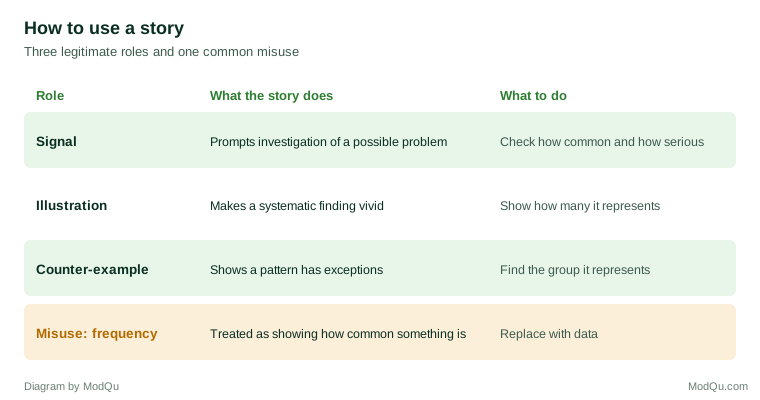
Several habits help. Code interview data systematically before choosing quotations. Keep a record of how many participants expressed each theme, and show it alongside quotes. When selecting video clips or case studies, choose ones that represent common patterns, and say so explicitly. Include at least one counter-example, so that audiences see that the picture is not uniform. And review final presentations with the question: if someone remembered only the stories, would they have an accurate picture of the evidence?
Building an evidence habit
Organisational routines can reduce reliance on anecdotes. Decision papers can include a standard section stating the evidence behind each claim and its source, distinguishing systematic data from individual cases. Meetings can adopt a simple rule that any story offered in support of a decision is followed by the question "how common is this?" Dashboards can show the frequency of complaint types and customer problems alongside selected verbatim comments, so that stories are always seen in context. And senior leaders can model the behaviour by asking for base rates themselves, which signals that evidence matters more than the vividness of a story.
None of this requires discouraging stories. Customers' stories are often the most direct route to understanding what an experience is like, and they can motivate action in a way that numbers rarely do. The aim is to make sure that the stories that shape decisions are representative of the evidence, rather than a substitute for it.
The opposite error
Dismissing all anecdotes is also a mistake. A single story can reveal a problem that systematic measures miss: a new kind of failure, a vulnerable group of customers, or a risk that has not yet produced many cases. Critical incident research, as developed by Flanagan (1954), is built on the value of specific stories. In medicine and aviation, individual incident reports are an important source of safety learning, precisely because rare events matter.
The question is not whether to use stories but how. An anecdote can be a signal that prompts investigation, an illustration that makes a systematic finding understandable, or a counter-example that shows a general pattern has exceptions. It should not be used as evidence of how common something is.
Rare but serious cases
Some problems are rare but serious: a product that occasionally injures someone, a process that sometimes exposes customers' personal data, or a service failure that affects a vulnerable customer badly. For such problems, a single case may be enough to justify action, because the cost of the problem is high even if its frequency is low. Systematic measures designed to track common experiences may miss these cases entirely, and stories may be the only early warning.
The right response to a serious anecdote is therefore neither to dismiss it as unrepresentative nor to treat it as typical. It is to ask two questions separately: how often could this happen, and how bad is it when it does? A story that reveals a rare but severe risk deserves investigation of its causes and of whether similar cases have gone unreported. A story about a minor irritation affecting one customer deserves to be logged and compared with the systematic data, but not to redirect a strategy.
Using anecdotes responsibly
Pfeffer and Sutton (2006) argued for evidence-based management, in which decisions are based on the best available evidence rather than on habit, imitation or stories. Rousseau (2006) described evidence-based management as combining research findings, organisational data, practitioner judgement and the values of those affected. Within this approach, anecdotes have a place, but a defined one.
Several practices help.
Treat a story as a hypothesis. When a vivid anecdote arrives, ask how common the problem is and check with data before acting.
Ask where the story came from. Consider the channel through which it arrived and whether stories from that channel are typical.
Pair stories with numbers. When using a quotation or case to illustrate a finding, show how many customers it represents. Sandelowski (1994) and Corden and Sainsbury (2006) emphasised that quotations in qualitative research should be chosen to represent patterns fairly, not simply because they are striking.
Look for the missing stories. Ask what stories are not being told: from customers who leave quietly, from failures that are not discussed, from groups that do not complain.
Use visual displays of data. Fagerlin et al. (2005) found that visual presentations of statistics reduced the influence of anecdotes. Simple charts that show how often something happens can help balance a powerful story.
Choose representative stories deliberately. Stories are memorable, as Heath and Heath (2007) described. That is a reason to choose them carefully: once the data have shown what is common and important, a representative story can make that finding stick.
An example
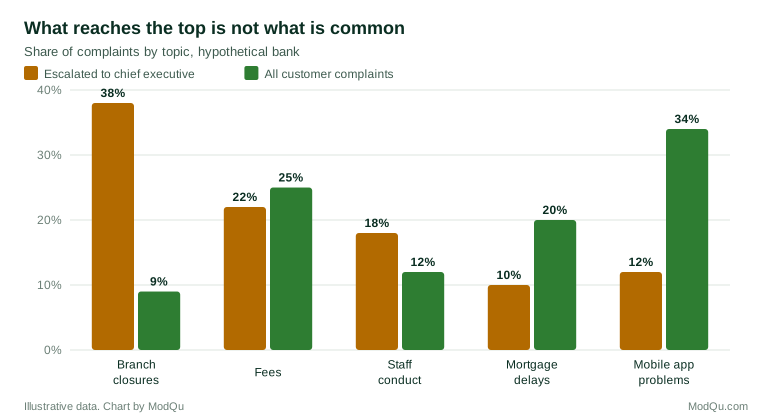
Consider a hypothetical bank whose chief executive receives a series of angry letters about branch closures. The letters are moving, and several come from long-standing customers. The executive team considers halting the closure programme.
The insight team is asked for a view. It reviews all complaints received over the past year and finds that branch closures account for a large share of complaints escalated to the chief executive, but a small share of all complaints. The largest category overall is problems with the mobile app, which rarely reach the executive because the customers affected tend to complain through the app itself. A survey of customers in areas where branches have closed finds that most have switched to other channels without difficulty, but that a minority, mainly older customers and those without reliable internet access, have been seriously affected.
The bank changes its plan. It continues the closure programme but introduces targeted support for affected customers, including telephone appointments and partnerships with local post offices. It also launches a project to fix the app problems that the systematic data revealed. When the executive team reports the decision to the board, it uses two of the letters to illustrate the experience of the customers most affected, alongside the survey figures showing how many customers that experience represents. The stories are still there, but now they sit on top of the evidence rather than in place of it, and the board can see both the human cost and its scale. The anecdotes were not wrong: they pointed to a real problem for a real group of customers. But taken alone, they would have led the bank to misjudge both the size of that problem and the existence of a larger one.
Key takeaways
Anecdotes are persuasive because they are vivid, easy to recall, emotionally engaging and about identifiable people. Research shows that people often generalise from single cases even when told they are atypical, and that stories can outweigh statistics, especially in emotional and personal decisions. In organisations, the stories that reach decision makers are not a random sample: they come from particular channels, over-represent successes and the most vocal customers, and often confirm existing beliefs. Anecdotes are valuable as signals, illustrations and counter-examples, but not as measures of how common something is. Treating stories as hypotheses, checking their source, pairing them with numbers and choosing representative ones deliberately allows organisations to benefit from stories without being misled by them.
References
Allen, M., & Preiss, R. W. (1997). Comparing the persuasiveness of narrative and statistical evidence using meta-analysis. Communication Research Reports, 14(2), 125–131. https://doi.org/10.1080/08824099709388654
Bar-Hillel, M. (1980). The base-rate fallacy in probability judgments. Acta Psychologica, 44(3), 211–233. https://doi.org/10.1016/0001-6918(80)90046-3
Borgida, E., & Nisbett, R. E. (1977). The differential impact of abstract vs. concrete information on decisions. Journal of Applied Social Psychology, 7(3), 258–271. https://doi.org/10.1111/j.1559-1816.1977.tb00750.x
Corden, A., & Sainsbury, R. (2006). Using verbatim quotations in reporting qualitative social research: Researchers' views. Social Policy Research Unit, University of York.
Denrell, J. (2003). Vicarious learning, undersampling of failure, and the myths of management. Organization Science, 14(3), 227–243. https://doi.org/10.1287/orsc.14.3.227.15164
Fagerlin, A., Wang, C., & Ubel, P. A. (2005). Reducing the influence of anecdotal reasoning on people's health care decisions: Is a picture worth a thousand statistics? Medical Decision Making, 25(4), 398–405. https://doi.org/10.1177/0272989X05278931
Flanagan, J. C. (1954). The critical incident technique. Psychological Bulletin, 51(4), 327–358. https://doi.org/10.1037/h0061470
Freling, T. H., Yang, Z., Saini, R., Itani, O. S., & Abualsamh, R. R. (2020). When poignant stories outweigh cold hard facts: A meta-analysis of the anecdotal bias. Organizational Behavior and Human Decision Processes, 160, 51–67. https://doi.org/10.1016/j.obhdp.2020.01.006
Gilovich, T. (1991). How we know what isn't so: The fallibility of human reason in everyday life. Free Press.
Green, M. C., & Brock, T. C. (2000). The role of transportation in the persuasiveness of public narratives. Journal of Personality and Social Psychology, 79(5), 701–721. https://doi.org/10.1037/0022-3514.79.5.701
Hamill, R., Wilson, T. D., & Nisbett, R. E. (1980). Insensitivity to sample bias: Generalizing from atypical cases. Journal of Personality and Social Psychology, 39(4), 578–589. https://doi.org/10.1037/0022-3514.39.4.578
Heath, C., & Heath, D. (2007). Made to stick: Why some ideas survive and others die. Random House.
Jenni, K. E., & Loewenstein, G. (1997). Explaining the "identified victim effect". Journal of Risk and Uncertainty, 14(3), 235–257. https://doi.org/10.1023/A:1007740225484
Lichtenstein, S., Slovic, P., Fischhoff, B., Layman, M., & Combs, B. (1978). Judged frequency of lethal events. Journal of Experimental Psychology: Human Learning and Memory, 4(6), 551–578. https://doi.org/10.1037/0278-7393.4.6.551
Mintzberg, H. (1973). The nature of managerial work. Harper & Row.
Nisbett, R. E., & Ross, L. (1980). Human inference: Strategies and shortcomings of social judgment. Prentice-Hall.
Pfeffer, J., & Sutton, R. I. (2006). Evidence-based management. Harvard Business Review, 84(1), 62–74.
Rosenzweig, P. (2007). The halo effect... and the eight other business delusions that deceive managers. Free Press.
Rousseau, D. M. (2006). Is there such a thing as "evidence-based management"? Academy of Management Review, 31(2), 256–269. https://doi.org/10.5465/amr.2006.20208679
Sandelowski, M. (1994). The use of quotes in qualitative research. Research in Nursing & Health, 17(6), 479–482. https://doi.org/10.1002/nur.4770170611
Shen, F., Sheer, V. C., & Li, R. (2015). Impact of narratives on persuasion in health communication: A meta-analysis. Journal of Advertising, 44(2), 105–113. https://doi.org/10.1080/00913367.2015.1018467
Small, D. A., Loewenstein, G., & Slovic, P. (2007). Sympathy and callousness: The impact of deliberative thought on donations to identifiable and statistical victims. Organizational Behavior and Human Decision Processes, 102(2), 143–153. https://doi.org/10.1016/j.obhdp.2006.01.005
Taylor, S. E., & Thompson, S. C. (1982). Stalking the elusive "vividness" effect. Psychological Review, 89(2), 155–181. https://doi.org/10.1037/0033-295X.89.2.155
Tversky, A., & Kahneman, D. (1973). Availability: A heuristic for judging frequency and probability. Cognitive Psychology, 5(2), 207–232. https://doi.org/10.1016/0010-0285(73)90033-9
Tversky, A., & Kahneman, D. (1974). Judgment under uncertainty: Heuristics and biases. Science, 185(4157), 1124–1131. https://doi.org/10.1126/science.185.4157.1124
Ubel, P. A., Jepson, C., & Baron, J. (2001). The inclusion of patient testimonials in decision aids: Effects on treatment choices. Medical Decision Making, 21(1), 60–68. https://doi.org/10.1177/0272989X0102100108