
Inquiry · Philosophy of inquiry
Empiricism and Rationalism: Two Routes to Knowledge
Does knowledge come from reason or from experience? This article explains the classic debate between rationalists and empiricists, how Kant and modern science reshaped it, and why good inquiry still needs both.
When we claim to know something, where does that knowledge come from? Some knowledge seems to come from reasoning alone: no survey is needed to establish that a triangle has three sides or that seven plus five is twelve. Other knowledge seems to come only from experience: no amount of thinking will tell you the boiling point of water at altitude or what your customers prefer. In the seventeenth and eighteenth centuries, philosophers divided sharply over which of these two sources is fundamental. The debate between rationalism and empiricism shaped modern science and still shapes how researchers think about evidence.
Rationalism: knowledge through reason
Rationalists held that reason is the primary source of knowledge, and that some important truths can be known independently of experience, or a priori. The leading figures were René Descartes, Baruch Spinoza and Gottfried Wilhelm Leibniz (Cottingham, 1988). Descartes (1984) argued that the senses can deceive us and that certainty is found only in ideas perceived "clearly and distinctly" by the intellect. Mathematics was the rationalists' model: its truths are certain, universal and discovered by reasoning, not observation.
Rationalists also held that the mind is born with some innate ideas or principles. Leibniz compared the mind not to a blank slate but to a block of marble with veins that make it easier to carve some figures than others. Experience is needed to bring the figure out, but the structure is already there (Leibniz, 1996). Ideas such as identity, cause and number, on this view, cannot be derived from the senses, because they are needed to make sense of what the senses report.
Empiricism: knowledge through experience
Empiricists replied that all knowledge about the world ultimately comes from experience. John Locke (1975) attacked innate ideas directly, arguing that if they existed, children and "idiots" would know them, which they plainly do not. The mind at birth, he wrote, is like "white paper, void of all characters", and every idea comes from sensation or from reflection on the mind's own operations. George Berkeley and David Hume pushed the position further (Woolhouse, 1988).
Hume drew the sharpest conclusions. He distinguished "relations of ideas", such as mathematical truths, which are certain but say nothing about the world, from "matters of fact", which can be known only by experience. Our belief that the future will resemble the past, he argued, cannot be justified by reason, because it is always conceivable that it will not; nor by experience, because using past experience to justify reliance on past experience would be circular. We rely on such expectations out of custom or habit (Hume, 2007). This "problem of induction" remains unsolved and still troubles anyone who generalises from data.
Francis Bacon, writing earlier, had already made experience the basis of a programme of inquiry. In the New Organon he criticised philosophers who, like spiders, spin webs out of their own substance, and those who, like ants, merely collect facts; the true inquirer should be like the bee, which gathers material and transforms it (Bacon, 1620/2000).
Kant's synthesis
Immanuel Kant, who said that Hume had woken him from his "dogmatic slumber", proposed a synthesis that changed the terms of the debate. In the Critique of Pure Reason, Kant (1781/1998) argued that "all our cognition commences with experience" but that it does not all arise from experience. The mind supplies the forms of space and time and categories such as cause and substance, through which experience becomes possible at all. "Thoughts without content are empty, intuitions without concepts are blind" (Kant, 1781/1998, A51/B75). Knowledge requires both: the raw material of the senses and the organising work of the understanding.
The debate in modern science
Twentieth-century philosophy and psychology revisited both positions. W. V. O. Quine (1951) challenged the sharp distinction between truths of reason and truths of experience, arguing that even beliefs that seem purely logical could, in principle, be revised in the light of experience, and that our beliefs face the evidence as a whole rather than one by one. Karl Popper (1959) proposed that science proceeds not by collecting observations and generalising, as naive empiricism suggested, but by inventing bold hypotheses and testing them against experience. Reason proposes; experience disposes.
Developmental psychology has, in a sense, put the question to experiment. Noam Chomsky (1965) argued that children could not learn language as quickly as they do unless they had an innate capacity for grammar. Research with infants has found early abilities that look partly innate: Karen Wynn (1992) reported that five-month-olds appear surprised when a puppet is added to another and the result is one puppet rather than two, and Spelke and Kinzler (2007) review evidence for "core knowledge" systems for objects, number and space. At the same time, Saffran et al. (1996) showed that eight-month-old infants can learn word boundaries purely from the statistical patterns in a stream of syllables, a striking demonstration of learning from experience. The current view in cognitive science is that both innate structure and learning from experience play essential roles.
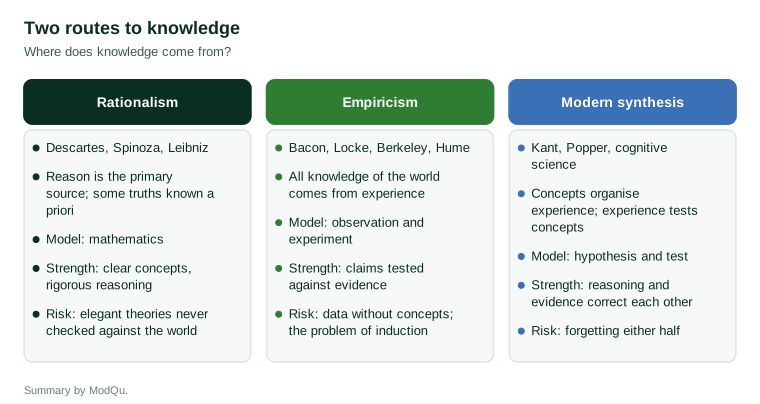
Figure 1 summarises the main positions.
Why the debate matters for inquiry
The rationalist–empiricist debate is not only a historical curiosity. Each side identifies a real danger for anyone conducting research.
The rationalist danger is reasoning in a vacuum. A strategy built on what "must" be true, because it follows logically from assumptions about how customers or markets behave, can be elegant and wrong. Business history is full of products that made perfect sense on paper and failed in the market. The cure is the empiricist's insistence on checking ideas against experience.
The empiricist danger is data without understanding. A dashboard of measurements does not explain anything by itself, and Hume's problem of induction is a reminder that patterns in past data may not continue. Without concepts and hypotheses to organise them, observations pile up without telling us what to do. The cure is the rationalist's insistence on clear concepts and sound reasoning.
Consider a company deciding whether to raise its prices. A purely rationalist approach reasons from economic principles: demand for this product is probably inelastic because customers have few alternatives, so revenue will rise. A purely empiricist approach looks at historical sales and notes that past price changes made little difference. Each approach alone is risky. The economic reasoning rests on assumptions about alternatives that may no longer hold, and the historical data cover only small price changes made in different market conditions, so extrapolating from them is exactly the kind of inductive leap Hume warned about. Combined, the two approaches correct each other. The reasoning identifies what to measure, such as how many customers know of a cheaper alternative, and the measurements test whether the reasoning's assumptions are true. A small, controlled price test then puts the joint conclusion to experience before the whole business depends on it.
Good inquiry, as Kant argued, needs both. In practice, that means stating clear hypotheses and definitions before collecting data, designing research so that experience can actually test those hypotheses, and treating both the reasoning and the data as open to correction. The bee, in Bacon's image, neither spins nor merely gathers; it does both, and turns what it collects into something useful.
References
Bacon, F. (2000). The new organon (L. Jardine & M. Silverthorne, Eds.). Cambridge University Press. https://doi.org/10.1017/CBO9781139164030 (Original work published 1620)
Chomsky, N. (1965). Aspects of the theory of syntax. MIT Press.
Cottingham, J. (1988). The rationalists. Oxford University Press.
Descartes, R. (1984). The philosophical writings of Descartes (J. Cottingham, R. Stoothoff, & D. Murdoch, Trans.; Vol. 2). Cambridge University Press. (Original work published 1641)
Hume, D. (2007). An enquiry concerning human understanding (P. Millican, Ed.). Oxford University Press. (Original work published 1748)
Kant, I. (1998). Critique of pure reason (P. Guyer & A. W. Wood, Eds. & Trans.). Cambridge University Press. https://doi.org/10.1017/CBO9780511804649 (Original work published 1781)
Leibniz, G. W. (1996). New essays on human understanding (P. Remnant & J. Bennett, Eds. & Trans.). Cambridge University Press. https://doi.org/10.1017/CBO9781139166874 (Original work written 1704)
Locke, J. (1975). An essay concerning human understanding (P. H. Nidditch, Ed.). Clarendon Press. (Original work published 1689)
Popper, K. R. (1959). The logic of scientific discovery. Hutchinson.
Quine, W. V. O. (1951). Two dogmas of empiricism. The Philosophical Review, 60(1), 20–43. https://doi.org/10.2307/2181906
Saffran, J. R., Aslin, R. N., & Newport, E. L. (1996). Statistical learning by 8-month-old infants. Science, 274(5294), 1926–1928. https://doi.org/10.1126/science.274.5294.1926
Spelke, E. S., & Kinzler, K. D. (2007). Core knowledge. Developmental Science, 10(1), 89–96. https://doi.org/10.1111/j.1467-7687.2007.00569.x
Woolhouse, R. S. (1988). The empiricists. Oxford University Press.
Wynn, K. (1992). Addition and subtraction by human infants. Nature, 358(6389), 749–750. https://doi.org/10.1038/358749a0