
Inquiry · Philosophy of inquiry
Descartes and Methodical Doubt
René Descartes tried to rebuild knowledge by first doubting everything that could be doubted. This article explains his method, the famous arguments of the Meditations, the main objections to it and the practical value of systematic doubt in modern inquiry.
In 1641 the French philosopher René Descartes published a short book that set out to tear down everything he believed and rebuild it on foundations that could not be shaken. Meditations on First Philosophy begins with a confession: Descartes had noticed how many false things he had accepted as true in his youth, and how doubtful was everything he had built on them. He resolved, "once in the course of my life", to demolish everything and start again from the foundations (Descartes, 1984, p. 12). The method he used, methodical doubt, is one of the most famous strategies of inquiry ever devised. It also provoked some of the most important criticisms of how inquiry should work.
Descartes and the search for certainty
Descartes (1596–1650) was a mathematician as well as a philosopher. He invented the coordinate geometry that bears his name, and he admired mathematics because its conclusions follow with certainty from evident starting points. He wanted the same certainty for knowledge in general. The intellectual climate of his time made that ambition urgent. The revival of ancient scepticism in the sixteenth century, and the collapse of long-trusted authorities in astronomy and religion, had left many educated Europeans unsure whether anything could be known for certain (Popkin, 2003).
In the Discourse on the Method (1637), Descartes set out four rules for directing inquiry. The first was never to accept anything as true unless he clearly recognised it to be so, avoiding haste and prejudice. The second was to divide each difficulty into as many parts as possible. The third was to proceed in order, from the simplest matters to the most complex. The fourth was to make enumerations so complete that nothing was omitted (Descartes, 1985, p. 120). Methodical doubt is the first rule applied with complete rigour.
The method of doubt
Descartes did not doubt beliefs one by one, which would never end. Instead, he attacked the foundations on which whole groups of beliefs rest, and he resolved to treat anything that could be doubted at all as if it were false. Bernard Williams (1978) called this "the project of pure enquiry": an attempt to find what can be known by someone who sets aside every practical consideration and asks only what is certain. Janet Broughton (2002) shows that the doubt was a tool, not a conclusion. Descartes was not a sceptic; he used sceptical arguments in order to defeat scepticism.
The Meditations raise doubt in three escalating waves (Figure 1).
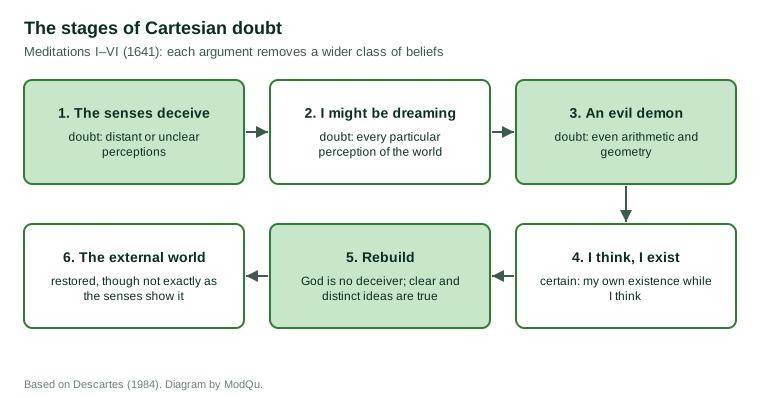
The senses sometimes deceive. A tower that looks round from far away turns out to be square; a stick in water looks bent. It is unwise, Descartes said, to trust completely those who have deceived us even once. But this argument only casts doubt on perceptions of distant or small objects under poor conditions. Surely I cannot doubt that I am sitting by the fire in my dressing gown?
I might be dreaming. Descartes recalled that he had often dreamed exactly such ordinary scenes, and that there are "no sure signs" by which waking can be distinguished from sleep (Descartes, 1984, p. 13). If so, any particular perception might be a dream. Yet even in dreams, he noted, the simplest elements, such as shape, size, number and time, seem to remain, and arithmetic and geometry seem true whether one is awake or asleep.
An evil demon might deceive me about everything. Finally, Descartes supposed that a supremely powerful and malicious being might be devoting all its energies to deceiving him, so that even when he adds two and three he goes wrong. Under this hypothesis, nothing he believes about the external world, his own body or even mathematics is beyond doubt. Modern philosophers have given the thought experiment a scientific form: how could you tell that you are not a brain in a vat, fed with experiences by a computer (Putnam, 1981)?
"I think, therefore I am"
At the bottom of this doubt, Descartes found one thing that resisted. However thoroughly he was deceived, he must exist in order to be deceived. "This proposition, I am, I exist, is necessarily true whenever it is put forward by me or conceived in my mind" (Descartes, 1984, p. 17). The Discourse expressed the same thought in the formula cogito, ergo sum: I think, therefore I am.
Philosophers have debated what kind of argument this is. Jaakko Hintikka (1962) argued that the cogito is not an inference from a premise but a performance: the act of thinking "I exist" makes itself true, whereas the sentence "I do not exist" defeats itself whenever anyone tries to assert it. Whatever its logical form, the cogito gave Descartes the fixed point he wanted. From it, he tried to rebuild knowledge: he argued that God exists and is no deceiver, so that whatever he perceived clearly and distinctly must be true, and that the external world therefore exists, though it may not be exactly as the senses represent it (Cottingham, 1986).
Few philosophers have accepted the rebuilding. The proof of God's existence relies on clear and distinct perception, while the reliability of clear and distinct perception is guaranteed by God, a circle that Descartes's contemporary Antoine Arnauld pointed out and that commentators still discuss (Curley, 1978; Frankfurt, 1970). The method of doubt has proved far more influential than the system it was meant to support.
Why the method was so influential
Methodical doubt changed the starting point of philosophy. Before Descartes, inquiry typically began with authorities, such as Aristotle or scripture, and asked how their claims should be interpreted. After him, it became common to begin with the individual inquirer and ask what that person could know for themselves, and on what grounds. John Cottingham (1986) describes this as a shift from received wisdom to the inquirer's own critical scrutiny, and it shaped the epistemology of the following three centuries.
The method also carried an implicit standard for evidence that still matters. Descartes refused to accept a belief merely because it was widely held, because it was old, or because it was useful. He asked only whether it was well grounded. That refusal is now built into the norms of science and of careful professional work, from audit to journalism, where claims are supposed to be checked rather than taken on trust. Richard Popkin (2003) shows how the sceptical arguments Descartes used, and the attempt to answer them, set the agenda for later philosophers such as Locke, Hume and Kant.
Finally, Descartes made the order of inquiry a question in its own right. His rules required that the simplest and most certain matters be settled first, and that more complex conclusions be built on them step by step. Even inquirers who reject his foundations recognise the value of knowing which of their beliefs carry the most weight, and of testing those first.
The Peircean objection: paper doubt
The most important criticism of methodical doubt came from Charles Sanders Peirce. In 1868 he argued that "we cannot begin with complete doubt. We must begin with all the prejudices which we actually have" (Peirce, 1868, p. 140). Doubt cannot be produced by deciding to doubt. A person who announces that they doubt the existence of the external world, but continues to open doors and avoid traffic, does not really doubt it. Peirce called such manufactured scepticism "paper doubt" and held that it cannot start genuine inquiry, which requires a real reason for doubt arising from experience (Peirce, 1877).
Peirce also rejected Descartes's individualism. For Descartes, the test of truth was what one mind could perceive clearly and distinctly. For Peirce, inquiry is the work of a community, and no single inquirer's sense of certainty settles anything. Susan Haack (1982) describes this as the replacement of the solitary Cartesian thinker with a "cognitive community" whose collective, fallible inquiry is the route to knowledge.
Other critics: certainty and the boat at sea
Later philosophers developed further objections. G. E. Moore (1939) argued that he knew some things, such as that he had two hands, more certainly than he could ever know the premises of any sceptical argument against them; so if an argument concluded otherwise, it was the argument that should be rejected. Ludwig Wittgenstein (1969), responding to Moore, argued that doubt itself presupposes certainty: to doubt one thing, we must take many others for granted, and a doubt that doubted everything would not be a doubt at all.
The most widely quoted image of the alternative came from the Austrian philosopher Otto Neurath, who compared inquirers to sailors who must rebuild their ship on the open sea, never able to put it into dry dock and reconstruct it from the best materials. Quine (1960) adopted the image to describe how knowledge is revised piece by piece, using beliefs we currently trust to test those we question. In this picture there are no foundations beyond doubt, but there is also no need for them.
A different line of criticism came from neuroscience. Antonio Damasio (1994) argued that Descartes's separation of thinking from the body and the emotions was a mistake, and that patients with damage to brain areas linking emotion and reasoning make poor decisions even when their logical abilities are intact. On this view, inquiry cannot be purely intellectual, as Descartes imagined.
What survives: doubt as a discipline
If Descartes's project failed, why is his method still taught? Because, used in a limited and practical way, deliberate doubt is one of the most effective tools of inquiry available. Psychology has shown that people tend to seek and interpret evidence in ways that confirm what they already believe (Nickerson, 1998). Deliberately imagining that a belief might be false counteracts this.
Several modern techniques are, in effect, controlled versions of Cartesian doubt:
- Considering the opposite. Lord et al. (1984) found that asking people to consider whether they would have evaluated evidence the same way if it had pointed the other way reduced biased assimilation of evidence more than simply asking them to be fair.
- The premortem. Gary Klein (2007) proposed that before committing to a plan, a team should imagine that it has failed and write down why. Mitchell et al. (1989) had found that imagining an event as having already happened makes it easier to generate explanations for it, which is why this kind of prospective hindsight surfaces risks that ordinary planning misses.
- Assumption audits. Listing the beliefs on which a conclusion depends, and asking for each "what if this were false?", is a direct descendant of Descartes's attack on foundations.
The difference from Descartes is one of scope. Modern inquirers doubt particular beliefs for particular reasons and keep the rest fixed while they test them, which is Neurath's boat rather than Descartes's demolition. Stephen Gaukroger (1995) notes that Descartes himself, in his scientific work, often proceeded in this more piecemeal way.
Lessons for inquiry
Descartes's method offers three lasting lessons for anyone who has to establish what is true.
- Examine foundations, not just conclusions. Many disagreements persist because the parties never question the assumptions that their reasoning rests on. Descartes's practice of asking what a whole group of beliefs depends on remains valuable.
- Make doubt deliberate. Left to themselves, people doubt what they dislike and accept what they like. Scheduling doubt, through premortems, opposing arguments or independent checks, applies it more evenly.
- Do not confuse certainty with knowledge. Descartes demanded certainty and found almost none. Most useful knowledge, in science and in business, is well supported but fallible. The goal of doubt is to test beliefs, not to make action impossible.
Conclusion
Descartes hoped to make knowledge as certain as mathematics by first doubting everything. He did not succeed, and his critics showed why universal doubt is neither possible nor necessary. But the impulse behind the method, to refuse to accept anything merely because it is familiar and to look for the weakest point in one's own beliefs, remains at the heart of careful inquiry. Used selectively and for good reasons, Cartesian doubt is less a route to certainty than a protection against error.
References
Broughton, J. (2002). Descartes's method of doubt. Princeton University Press.
Cottingham, J. (1986). Descartes. Blackwell.
Curley, E. M. (1978). Descartes against the skeptics. Harvard University Press.
Damasio, A. R. (1994). Descartes' error: Emotion, reason, and the human brain. G. P. Putnam's Sons.
Descartes, R. (1984). The philosophical writings of Descartes (J. Cottingham, R. Stoothoff, & D. Murdoch, Trans.; Vol. 2). Cambridge University Press. (Original work published 1641)
Descartes, R. (1985). The philosophical writings of Descartes (J. Cottingham, R. Stoothoff, & D. Murdoch, Trans.; Vol. 1). Cambridge University Press. (Original work published 1637)
Frankfurt, H. G. (1970). Demons, dreamers, and madmen: The defense of reason in Descartes's Meditations. Bobbs-Merrill.
Gaukroger, S. (1995). Descartes: An intellectual biography. Clarendon Press.
Haack, S. (1982). Descartes, Peirce and the cognitive community. The Monist, 65(2), 156–181. https://doi.org/10.5840/monist198265214
Hintikka, J. (1962). Cogito, ergo sum: Inference or performance? The Philosophical Review, 71(1), 3–32. https://doi.org/10.2307/2183678
Klein, G. (2007). Performing a project premortem. Harvard Business Review, 85(9), 18–19.
Lord, C. G., Lepper, M. R., & Preston, E. (1984). Considering the opposite: A corrective strategy for social judgment. Journal of Personality and Social Psychology, 47(6), 1231–1243. https://doi.org/10.1037/0022-3514.47.6.1231
Mitchell, D. J., Russo, J. E., & Pennington, N. (1989). Back to the future: Temporal perspective in the explanation of events. Journal of Behavioral Decision Making, 2(1), 25–38. https://doi.org/10.1002/bdm.3960020103
Moore, G. E. (1939). Proof of an external world. Proceedings of the British Academy, 25, 273–300.
Nickerson, R. S. (1998). Confirmation bias: A ubiquitous phenomenon in many guises. Review of General Psychology, 2(2), 175–220. https://doi.org/10.1037/1089-2680.2.2.175
Peirce, C. S. (1868). Some consequences of four incapacities. The Journal of Speculative Philosophy, 2(3), 140–157.
Peirce, C. S. (1877). The fixation of belief. Popular Science Monthly, 12, 1–15.
Popkin, R. H. (2003). The history of scepticism: From Savonarola to Bayle (Rev. ed.). Oxford University Press.
Putnam, H. (1981). Reason, truth and history. Cambridge University Press. https://doi.org/10.1017/CBO9780511625398
Quine, W. V. O. (1960). Word and object. MIT Press.
Williams, B. (1978). Descartes: The project of pure enquiry. Penguin.
Wittgenstein, L. (1969). On certainty (G. E. M. Anscombe & G. H. von Wright, Eds.; D. Paul & G. E. M. Anscombe, Trans.). Blackwell.