
The Generation of Knowledge · Epistemology
What Is Knowledge? Justified True Belief and Its Challenges
The classic definition of knowledge as justified true belief, where it comes from, why a three-page paper in 1963 unsettled it, and what the debate means for anyone who produces evidence for decisions.
Every survey, research study and investigation claims, in the end, to tell someone something they did not know before. That claim raises an old question: what does it mean to know something, as opposed to believing it or guessing correctly? Philosophers call the study of this question epistemology. For more than two thousand years the most influential answer has been that knowledge is justified true belief. This article explains that definition, the challenge that shook it in the twentieth century, and why the debate still matters to people whose job is to generate reliable knowledge.
The tripartite definition
The definition is usually traced to Plato's dialogue Theaetetus, in which Socrates and a young mathematician test several answers to the question "What is knowledge?" (Plato, 1997). One proposal is that knowledge is true belief accompanied by an "account" (logos), a reason or explanation. The dialogue ends without accepting it, partly because it is hard to say what an account adds, but the idea became the standard starting point for later philosophers.
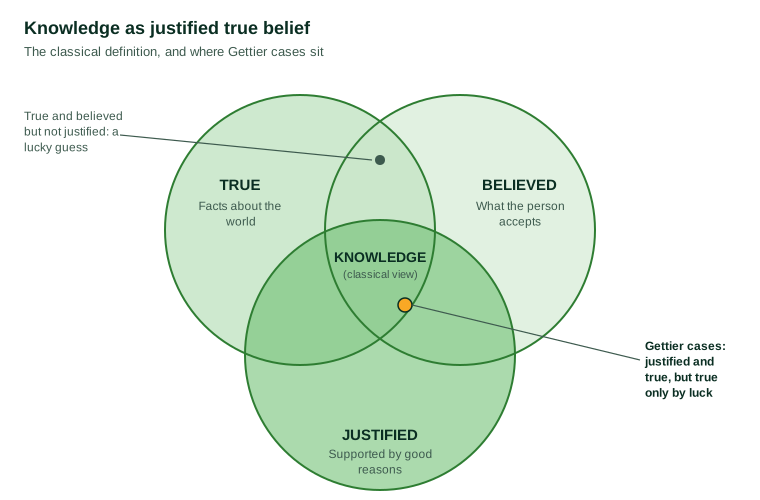
In its modern form, the definition says that a person S knows a proposition p if and only if three conditions hold:
- Truth. p is true.
- Belief. S believes p.
- Justification. S is justified in believing p.
Each condition does real work. Truth separates knowledge from error: you cannot know that the meeting is on Tuesday if it is on Wednesday, however sure you feel. Belief separates knowledge from facts that nobody has grasped. Justification separates knowledge from lucky guesses. A gambler who is certain the next card will be red, and is right, did not know it. Twentieth-century philosophers gave versions of the definition in clear terms. Ayer (1956) required that the knower be sure and have "the right to be sure", and Chisholm (1957) required that the belief be true and evident to the believer.
Gettier's three pages
In 1963 Edmund Gettier published a paper of under three pages that asked, in its title, "Is justified true belief knowledge?" (Gettier, 1963). He answered no, and gave two counterexamples.
In the first, Smith and Jones have applied for the same job. Smith has strong evidence that Jones will get it, and he has counted the ten coins in Jones's pocket. Smith therefore believes, with justification, that "the man who will get the job has ten coins in his pocket". In fact Smith himself gets the job, and, unknown to him, Smith also has ten coins in his pocket. His belief is true and justified, yet it seems wrong to say he knew it. It was true by coincidence.
Similar cases had been noticed before. Russell (1948) described a person who looks at a clock that stopped exactly twelve hours earlier and so reads the correct time. The belief is justified, because clocks are usually reliable, and it is true, but it is true by luck. Gettier's contribution was to state the problem against the formal definition. His examples were simple, easy to vary and hard to dismiss. Within a few years the "Gettier problem" had become one of the most discussed topics in philosophy.
Attempts to repair the definition
The first responses tried to add a fourth condition. Clark (1963) proposed that a belief must not rest on any false grounds. Smith's belief rested on the false belief that Jones would get the job, so it would not count. Critics soon found cases in which no false belief is involved.
Lehrer and Paxson (1969) proposed a defeasibility condition: a justified true belief is knowledge only if there is no further truth that, if the believer knew it, would undermine the justification. Goldman (1967) proposed a causal condition: the fact that makes the belief true must cause the belief in the right way. Nozick (1981) offered a tracking account: you know p only if, had p been false, you would not have believed it. The stopped clock fails this test, because the observer would have believed the same time even if it had been wrong.
Each proposal handles some cases and struggles with others. Zagzebski (1994) argued that the difficulty is structural. As long as justification can fall short of guaranteeing truth, it is possible to build a case in which a justified belief would have been false but for a stroke of luck that makes it true. Any definition with that gap, she argued, will meet a Gettier case.
Different directions
Some epistemologists responded by changing the question. Williamson (2000) argued that knowledge cannot be broken down into simpler parts at all; it is a basic mental state, and other notions such as evidence should be explained in terms of it. Virtue epistemologists such as Sosa (2007) treat knowledge as belief that is true because of the knower's competence, in the way an archer's hit counts as skilful only when the arrow hits because of the archer's skill and not a gust of wind. A summary of these positions is given by Ichikawa and Steup (2018).
Researchers have also tested whether ordinary people share philosophers' reactions to Gettier cases. Weinberg et al. (2001) reported cultural differences in responses, which raised questions about relying on philosophers' intuitions. A later study with participants in Brazil, India, Japan and the United States found that most people in all four countries deny that the person in a Gettier case knows (Machery et al., 2017). The intuition that luck undermines knowledge appears to be widely shared.
Why it matters for research
The debate can look remote from business research, but its core lesson is practical: a correct result is not the same as a known result. A forecast can be right for the wrong reasons. A survey estimate can be close to the true figure even though the sample was badly biased, because two errors happened to cancel. In both cases the method did not earn the result, and nothing guarantees that it will work next time.
This is why serious research organisations judge their work by its method as well as its results. A finding counts as knowledge when the process that produced it would reliably have given a different answer if the truth had been different, which is close to Nozick's (1981) tracking condition and to reliabilist views that grew out of causal accounts such as Goldman's (1967). Documented sampling, tested questions, transparent weighting and honest margins of error are the practical forms of justification. They are what turn a correct number into something a decision-maker can know.
References
Ayer, A. J. (1956). The problem of knowledge. Macmillan.
Chisholm, R. M. (1957). Perceiving: A philosophical study. Cornell University Press.
Clark, M. (1963). Knowledge and grounds: A comment on Mr. Gettier's paper. Analysis, 24(2), 46–48. https://doi.org/10.1093/analys/24.2.46
Gettier, E. L. (1963). Is justified true belief knowledge? Analysis, 23(6), 121–123. https://doi.org/10.1093/analys/23.6.121
Goldman, A. I. (1967). A causal theory of knowing. The Journal of Philosophy, 64(12), 357–372. https://doi.org/10.2307/2024268
Ichikawa, J. J., & Steup, M. (2018). The analysis of knowledge. In E. N. Zalta (Ed.), The Stanford encyclopedia of philosophy (Summer 2018 ed.). https://plato.stanford.edu/archives/sum2018/entries/knowledge-analysis/
Lehrer, K., & Paxson, T. (1969). Knowledge: Undefeated justified true belief. The Journal of Philosophy, 66(8), 225–237. https://doi.org/10.2307/2024435
Machery, E., Stich, S., Rose, D., Chatterjee, A., Karasawa, K., Struchiner, N., Sirker, S., Usui, N., & Hashimoto, T. (2017). Gettier across cultures. Noûs, 51(3), 645–664. https://doi.org/10.1111/nous.12110
Nozick, R. (1981). Philosophical explanations. Harvard University Press.
Plato. (1997). Theaetetus (M. J. Levett, Trans.; M. Burnyeat, Rev.). In J. M. Cooper (Ed.), Plato: Complete works. Hackett.
Russell, B. (1948). Human knowledge: Its scope and limits. George Allen & Unwin.
Sosa, E. (2007). A virtue epistemology: Apt belief and reflective knowledge, Volume I. Oxford University Press. https://doi.org/10.1093/acprof:oso/9780199297023.001.0001
Weinberg, J. M., Nichols, S., & Stich, S. (2001). Normativity and epistemic intuitions. Philosophical Topics, 29(1–2), 429–460. https://doi.org/10.5840/philtopics2001291/217
Williamson, T. (2000). Knowledge and its limits. Oxford University Press. https://doi.org/10.1093/019925656X.001.0001
Zagzebski, L. (1994). The inescapability of Gettier problems. The Philosophical Quarterly, 44(174), 65–73. https://doi.org/10.2307/2220147