
The Generation of Knowledge · Epistemology
The Gettier Problem and the Definition of Knowledge
How Edmund Gettier's counterexamples broke the classical definition of knowledge, the sixty-year search for a fourth condition, and what the problem of epistemic luck teaches anyone who relies on evidence.
In 1963 a young philosopher at Wayne State University published a paper of about a thousand words in the journal Analysis. Edmund Gettier's "Is justified true belief knowledge?" (Gettier, 1963) did something rare in philosophy: it changed the direction of a whole field almost overnight. Before it, most philosophers accepted, at least as a working definition, that knowledge is justified true belief. After it, they spent decades trying to say what is missing. This article sets out the problem, the main attempts to solve it, and why the underlying issue, epistemic luck, matters well beyond philosophy.
The classical definition
The definition Gettier attacked holds that a person knows a proposition when three conditions are met: the proposition is true, the person believes it, and the person is justified in believing it. Versions had been stated by Ayer (1956), who required "the right to be sure", and by Chisholm (1957). The definition seemed to capture what separates knowledge from a lucky guess: justification ties the belief to good reasons.
Gettier's paper accepted two background principles. First, a person can be justified in believing something that is false, because good evidence can mislead. Second, if a person is justified in believing p, and correctly deduces q from p, they are justified in believing q. From these he built two cases.
The two cases
Case I. Smith and Jones have applied for the same job. Smith has strong evidence that Jones will be appointed, and he has counted ten coins in Jones's pocket. He infers: "The man who will get the job has ten coins in his pocket." Unknown to Smith, he himself will get the job, and he also happens to have ten coins in his pocket. His belief is true and justified, but he does not seem to know it.
Case II. Smith has good evidence that Jones owns a Ford. He has no idea where his friend Brown is, but he infers, correctly from what he believes, "Either Jones owns a Ford or Brown is in Barcelona." In fact Jones does not own a Ford, but by coincidence Brown is in Barcelona. Again the belief is justified and true, and again it seems not to be knowledge.
In both cases, the justification and the truth come apart. What makes the belief true is not what makes it justified. The belief "hits the target", but by accident.
The search for a fourth condition
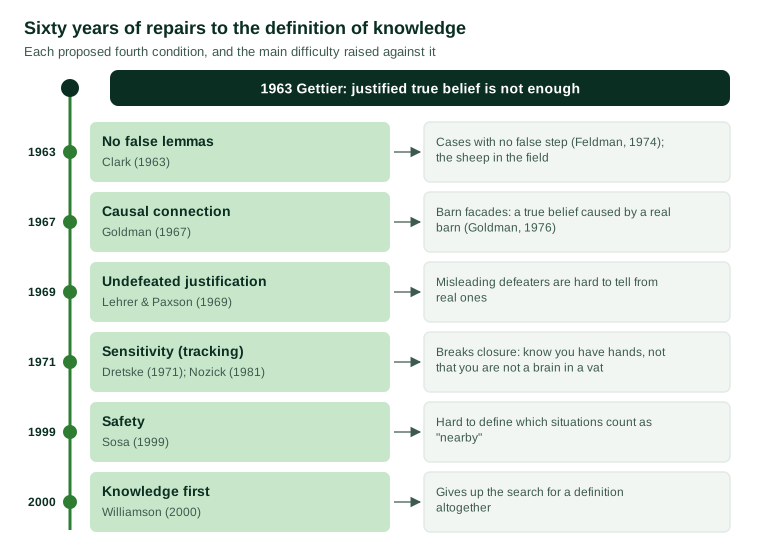
The most natural response was to keep the three conditions and add a fourth. Shope (1983) catalogued the many proposals of the first two decades. The main families are summarised in Figure 1.
No false lemmas
Both of Gettier's cases involve reasoning from a false belief: that Jones will get the job, or that Jones owns a Ford. Clark (1963) therefore proposed that knowledge requires a justified true belief that is not based on any false belief. Feldman (1974) replied that Gettier-style cases can be built without any false step, by having the believer reason from a true existential claim. Chisholm (1966) offered a further example in which a person sees what looks like a sheep in a field and believes there is a sheep in the field. The object is a dog, but a real sheep is hidden behind a hill. The belief is formed directly from perception, with no inference at all.
Causal and reliability conditions
Goldman (1967) proposed that a belief is knowledge only if the fact that makes it true causes the belief in an appropriate way. The sheep-shaped dog, not the sheep, caused the belief, so it fails. But Goldman himself later described a case that troubled causal accounts (Goldman, 1976). Henry drives through a district where, unknown to him, the locals have put up many papier-mâché barn facades. He looks at the one real barn and believes "That is a barn." His belief is true and is caused by a real barn, yet, because he could so easily have been looking at a fake, many people judge that he does not know. Goldman's response was to require that the believer be able to discriminate the truth from relevant alternatives, an idea that grew into reliabilism.
Defeasibility
Lehrer and Paxson (1969) proposed that knowledge is justified true belief that is undefeated: there is no truth which, if added to the person's evidence, would destroy the justification. The difficulty is that some truths would mislead. If an unreliable rumour claims that the barn is a fake, adding the rumour's existence to Henry's evidence would weaken his justification, yet that should not stop him knowing. Distinguishing misleading from genuine defeaters proved difficult.
Sensitivity and safety
Dretske (1971) and Nozick (1981) proposed sensitivity: you know p only if, had p been false, you would not have believed it. Henry fails, because had he been looking at a facade he would still have believed it was a barn. Sensitivity has a cost. It implies that you can know you have hands without knowing you are not a brain in a vat, which many philosophers find unacceptable because it breaks the principle that knowledge extends to what you know follows from it. Sosa (1999) proposed safety instead: a belief is safe if, in nearby situations where you would hold it, it would still be true. Safety keeps the closure principle and still explains barn country.
Is the problem solvable?
Zagzebski (1994) argued that no such repair can succeed while justification falls short of guaranteeing truth. Her recipe is simple. Take any case of justified false belief, then add a stroke of luck that makes the belief true for a reason unconnected with the justification. The result is a Gettier case for whatever definition is on offer. Either justification guarantees truth, in which case very little would count as knowledge, or the gap remains open to luck.
Two responses gained ground. Williamson (2000) proposed that knowledge cannot be analysed into simpler parts; it is a basic state, and justification and evidence are best explained in terms of knowledge, not the other way round. Pritchard (2005) argued that the core of the problem is epistemic luck, and that an adequate theory needs both an anti-luck condition, such as safety, and an ability condition, so that a true belief counts as knowledge when it is true because of the believer's competence.
Others questioned the cases themselves. Kirkham (1984) argued that Gettier's cases rest on a mistake about justification, and that the problem disappears if justification is made strict enough. Experimental philosophers have tested whether ordinary people share the intuition. Starmans and Friedman (2012) found that lay participants sometimes attributed knowledge in cases philosophers would deny it, while Machery et al. (2017) found that participants in Brazil, India, Japan and the United States mostly deny knowledge in a classic Gettier case. The basic intuition appears robust, even if responses to unusual variants differ.
Why the problem matters for research
The Gettier problem is about luck, and luck is a constant threat in empirical work. Consider three examples:
- A poll predicts an election result to within one point, but only because a biased sample and a late swing cancelled each other out.
- A sales forecast is correct, but the model that produced it relied on a relationship that had already broken down.
- An investigator names the right suspect for reasons that later prove to be mistaken.
In each case the conclusion is true and the reasoning looked sound, yet the conclusion was not earned. Nothing guarantees that the same method will succeed next time. In Sosa's terms the result was not safe; in Nozick's, it did not track the truth.
The practical safeguards that research organisations use can be read as anti-luck conditions. Probability sampling, pre-registered analyses, replication, triangulation across methods and checks of the assumptions behind a model all ask the same question: would this method have given a different answer if the truth had been different? A finding that passes those tests is more than true. It is knowledge in the sense that matters to decision-makers, because the process that produced it can be relied on again.
References
Ayer, A. J. (1956). The problem of knowledge. Macmillan.
Chisholm, R. M. (1957). Perceiving: A philosophical study. Cornell University Press.
Chisholm, R. M. (1966). Theory of knowledge. Prentice-Hall.
Clark, M. (1963). Knowledge and grounds: A comment on Mr. Gettier's paper. Analysis, 24(2), 46–48. https://doi.org/10.1093/analys/24.2.46
Dretske, F. (1971). Conclusive reasons. Australasian Journal of Philosophy, 49(1), 1–22. https://doi.org/10.1080/00048407112341001
Feldman, R. (1974). An alleged defect in Gettier counter-examples. Australasian Journal of Philosophy, 52(1), 68–69.
Gettier, E. L. (1963). Is justified true belief knowledge? Analysis, 23(6), 121–123. https://doi.org/10.1093/analys/23.6.121
Goldman, A. I. (1967). A causal theory of knowing. The Journal of Philosophy, 64(12), 357–372. https://doi.org/10.2307/2024268
Goldman, A. I. (1976). Discrimination and perceptual knowledge. The Journal of Philosophy, 73(20), 771–791. https://doi.org/10.2307/2025679
Kirkham, R. L. (1984). Does the Gettier problem rest on a mistake? Mind, 93(372), 501–513. https://doi.org/10.1093/mind/XCIII.372.501
Lehrer, K., & Paxson, T. (1969). Knowledge: Undefeated justified true belief. The Journal of Philosophy, 66(8), 225–237. https://doi.org/10.2307/2024435
Machery, E., Stich, S., Rose, D., Chatterjee, A., Karasawa, K., Struchiner, N., Sirker, S., Usui, N., & Hashimoto, T. (2017). Gettier across cultures. Noûs, 51(3), 645–664. https://doi.org/10.1111/nous.12110
Nozick, R. (1981). Philosophical explanations. Harvard University Press.
Pritchard, D. (2005). Epistemic luck. Oxford University Press. https://doi.org/10.1093/019928038X.001.0001
Shope, R. K. (1983). The analysis of knowing: A decade of research. Princeton University Press.
Sosa, E. (1999). How to defeat opposition to Moore. Philosophical Perspectives, 13, 141–153. https://doi.org/10.1111/0029-4624.33.s13.7
Starmans, C., & Friedman, O. (2012). The folk conception of knowledge. Cognition, 124(3), 272–283. https://doi.org/10.1016/j.cognition.2012.05.017
Williamson, T. (2000). Knowledge and its limits. Oxford University Press. https://doi.org/10.1093/019925656X.001.0001
Zagzebski, L. (1994). The inescapability of Gettier problems. The Philosophical Quarterly, 44(174), 65–73. https://doi.org/10.2307/2220147