
The Generation of Knowledge · Epistemology
Testimony as a Source of Knowledge
Most of what we know we were told by someone else. This article explains how philosophers have tried to justify trust in testimony, what psychology shows about when people believe others, and why every survey is a form of testimony.
Few people have checked for themselves that the Earth orbits the Sun, that smoking causes cancer, or even when and where they were born. We know these things because someone told us: parents, teachers, books, experts, records. Philosophers use the word testimony for this source of knowledge, in a broad sense that covers any case in which a person comes to believe something because another person asserted it. It is not limited to courtroom evidence. Coady (1992) argued that testimony is so pervasive that, if it were removed, very little of what any individual knows would survive.
Testimony is also at the heart of survey research. A respondent who reports how often they shop online, how satisfied they are with a service, or whom they intend to vote for is giving testimony. Understanding when testimony can be trusted is therefore not only a philosophical question but a practical one for anyone who generates knowledge by asking people questions.
The central question
The problem of testimony can be put simply: what makes it reasonable to believe what we are told? Perception and memory seem to put us in direct contact with the world. Testimony does not. When I believe what you say, my belief depends on your perception, your memory, your honesty and your ability to express yourself. Any of these can fail.
Two broad answers have shaped the debate since the eighteenth century.
Reductionism: trust must be earned
The Scottish philosopher David Hume argued that our reliance on testimony is justified by experience. We have observed, many times, that what people report generally matches the facts, and so we reasonably expect it to continue (Hume, 1748/2007). On this view, testimony is not a basic source of knowledge. Its authority can be reduced to perception, memory and inductive reasoning about the reliability of speakers.
Reductionism captures something important: we do and should trust some speakers more than others, depending on what we know of them. But critics point out that it demands too much. Coady (1992) observed that no individual has checked enough reports against the facts to support a general inference that testimony is reliable. Most of the evidence we would use to check testimony, such as maps, encyclopaedias and records, is itself testimony. A young child, who has checked almost nothing, would on this view know almost nothing they had been told.
Anti-reductionism: trust is the default
Hume's contemporary Thomas Reid proposed a different picture. Humans, he argued, have a natural "principle of credulity", a disposition to believe what others tell them, matched by a "principle of veracity", a disposition to tell the truth (Reid, 1764/1997). Testimony is a basic source of knowledge alongside perception and memory. We are entitled to accept what we are told unless we have reason to doubt it.
Modern anti-reductionists such as Coady (1992) and Burge (1993) defend versions of this view. Burge argued that we are entitled to accept what is presented as true by a rational source, unless there are stronger reasons not to, and that testimony preserves knowledge from speaker to hearer in the way that memory preserves it from one time to another. The objection is that a default of trust seems too permissive. It appears to license gullibility.
Middle positions
Elizabeth Fricker (1995) proposed a local form of reductionism. We do not need to justify testimony in general, but a hearer should monitor each speaker for signs of insincerity or incompetence, and should be able to say why this particular speaker on this particular topic is likely to be right. Lackey (2008) argued that both sides have misunderstood the issue. What matters is less the speaker's state of mind than the reliability of the statement itself: a teacher who does not personally believe a theory can still pass on knowledge of it by teaching it accurately. In Lackey's phrase, we learn from words, not only from believers.
Sincerity and competence
Whatever position is taken, most accounts agree that a hearer is relying on two different things: that the speaker is sincere (says what they believe) and competent (believes what is true). The two can fail separately, as Figure 1 shows.
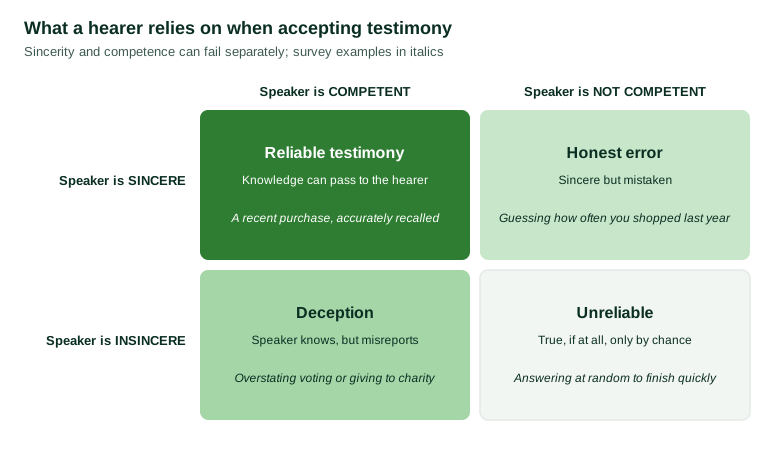
In survey research both kinds of failure are familiar. Insincerity appears as social desirability bias: respondents may overstate voting or charitable giving and understate drinking or prejudice. Incompetence appears when people sincerely report things they cannot accurately know, such as how many times they visited a supermarket in the past year, or why they made a decision. Tourangeau et al. (2000) describe answering a survey question as four steps, comprehension, retrieval, judgement and response, each of which can go wrong. Schwarz (1999) showed that the wording, order and response options of questions shape the answers people give, even when they are trying to be accurate.
What psychology shows about trust
Research in developmental and cognitive psychology suggests that people are neither as credulous as Reid's default implies nor as cautious as Hume's standard demands.
Children rely heavily on testimony, but they are selective from an early age. Koenig and Harris (2005) found that preschool children prefer to learn new words from a speaker who has previously named familiar objects correctly over one who has made mistakes. Harris and Koenig (2006) argued that much of what children learn about science and religion, from the shape of the Earth to the existence of germs, depends on testimony about things they cannot observe, and that children's trust is shaped by the consensus around them.
Sperber et al. (2010) argued that humans have evolved mechanisms of epistemic vigilance: ways of checking both the source of a message (is this person competent and benevolent?) and its content (is it consistent with what I already believe?). Mercier (2017) reviewed evidence from many fields and concluded that people are generally not gullible; if anything, they tend to give too little weight to good information from others when it conflicts with their own views.
Expertise and dependence
Modern knowledge depends on testimony in a deeper way. Hardwig (1985) argued that scientists routinely rely on colleagues' results that they cannot check, and that a layperson has good reason to defer to an expert even without understanding the expert's reasons. In a later paper Hardwig (1991) argued that much scientific knowledge rests on trust in the honesty and competence of other researchers, and would collapse without it. The historian Shapin (1994) showed how, in seventeenth-century England, the credibility of scientific reports depended on the social standing and reputation for honesty of the gentlemen who made them.
This raises a hard question for non-experts: how do we choose which expert to believe? Goldman (2001) suggested several kinds of evidence a layperson can use, including the arguments each expert offers, agreement among other experts, independent signs of expertise such as credentials, evidence of bias or interest, and the expert's past track record. None is decisive, but together they allow reasonable, if imperfect, judgements. The same tests apply when a business weighs a consultant's report or a published study: who produced it, what interests they had, whether others agree and how their earlier claims have fared.
Testimony can also fail through prejudice on the hearer's side. Miranda Fricker (2007) introduced the term testimonial injustice for cases in which a speaker is given less credibility than they deserve because of prejudice about their group. Testimonial injustice wrongs the speaker and also costs the hearer knowledge they could have had.
Eyewitnesses and memory
The limits of testimony are clearest in the law. Loftus and Palmer (1974) showed that the wording of a question changes what witnesses report: people who were asked how fast cars were going when they "smashed" into each other gave higher speed estimates than those asked about cars that "hit" each other, and were more likely a week later to report seeing broken glass that was not there. Wells and Olson (2003) reviewed research showing that eyewitness confidence is often a weak guide to accuracy under the conditions in which identifications are usually made, and that the procedures used to collect testimony can greatly improve or degrade it.
Testimony in survey research
Every survey is an exercise in collecting and evaluating testimony at scale. The philosophical debate maps closely onto the practical choices of survey designers.
Assume a default of trust, but check. Like the anti-reductionist, survey research takes respondents' answers as evidence by default. Like the local reductionist, it builds in checks: attention questions, consistency checks across items, comparisons with external benchmarks and records.
Ask only what respondents can know. Competence depends on the question. People can usually report recent, specific, salient behaviour more accurately than distant or routine behaviour, and they can report their current opinions better than the causes of past decisions (Tourangeau et al., 2000).
Reduce reasons for insincerity. Self-administered modes, assurances of confidentiality and neutral wording reduce the pressure to give socially desirable answers.
Be careful with second-hand reports. Surveys often ask one person to report on others, for example a parent describing a child's media use or a manager describing company spending. These proxy reports add a further link to the chain of testimony. The respondent may be sincere but simply not know, which places the answer in the "honest error" cell of Figure 1. Where possible, ask the person who has direct knowledge, or record that an answer was given by proxy so that analysts can judge it accordingly.
Avoid leading questions. The findings of Loftus and Palmer (1974) and Schwarz (1999) apply directly: the way a question is asked can create the answer.
Treat no group as less credible by default. Fricker's (2007) analysis is a reminder that discounting the testimony of particular groups, for example through instruments that do not work well for them or samples that exclude them, produces knowledge that is both unfair and wrong.
Seen in this light, much of survey methodology is applied epistemology of testimony: a set of procedures for deciding when, and how far, what people tell us can become knowledge.
References
Burge, T. (1993). Content preservation. The Philosophical Review, 102(4), 457–488. https://doi.org/10.2307/2185680
Coady, C. A. J. (1992). Testimony: A philosophical study. Clarendon Press. https://doi.org/10.1093/0198235518.001.0001
Fricker, E. (1995). Telling and trusting: Reductionism and anti-reductionism in the theory of testimony. Mind, 104(414), 393–411. https://doi.org/10.1093/mind/104.414.393
Fricker, M. (2007). Epistemic injustice: Power and the ethics of knowing. Oxford University Press. https://doi.org/10.1093/acprof:oso/9780198237907.001.0001
Goldman, A. I. (2001). Experts: Which ones should you trust? Philosophy and Phenomenological Research, 63(1), 85–110. https://doi.org/10.1111/j.1933-1592.2001.tb00093.x
Hardwig, J. (1985). Epistemic dependence. The Journal of Philosophy, 82(7), 335–349. https://doi.org/10.2307/2026523
Hardwig, J. (1991). The role of trust in knowledge. The Journal of Philosophy, 88(12), 693–708. https://doi.org/10.2307/2027007
Harris, P. L., & Koenig, M. A. (2006). Trust in testimony: How children learn about science and religion. Child Development, 77(3), 505–524. https://doi.org/10.1111/j.1467-8624.2006.00886.x
Hume, D. (2007). An enquiry concerning human understanding (P. Millican, Ed.). Oxford University Press. (Original work published 1748)
Koenig, M. A., & Harris, P. L. (2005). Preschoolers mistrust ignorant and inaccurate speakers. Child Development, 76(6), 1261–1277. https://doi.org/10.1111/j.1467-8624.2005.00849.x
Lackey, J. (2008). Learning from words: Testimony as a source of knowledge. Oxford University Press. https://doi.org/10.1093/acprof:oso/9780199219162.001.0001
Loftus, E. F., & Palmer, J. C. (1974). Reconstruction of automobile destruction: An example of the interaction between language and memory. Journal of Verbal Learning and Verbal Behavior, 13(5), 585–589. https://doi.org/10.1016/S0022-5371(74)80011-3
Mercier, H. (2017). How gullible are we? A review of the evidence from psychology and social science. Review of General Psychology, 21(2), 103–122. https://doi.org/10.1037/gpr0000111
Reid, T. (1997). An inquiry into the human mind on the principles of common sense (D. R. Brookes, Ed.). Edinburgh University Press. (Original work published 1764)
Schwarz, N. (1999). Self-reports: How the questions shape the answers. American Psychologist, 54(2), 93–105. https://doi.org/10.1037/0003-066X.54.2.93
Shapin, S. (1994). A social history of truth: Civility and science in seventeenth-century England. University of Chicago Press.
Sperber, D., Clément, F., Heintz, C., Mascaro, O., Mercier, H., Origgi, G., & Wilson, D. (2010). Epistemic vigilance. Mind & Language, 25(4), 359–393. https://doi.org/10.1111/j.1468-0017.2010.01394.x
Tourangeau, R., Rips, L. J., & Rasinski, K. (2000). The psychology of survey response. Cambridge University Press. https://doi.org/10.1017/CBO9780511819322
Wells, G. L., & Olson, E. A. (2003). Eyewitness testimony. Annual Review of Psychology, 54, 277–295. https://doi.org/10.1146/annurev.psych.54.101601.145028