
The Generation of Knowledge · Epistemology
Foundationalism, Coherentism and the Structure of Knowledge
Does knowledge rest on secure foundations, or is it a web of beliefs that support one another? The regress problem, the main theories of epistemic structure, and what they imply for building a trustworthy body of evidence.
Ask why you believe something, and you will usually give a reason. Ask why you believe the reason, and you will give another. This simple exercise leads to one of the oldest problems in the theory of knowledge: where does the chain of reasons end? The answer determines what philosophers call the structure of knowledge, the way individual beliefs support one another to form a body of justified belief. Two main answers have dominated the debate. Foundationalism holds that knowledge rests on basic beliefs that need no further support. Coherentism holds that beliefs are justified by fitting together into a coherent whole. This article explains both, the main objections to each, the hybrid views that have emerged, and why the question matters to anyone who has to build a body of evidence that others can trust.
The regress problem
The problem was set out in ancient Greece. The sceptic Agrippa, as reported by Sextus Empiricus, argued that any attempt to justify a belief faces three unattractive options (Sextus Empiricus, 2000). The chain of reasons can go on forever, with each reason requiring a further one. It can stop at some point with a belief that is simply assumed. Or it can loop back on itself, so that a belief is eventually supported by itself. An infinite regress seems impossible to complete, an arbitrary stopping point seems to provide no real justification, and a circle seems to beg the question. If all three options fail, the sceptic concludes, no belief is justified.
This argument, often called Agrippa's trilemma, has shaped the theory of knowledge ever since. Each main theory of epistemic structure can be understood as accepting one of the three options and arguing that, properly understood, it is not as bad as it looks. Foundationalism accepts that the chain stops, but denies that the stopping point is arbitrary. Coherentism accepts a kind of circularity, but denies that it is vicious. A third, less common view, infinitism, accepts the infinite chain (Klein, 1999).
Foundationalism
The classical version
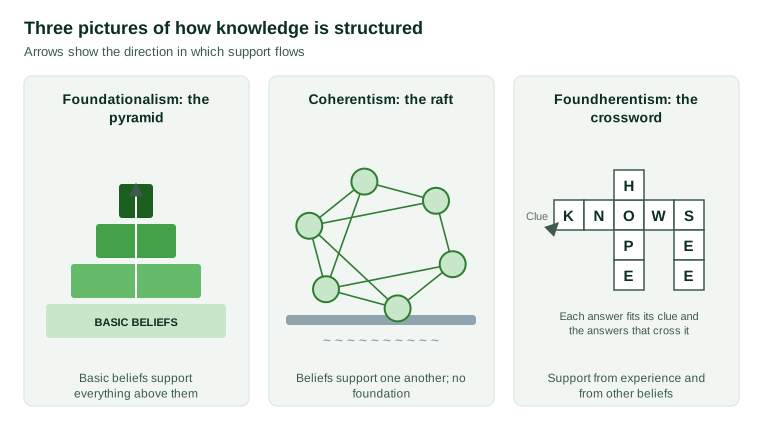
Foundationalism holds that some beliefs are basic: they are justified without depending on any other belief. All other justified beliefs are supported, directly or indirectly, by these foundations. The picture is a building or a pyramid. The foundations must be secure, and everything above them is only as strong as the support they provide.
The most famous foundationalist is René Descartes. In his Meditations, first published in 1641, Descartes set out to doubt everything that could possibly be doubted, so as to find a belief that was absolutely certain (Descartes, 1996). He found it in the awareness of his own thinking: whatever else he might be deceived about, he could not be deceived that he was thinking, and so that he existed. From this foundation he attempted to rebuild knowledge of God, the external world and mathematics.
Classical foundationalism sets demanding standards for basic beliefs. They must be infallible, or at least certain, and they are usually limited to beliefs about one's own mental states, such as "I seem to see something red", together with self-evident truths of logic and mathematics. Lewis (1946) put the motivation memorably, arguing that if anything is to be probable, something must be certain.
Problems with classical foundationalism
Classical foundationalism faces two serious difficulties. First, it is hard to get from the foundations to the rest of what we take ourselves to know. Few beliefs about one's own experiences are certain, and even if they were, they do not logically guarantee beliefs about tables, trees, other people or the past. Descartes needed to prove that God exists and is no deceiver in order to bridge the gap, and few have found that proof convincing.
Second, Sellars (1997) argued, in lectures first given in 1956, that the very idea of a basic belief is confused, a view he called an attack on "the myth of the given". To serve as a foundation, an experience must be able to justify a belief, which means it must have content that can stand in logical relations, such as "this is red". But if the experience already has that kind of content, it is itself something that could be mistaken and that stands in need of justification. If it lacks such content, it cannot justify anything. Either way, the foundations seem to disappear.
Modest foundationalism
Most contemporary foundationalists have responded by lowering the bar. Modest foundationalism holds that basic beliefs need not be certain or infallible; they need only be justified to some degree without depending on other beliefs. Alston (1976) distinguished between being immediately justified and being certain, and argued that foundationalism needs only the first. Perceptual beliefs, memory beliefs and beliefs based on testimony can all count as basic, so long as they enjoy some justification of their own.
A related view is phenomenal conservatism. Huemer (2007) argued that if it seems to a person that something is so, then, in the absence of reasons to doubt it, the person has some justification for believing it. Pryor (2000) defended a similar position, which he called dogmatism: perceptual experience provides immediate, though defeasible, justification for beliefs about the world. On these views, the foundations are fallible and can be revised, but they are real.
Coherentism
The raft, not the pyramid
Coherentists reject the idea that some beliefs are privileged foundations. Instead, a belief is justified by its membership in a coherent system of beliefs that support one another. Sosa (1980) captured the contrast in two images: the foundationalist's pyramid, built up from a secure base, and the coherentist's raft, which floats free and holds together because its planks are tied to one another.
The raft image goes back to the philosopher Otto Neurath, who compared scientists to sailors who must rebuild their ship on the open sea, plank by plank, without ever being able to bring it into dry dock. Quine (1960) placed Neurath's image at the start of Word and Object. In an earlier paper, Quine (1951) argued that our beliefs form a "web" that meets experience only at its edges. When an experience conflicts with our expectations, we can adjust any part of the web to restore consistency, although we usually prefer to change beliefs near the edge, about particular observations, rather than those at the centre, such as the laws of logic. This holism echoed an argument by Duhem (1954), first published in 1906, that a scientific hypothesis is never tested in isolation, but always together with a set of auxiliary assumptions.
What coherence requires
Coherence is more than consistency. A set of beliefs that are merely consistent, such as a collection of unrelated facts, does not hang together in any interesting way. BonJour (1985) argued that coherence involves logical consistency, probabilistic consistency, and inferential connections: beliefs must support one another, explain one another and fit into a unified picture. The more beliefs a system connects, and the more tightly it connects them, the more coherent it is. Lehrer (1990) developed a related account in which a belief is justified when it beats every competitor relative to the person's overall system of acceptances.
Thagard (2000) made coherence more precise by treating it as a problem of constraint satisfaction. Beliefs that explain or support each other exert positive constraints; beliefs that contradict each other exert negative ones. The most coherent set of beliefs is the one that satisfies the most constraints, weighted by their importance. Thagard showed how this approach can model reasoning in science, law and everyday life, from the choice between scientific theories to a jury's decision about whether a defendant is guilty.
Problems with coherentism
Coherentism faces its own difficulties. The most obvious is the isolation objection. A well-written novel can be perfectly coherent and entirely false. If justification depends only on relations among beliefs, how is a belief system connected to the world at all? A coherent set of beliefs could, in principle, float free of reality. BonJour (1985) tried to meet this objection by requiring that a justified system include beliefs that arise spontaneously from observation, and that it remain coherent over time as such beliefs are added. Critics replied that this brings in experience in a way that looks very like foundationalism.
A second objection is the alternative systems objection. There may be many equally coherent systems of belief that are incompatible with one another. Coherence alone cannot tell us which one to accept. Davidson (1986) argued that this worry is less serious than it looks, because the process of interpreting other people's beliefs requires assuming that most of their beliefs are true; a largely false but coherent system, he argued, is not something we could recognise as a system of beliefs at all.
A third objection is technical. Formal epistemologists have asked whether coherence actually makes truth more probable. Bovens and Hartmann (2003) and Olsson (2005) used probability theory to show that, under quite general conditions, there is no measure of coherence that guarantees that a more coherent set of beliefs is more likely to be true. Coherence helps, they found, mainly when the individual beliefs already have some independent credibility, for example when they come from independent witnesses who are each somewhat reliable. This result suggests that coherence works best not as a replacement for foundations, but as an amplifier of evidence that has some weight of its own.
Hybrid views
Foundherentism
Haack (1993) argued that both traditional theories capture part of the truth and proposed a hybrid she called foundherentism. Her guiding image is a crossword puzzle. The answer to each clue is supported in two ways: by the clue itself, which corresponds to experience, and by the answers that cross it, which correspond to other beliefs. An answer is well supported when it fits its clue and meshes with the intersecting answers, and when those answers are themselves well supported. Neither experience nor coherence is enough alone. Experience provides the anchor that coherentism lacks; mutual support provides the strength that foundationalism, with its one-way flow of justification, cannot explain.
Infinitism
Klein (1999) defended the least popular option in Agrippa's trilemma. He argued that a chain of reasons can be infinite without being vicious, because justification is not something that has to be transmitted from a starting point; it is something that emerges as more reasons become available. A belief becomes better justified the further its chain of reasons can be extended. Few philosophers have accepted infinitism, but it has sharpened the debate by forcing foundationalists and coherentists to say exactly why an infinite chain is unacceptable.
The structure of scientific knowledge
The debate about structure has a counterpart in the philosophy of science. The logical empiricists of the early twentieth century hoped to ground science in observation statements, a foundationalist programme. Their critics argued that observation is itself shaped by theory. Hanson (1958) argued that what scientists see depends on what they know: a physicist and a layperson looking at the same X-ray tube do not, in the relevant sense, see the same thing. Kuhn (1962) argued that scientists work within paradigms that determine which problems are worth solving, which methods are acceptable and how observations should be interpreted.
These arguments seemed to favour coherentism: observations do not provide a neutral foundation, because they are interpreted within a web of theory. But the success of science also suggests that observation exerts real pressure on theory. Experiments often produce results that nobody expected and that force revisions. A balanced view, close to Haack's, is that observation provides fallible but genuine support, and that theories are judged both by how well they fit the evidence and by how well they hang together with other well-supported theories.
Lessons for building a body of evidence
The question of structure is not only a philosophical puzzle. Every organisation that relies on research faces a practical version of it: how should individual findings be combined into a body of knowledge that can be trusted? The philosophical debate offers several lessons.
Some evidence deserves to be treated as a foundation, but foundations are fallible. Well-designed measurements, such as data from a carefully drawn probability sample with a tested questionnaire, provide the closest thing research has to basic beliefs. They carry weight on their own. But, as modest foundationalism holds, they are not infallible. They can be overturned by evidence of a coding error, a sampling flaw or a misunderstood question. A body of research should treat its foundations as strong defaults, not as certainties.
Coherence amplifies evidence but does not replace it. The results of Bovens and Hartmann (2003) and Olsson (2005) have a direct practical counterpart. When several independent sources agree, such as a survey, sales data and customer interviews, their agreement makes the shared conclusion much more credible than any one source alone. But agreement among sources that each have little credibility, or that are not independent, proves little. Three reports that all repeat the same unreliable estimate are coherent but no better supported than the original.
Triangulate across methods. Social scientists have long recommended triangulation: approaching a question with several methods whose weaknesses differ, so that a conclusion supported by all of them is unlikely to be an artefact of any one (Jick, 1979). Munafò and Davey Smith (2018) made a similar argument for science more broadly, urging researchers to seek several lines of evidence with different sources of bias rather than relying on repeated studies of a single kind. This is Haack's crossword in practice: each finding is supported by its own evidence and by its fit with findings from other methods.
Watch for the isolated system. The coherentist's isolation problem has a familiar organisational form. A set of internal reports can reinforce one another, cite one another and present a perfectly consistent picture, while drifting away from what customers actually think and do. Regular contact with fresh, independent data is the remedy, equivalent to adding new clues to the crossword.
Be ready to rebuild the raft at sea. Neurath's image is a good description of how organisational knowledge actually changes. There is never a moment when everything can be set aside and rebuilt from first principles. Knowledge is revised plank by plank, while decisions continue to be made. Good research practice makes this possible by documenting which conclusions rest on which evidence, so that when one piece is found to be faulty, it is clear what else needs to be reconsidered.
Conclusion
Neither pure foundationalism nor pure coherentism has survived the debate intact. Classical foundations proved too narrow to support what we know, and pure coherence proved unable to explain how beliefs connect with the world. The views that have emerged in their place, modest foundationalism, phenomenal conservatism and foundherentism, agree on a common picture. Experience and careful observation provide real but fallible support. Beliefs gain further strength by fitting together. Knowledge is a structure that is never finished, and that must be maintained and repaired while it is in use. That is also a fair description of a well-run research programme.
References
Alston, W. P. (1976). Two types of foundationalism. The Journal of Philosophy, 73(7), 165–185.
BonJour, L. (1985). The structure of empirical knowledge. Harvard University Press.
Bovens, L., & Hartmann, S. (2003). Bayesian epistemology. Oxford University Press. https://doi.org/10.1093/0199269750.001.0001
Davidson, D. (1986). A coherence theory of truth and knowledge. In E. LePore (Ed.), Truth and interpretation: Perspectives on the philosophy of Donald Davidson (pp. 307–319). Blackwell.
Descartes, R. (1996). Meditations on first philosophy: With selections from the objections and replies (J. Cottingham, Ed. & Trans.; Rev. ed.). Cambridge University Press. https://doi.org/10.1017/CBO9780511805028 (Original work published 1641)
Duhem, P. (1954). The aim and structure of physical theory (P. P. Wiener, Trans.). Princeton University Press. (Original work published 1906)
Haack, S. (1993). Evidence and inquiry: Towards reconstruction in epistemology. Blackwell.
Hanson, N. R. (1958). Patterns of discovery: An inquiry into the conceptual foundations of science. Cambridge University Press.
Huemer, M. (2007). Compassionate phenomenal conservatism. Philosophy and Phenomenological Research, 74(1), 30–55. https://doi.org/10.1111/j.1933-1592.2007.00002.x
Jick, T. D. (1979). Mixing qualitative and quantitative methods: Triangulation in action. Administrative Science Quarterly, 24(4), 602–611. https://doi.org/10.2307/2392366
Klein, P. D. (1999). Human knowledge and the infinite regress of reasons. Philosophical Perspectives, 13, 297–325. https://doi.org/10.1111/0029-4624.33.s13.14
Kuhn, T. S. (1962). The structure of scientific revolutions. University of Chicago Press.
Lehrer, K. (1990). Theory of knowledge. Westview Press.
Lewis, C. I. (1946). An analysis of knowledge and valuation. Open Court.
Munafò, M. R., & Davey Smith, G. (2018). Robust research needs many lines of evidence. Nature, 553(7689), 399–401. https://doi.org/10.1038/d41586-018-01023-3
Olsson, E. J. (2005). Against coherence: Truth, probability, and justification. Oxford University Press. https://doi.org/10.1093/0199279993.001.0001
Pryor, J. (2000). The skeptic and the dogmatist. Noûs, 34(4), 517–549. https://doi.org/10.1111/0029-4624.00277
Quine, W. V. O. (1951). Two dogmas of empiricism. The Philosophical Review, 60(1), 20–43. https://doi.org/10.2307/2181906
Quine, W. V. O. (1960). Word and object. MIT Press.
Sellars, W. (1997). Empiricism and the philosophy of mind. Harvard University Press. (Original work published 1956)
Sextus Empiricus. (2000). Outlines of scepticism (J. Annas & J. Barnes, Trans.). Cambridge University Press.
Sosa, E. (1980). The raft and the pyramid: Coherence versus foundations in the theory of knowledge. Midwest Studies in Philosophy, 5(1), 3–26. https://doi.org/10.1111/j.1475-4975.1980.tb00394.x
Thagard, P. (2000). Coherence in thought and action. MIT Press. https://doi.org/10.7551/mitpress/1900.001.0001